Best GoPro for 2026: Hero 13, Mission 1 Pro Compared
GoPro's 2026 lineup spans $199 to $700 and covers five meaningfully different cameras. If you're trying to find the best GoPro for 2026, the short answer depends on what you actually shoot but most buyers should stop at the Hero 13 Black. Here's the full picture.
Quick picks:
- Mission 1 Pro ($700) buy it if you need 8K, serious slow motion, or a color-grading workflow
- Hero 13 Black (~$400) the right call for most buyers
- Hero 12 Black only worth it if priced meaningfully below the Hero 13
- Entry-level Hero ($199) casual shooters only; check the stabilization caveat before buying
- Max 2 the one to get for 360 footage, full stop
A bit of context before diving in. GoPro's Mission 1 line marks the first processor upgrade since the Hero 10 launched in 2021 the new GP3 chip, a 5-nanometer SoC, brings GoPro level with what DJI and Insta360 shipped in their late-2024 cameras, per WIRED's April 2026 update. The Mission 1 Pro got its first hands-on review from Gizmodo today, which called it "the best GoPro" while rejecting GoPro's own framing of it as a "compact cinematic camera system." That distinction matters at $700.
One more thing worth naming upfront: WIRED's action camera guide, updated last month, still ranks the DJI Osmo Action 6 as the best action camera overall. "Best GoPro" and "best action camera" are not the same sentence yet. That gap gets addressed directly in the competition section below.
All prices are standard retail as of June 2026. GoPro's subscription ($49.99/year after a discounted first year) reduces some hardware prices, but no recommendation here depends on it.
Why recent Hero Black models are more similar than their names suggest
Video of the Day
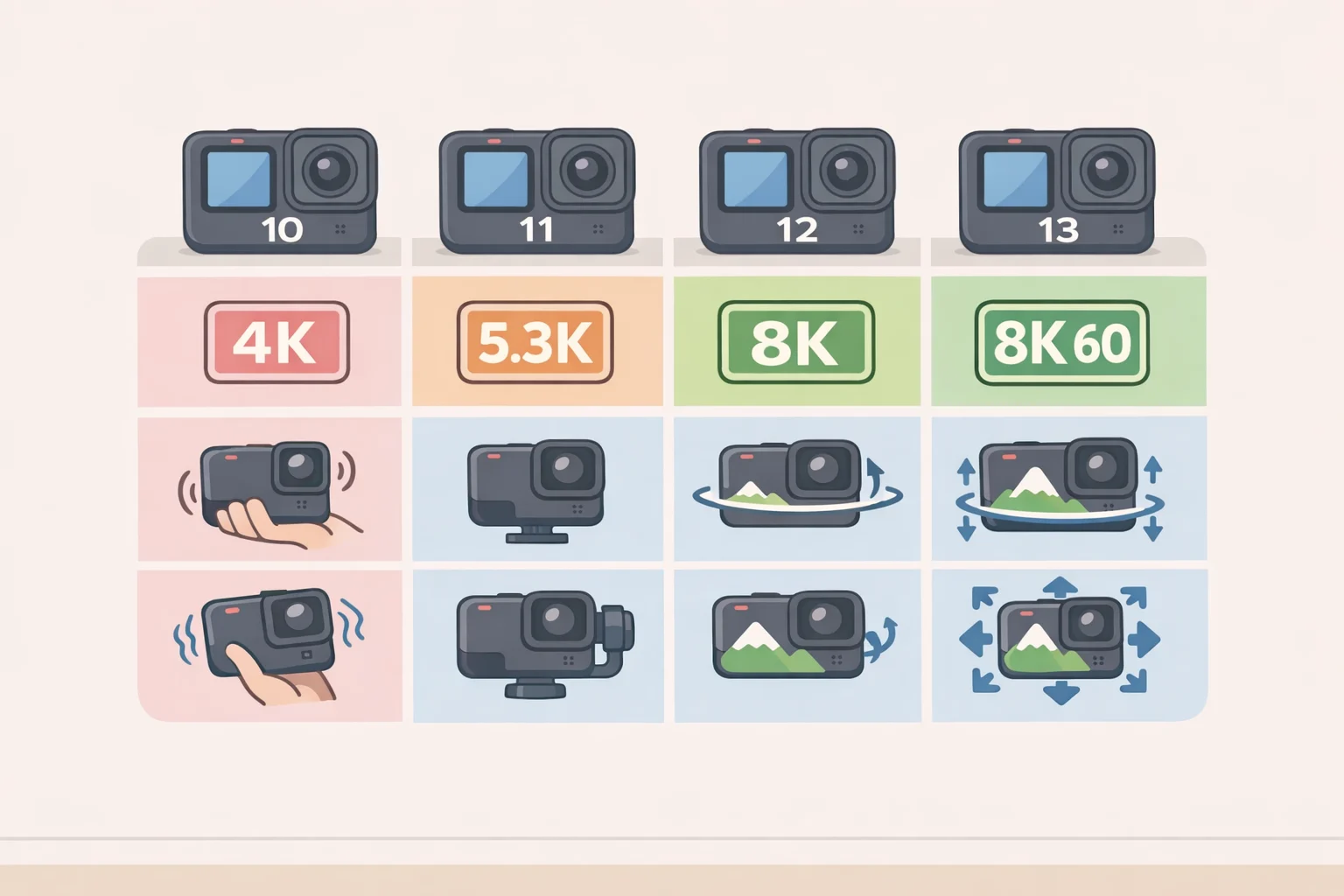
One of the most common GoPro buying mistakes is paying a premium for a generational label when the underlying performance difference is small.
Tom's Guide's 2026 roundup put it plainly: the Hero 10 through Hero 13 Black are broadly similar, each delivering incremental rather than substantial improvements over its predecessor. The Hero 10 and Hero 11 shoot 5K; the Hero 12 and Hero 13 push that to 5.3K. Stabilization improves slightly each cycle, but all four are genuinely good cameras. WIRED noted the Hero 13's most notable limitation directly: it runs the same 27MP sensor and processor as the Hero 12 and Hero 11 before it three years of hardware continuity on the silicon side. The Mission 1 Pro is the first real break from that pattern.
The practical implication: if the Hero 12 is priced meaningfully lower than the Hero 13, it's a reasonable value. If not, the Hero 13 wins on GPS, magnetic mounting, and broader lens mod compatibility. WIRED also flagged that the Hero 11, still available from third-party sellers, often lists at roughly the same price as the Hero 12, making it a poor buy. Skip it. The Hero 10 has similar problems its video quality and stabilization don't justify buying it over a discounted Hero 13.
Video of the Day
Best GoPro for 2026: Hero 13 Black vs Mission 1 Pro
Mission 1 Pro the best GoPro ever shipped, with one important caveat
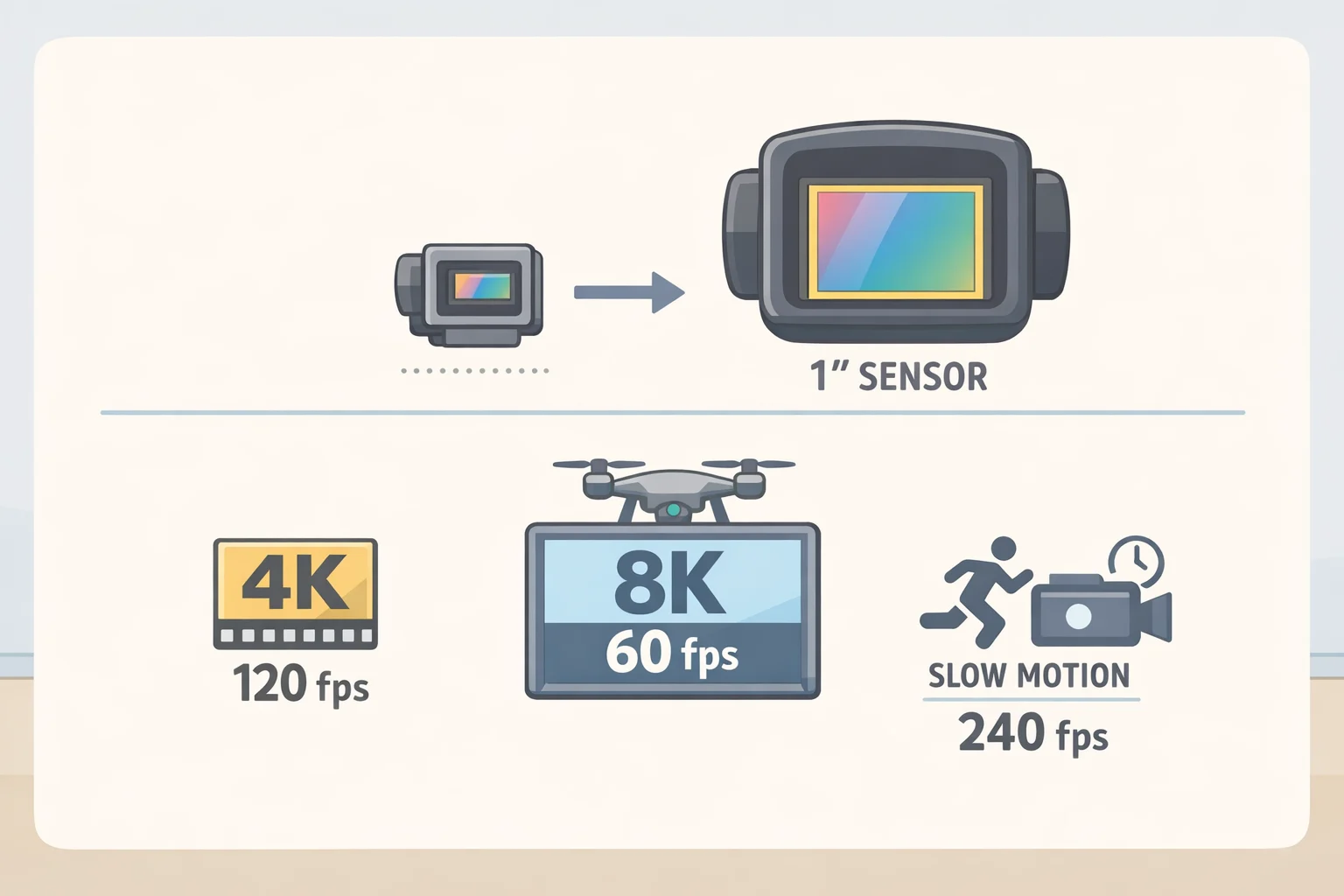
The hardware jump is real. The Mission 1 Pro replaces the Hero 13 Black's 27MP 1/1.9-inch sensor with a 50MP 1-inch sensor capable of 8K at 60fps or 4K at 240fps. For comparison, the $390 Insta360 Ace Pro 2 tops out at 8K/30fps, per Gizmodo's review.
Low-light performance improved substantially over both the Hero 13 Black and the DJI Osmo Action 5 Pro, driven by the larger sensor, f/2.8 aperture, and GP3 chip. A 240Mbps max bitrate and GP-Log 2 color profile support a post-production pipeline that, based on the available specs and the Gizmodo test, represents a meaningful step up from any previous GoPro though that conclusion should be taken as this guide's read on the cited data, not an independently verified fact. GoPro's own 14-stop dynamic range claim remains a manufacturer assertion; independent multi-source testing hasn't arrived yet, and WIRED's action camera guide hadn't tested the camera as of its May 2026 update.
The slow-motion capabilities are the headline. A "burst slow-mo" mode captures at 960fps, converting 10 seconds of footage into over five minutes of slowed-down playback. Standard slow motion goes to 4K/240fps; the whole Mission line supports up to 32x slow motion, per WIRED.
Battery life at 4K approached three hours in real-world testing; expect roughly half that at 8K or in sustained slow-motion modes, per Gizmodo. The Mission 1 Pro is also the first GoPro with USB-C fast charging 0 to 80% in under 30 minutes. Audio gets three built-in mics with wind reduction, USB-C input for external microphones, and a native wireless mic kit coming from GoPro that won't require an adapter.
A few caveats worth knowing before buying:
- Open gate (4:3) recording caps at 8K/30fps or 4K/120fps; SuperView mode at 156° FOV is limited to 30fps frame rate trade-offs that matter depending on how you shoot
- RAW photo capture takes nearly a second per frame, and a lens-corrected linear photo mode doesn't exist at launch, though GoPro has indicated it may add one via firmware update
- At $700 standard retail, the Mission 1 Pro costs roughly $300 more than both the Hero 13 Black and the DJI Osmo Action 6
All of the above comes from Gizmodo's first-look review, published today. It's the only hands-on test published as of this writing. If you're making a $700 decision based largely on hardware claims, wait for additional independent reviews to land.
Who it's for: Serious action videographers, travel creators with a color-grading workflow, anyone who shoots regularly in low light or needs extreme slow motion. Not the right call for casual shooters, or anyone for whom $300 is a meaningful number.
Hero 13 Black the best GoPro for most people
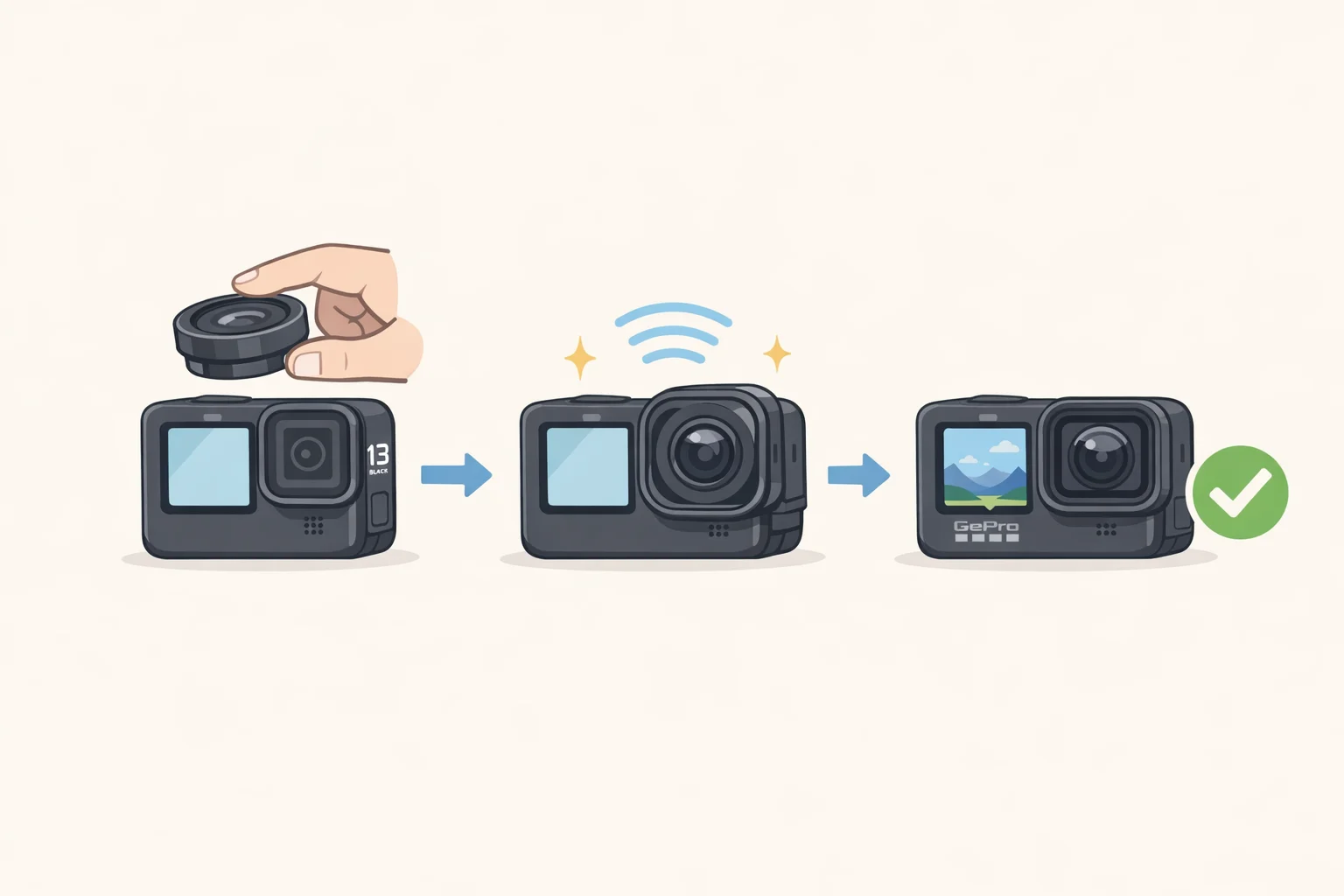
WIRED and Tom's Guide both maintain the Hero 13 Black as their mainstream pick, and the reasons are specific: GPS (which GoPro removed in the Hero 12 and reinstated here), magnetic mounting, USB-C pass-through charging, and a modular lens system that auto-detects attachments the moment you snap them on.
Those lens mods are worth understanding. Options include an Ultra Wide at $100 (177° field of view), a Macro at $149, and an Anamorphic at $150 with 21:9 aspect ratio and cinematic lens flare, per WIRED and the WIRED action camera guide. Video tops out at 5.3K/60 in 16:9 or 5.3K/30 in 8:7; slow motion reaches 2.7K/240. Waterproof to 33 feet without a housing, per PCMag.
Who it's for: Hikers, surfers, cyclists, weekend adventurers who want a proven, versatile camera with room to grow. Also the right upgrade path for anyone coming from a Hero 11 or earlier.
Hero 12 Black buy it only if the price is right
PCMag named the Hero 12 Black its best GoPro for the price it shoots the same 5.3K/60 and 4K/120 as the Hero 13, shares the same 33-foot waterproof rating, and costs less. The trade-offs versus the Hero 13: no GPS, fewer compatible lens mods, no magnetic mount. WIRED noted that GPS removal was GoPro's call based on claimed low usage, but for anyone recording routes while hiking, biking, or skiing, that omission ends the conversation.
The buying threshold here is this guide's recommendation, not a sourced number: the Hero 12 makes sense if it's priced meaningfully lower than the Hero 13 in the range of $50 to $75 less. Below that gap, the Hero 13's added features tip the balance.
Entry-level Hero ($199) casual shooters only
The GoPro Hero (2024) costs $199, shoots 4K at 30fps in its standard mode, and is waterproof to 16 feet, shallower than the 33-foot rating on the Hero 12 and Hero 13, per PCMag. The one thing no spec sheet warns you about: stabilization is processed in the app, not on-camera. WIRED called this workflow "cumbersome". For anyone who shoots action footage and cares about smooth playback, that's a real friction point. If you're on the fence, a discounted Hero 12 Black is the better investment.
Who it's for: True beginners, gift purchases, casual outdoor shooters with no serious editing plans.
GoPro Max 2 the best 360 camera, with one known weakness
The Max 2 is a different category of camera from everything else on this list. If 360 footage is what you need, it's the strongest option available. If it's not, move on.
The Max 2 uses dual lenses to capture 8K 360-degree video and 29MP stills, per PCMag. WIRED called it "the best 360 camera you can buy" and flagged its one consistent weakness: low-light performance is essentially nonexistent. Shooting in 8K spherical format means you can crop out a standard 16:9 frame in post and still deliver up to 4K resolution which Tom's Guide described as effectively combining two camera angles into one, with framing decisions made after the shoot. Tiny planet and invisible selfie stick effects come from the same footage.
The Max 2 also supports 10-bit color, something the competing Insta360 X5 lacks, and its lenses are physically replaceable without tools, per WIRED. Editing in the Quik mobile app is strong, with automated tracking that works well. The desktop experience is more limited and doesn't currently include those tools.
Who it's for: Travel and real estate videographers who want post-production angle flexibility, or adventure shooters where pre-planning the frame isn't possible. Plan shoots around daylight this isn't a low-light camera.
GoPro vs. the competition
Any honest GoPro buying guide has to address DJI and Insta360 directly.
WIRED's action camera guide, updated last month, named the DJI Osmo Action 6 not any GoPro the best action camera available right now. The Action 6 adds variable aperture, a larger sensor than the Action 5 Pro, 2x zoom, and 8K video, at roughly $400. Before the Mission 1 Pro existed as a tested product, PCMag had already given its Editors' Choice to the DJI Osmo Action 5 Pro. An eight-week independent camera comparison found the Hero 13 Black edged the Action 5 Pro overall, with DJI "slightly superior in low light" but differences "rather marginal," per a December 2024 YouTube comparison.
The Mission 1 Pro appears to reclaim the performance lead for GoPro. Gizmodo's reviewer called it "easily the best action camera experience I've had" but that's one published review, at $300 more than the Action 6. Broader testing hasn't landed.
Where GoPro holds a genuine edge: lens mods, magnetic mounting, GPS (Hero 13 and up), GoPro Labs firmware (which unlocks higher bitrates and extended timelapse capabilities beyond what stock firmware allows), and a mounting ecosystem with years of accessory compatibility behind it. These aren't trivial advantages for existing GoPro users. Where DJI has an edge: the Osmo Action 5 Pro includes 47GB of internal storage, per the December 2024 comparison a practical advantage that doesn't appear on spec tables.
Starting from scratch and the Mission 1 Pro's price is out of range? Compare the Hero 13 Black against the DJI Osmo Action 6 directly before committing. Already in GoPro's ecosystem? Upgrading within it makes more sense than it might appear on paper.
What to budget beyond the camera body
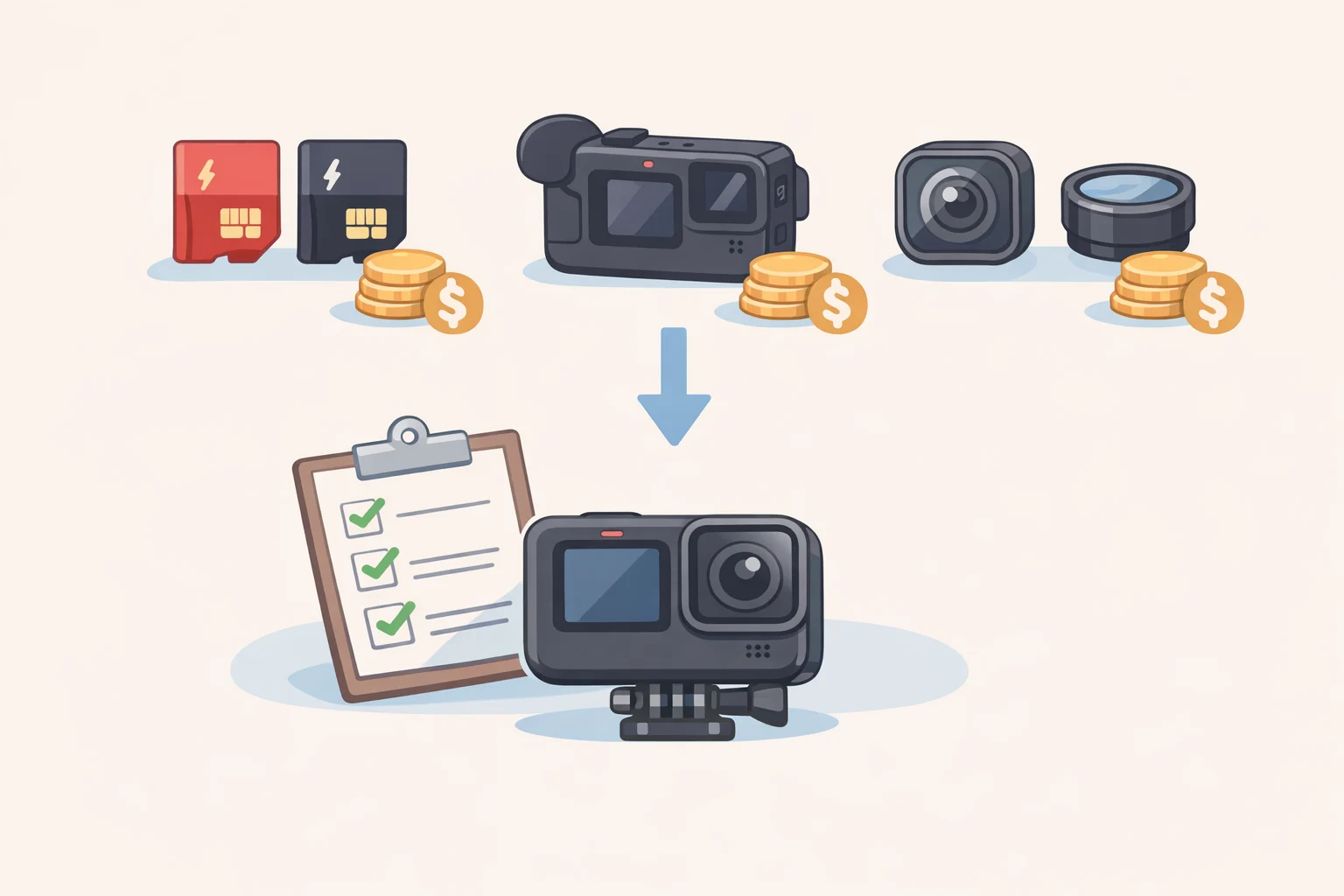
The model decision is only part of the cost. Here's what to plan for before you shoot anything:
- MicroSD card: GoPro recommends V30 or UHS-3 rated cards. Budget $25–50 for a reliable 256GB option, per WIRED.
- Media Mod ($79–100): The fastest way to meaningfully improve audio. WIRED named it their most-used GoPro accessory it lets you plug in a standard wired or wireless mic. Note: the camera is not waterproof while the Media Mod is attached.
- Lens mods (Hero 13 only): Ultra Wide, Macro, and Anamorphic options range from $100–150 each. Buy one that matches your shooting context; don't buy all three speculatively.
- GoPro subscription ($49.99/year after the first year): Useful if you shoot regularly cloud backup, device replacement, and accessory discounts up to 50%, per PCMag. Not required to operate any current GoPro.
One forward note: the Mission 1 Pro ILS, a variant using a Micro Four Thirds lens mount, is expected in Q3 2026 per WIRED but hasn't been tested by any publication. Hold off until reviews are in.