Marshall Acton IV and Stanmore IV Launch: What Actually Changed
Marshall launched the Acton IV and Stanmore IV today as part of its new Homeline IV lineup, priced at $299.99 and $399.99 respectively. Both are available now in black and cream. The refresh brings three reported improvements: tuned bass response that holds at low volumes without muddying at high ones, a port redesign that lets the speakers sit flush against a wall, and user-replaceable external parts, SoundGuys reported today. Trusted Reviews noted it's been a while since Marshall last updated its home audio lineup, per that coverage today.
TechRadar's hands-on with the Acton IV, published today, called it "a bass beast" with a "delicious design" but flagged a missing feature in the review title, per TechRadar. The review title hints at it without naming it outright, and the body text hasn't been extracted in available coverage, so it stays unspecified here.
Marshall Acton IV and Stanmore IV: what changed with the audio
Video of the Day

The main audio story centers on Dynamic Loudness, a system that actively adjusts frequency balance depending on playback level. At lower volumes, it boosts bass and treble to compensate for how human hearing loses sensitivity to those frequencies when listening quietly. At higher volumes it rolls those adjustments back to prevent distortion, as SoundGuys describes. Tom's Guide found that Marshall made "subtle adjustments" to the system for the Stanmore IV to keep output clean across the full volume range, per that review.
Updated internal limiters on both models are engineered to reduce distortion at maximum output, SoundGuys reported. That's a credible engineering detail. Independent lab measurements haven't been published yet, so how much it improves on the previous generation in practice remains unconfirmed.
Tom's Guide's early hands-on with the Stanmore IV found enhanced bass and a wider soundstage compared to its predecessor, per that review. The hardware supports that impression on paper. The Stanmore IV runs a 5-inch woofer through a dedicated 60W Class D amplifier, with two 25W Class D amplifiers handling its dual 0.75-inch tweeters, covering a frequency range of 36Hz to 38kHz, according to Tom's Guide.
What that translates to in a real listening room depends on more than specs. Room size, placement, and listening distance all factor in. The Dynamic Loudness system and updated limiters are the verifiable core of the audio upgrade. Superlatives from launch coverage around "ridiculously stunning sound" are worth holding at arm's length until more independent testing lands.
Video of the Day
Controls, app features, and the $100 gap

Both speakers share identical controls: three dials for bass, treble, and volume on a scale of one to ten; a joystick for track navigation and pause; a source button cycling between Bluetooth, AUX, and RCA inputs; and a programmable M button that defaults to Spotify but can be reassigned to any playlist, radio station, or sound profile, according to Tom's Guide. The Marshall app adds EQ adjustment and placement-based sound optimization for both models, per SoundGuys. The placement optimization is worth noting: rather than assuming ideal acoustic conditions, the app attempts to adapt output to wherever the speaker actually sits.
The difference between the two models comes down to cabinet size and amplifier headroom. Tom's Guide puts it plainly: the Stanmore IV's $100 premium is "the extra you pay for a bigger speaker and no distortion when playing music at the highest volume," per that review. That characterization is sourced and specific, though it reflects one reviewer's impression rather than independent comparative measurement.
Side-by-side testing at comparable volume levels hasn't yet been published, so the degree of difference at the top of the volume range isn't fully settled. Both models carry the same Dynamic Loudness architecture and control interface. Those listening at moderate levels in a typical living room will find the shared feature set more relevant than the amplifier gap.
Port redesign and what "repairable" actually covers

Connection ports on both the Acton IV and Stanmore IV moved from the rear panel to the underside of the cabinet. The result: both speakers can now sit flush against a wall without requiring clearance behind them for cables, as Tom's Guide confirmed. For a bookshelf setup where rear clearance is always a negotiation, this is a genuine quality-of-life improvement, and it's the kind of change that only registers once you've actually tried to hide cables behind a speaker placed against a wall.
The design holds to the same aesthetic logic. No RGB lighting anywhere on the cabinet. Illumination is limited to small red LED indicators on the top plate marking active settings, according to Tom's Guide. Heritage cabinet styling and FSC-certified wood construction round out the physical package, SoundGuys noted.
On repairability: both models ship with user-replaceable external components, specifically knobs, feet, and the front grille, SoundGuys reported. That's a step up from a fully sealed design. The limits are specific, though. What's confirmed as replaceable is cosmetic and structural. Whether internal components can be serviced, whether Marshall will sell replacement parts directly to consumers, and at what price, hasn't been addressed in available launch materials. No recycled-material figure for the Homeline IV has been specified in available coverage.
How the Stockwell III changes the comparison
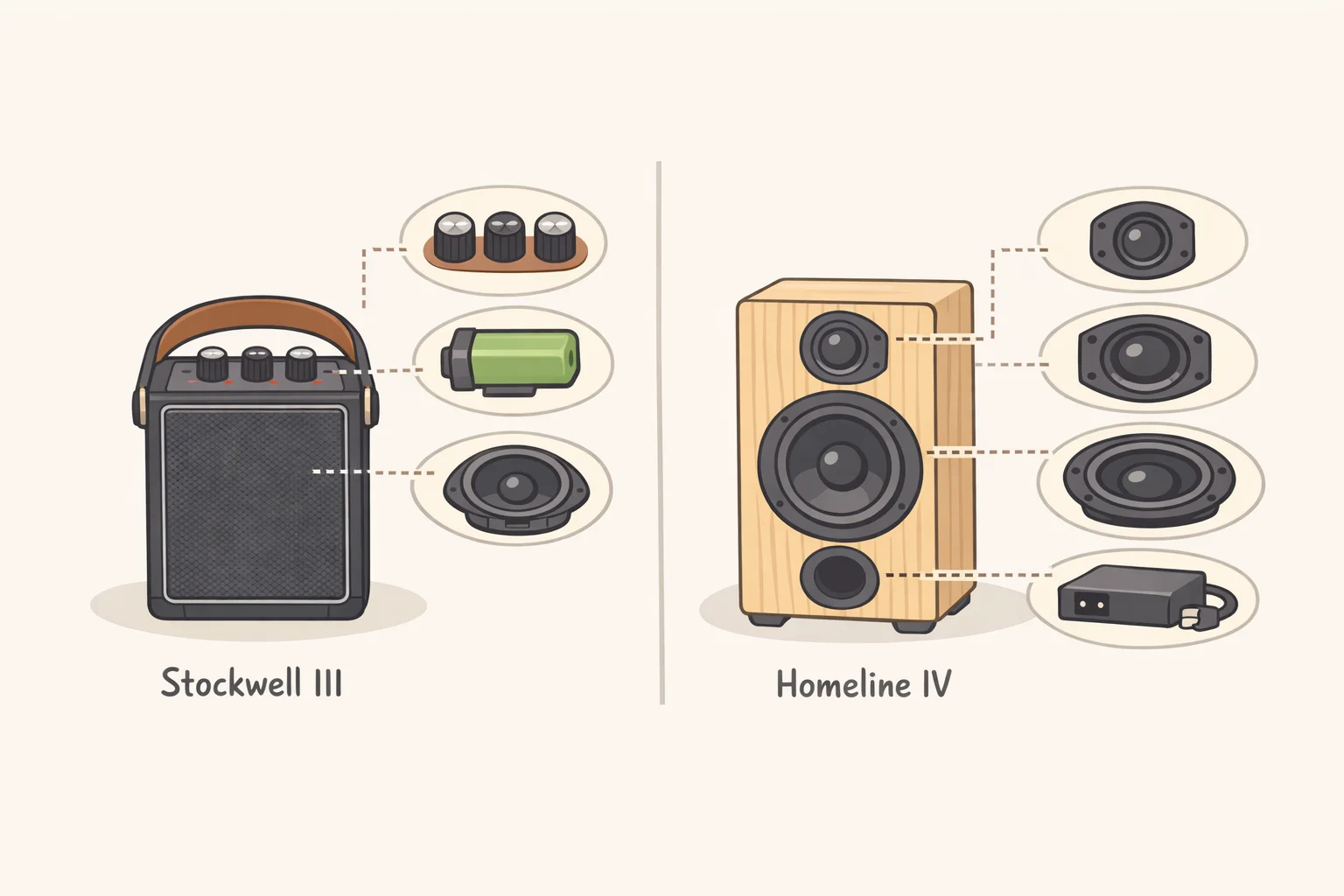
The contrast with Marshall's Stockwell III portable speaker, announced last month, sharpens what "repair-friendly" can mean in practice. That model goes further: user-replaceable front and back grilles, silicone sleeve, carrying strap, and internal battery, with 27% of total product weight from recycled materials, explicitly framed around EU product lifespan regulations, per Casawi. The Stockwell III goes on sale August 18 through Marshall's website, with retail availability following August 25, Casawi reported.
The Stockwell III's repairability covers the battery, which is the component most likely to determine a portable speaker's usable lifespan. The Homeline IV's replaceable parts are the ones most likely to show cosmetic wear. That's a meaningful distinction. Knobs and grilles can extend how a speaker looks over time; they don't extend what it can do when a driver or amplifier board degrades.
This isn't a knock on the direction. Marshall appears to be building a coherent durability platform across its lineup, and the Homeline IV fits that trajectory. The Stockwell III is just a more complete proof point for it. Whether the Acton IV and Stanmore IV develop a fuller repairability specification over time, including part availability and pricing, is the detail worth tracking as these speakers settle into the market.
What's confirmed, what's still open
The reported improvements to Dynamic Loudness, the updated limiters, the underside port placement, and the FSC-certified construction are all supported by multiple sources and consistent across coverage. Tom's Guide's early hands-on adds one credible listening impression behind the bass and soundstage claims.
What isn't settled: independent measurement data on distortion reduction, a direct performance comparison between the two models at high volume, and the consumer-facing repairability details, specifically whether parts will be sold separately and at what cost. Those aren't reasons to wait on the speakers themselves, but they are the claims that will either sharpen or soften over the next few weeks as more reviews publish.
The repairability angle is worth watching not just for these two models but for what it signals about Marshall's broader product direction. The Stockwell III's August launch will be the cleaner test of how that commitment holds up when it extends to components that actually fail.