Best Letters to Guess in Wordle, Backed by Research
About 60% of Wordle players start each puzzle with a word outside the top 20 most common openers, per garbagecollected.dev's analysis of over 1,000 days of WordleBot data. The players who do cluster around recognizable choices tend to favor vowel-heavy words that analysis flags as suboptimal. Picking the best letters to guess in Wordle comes down to one principle: the letters that eliminate the most candidates aren't the most familiar ones.
This guide explains why that gap exists, identifies which letters deserve an early slot and which don't, and translates the principle into specific opener choices. There's a section on Hard Mode at the end, where the calculus shifts enough to be worth addressing separately.
Prerequisites: Standard Wordle familiarity. Green means right letter, right position. Yellow means right letter, wrong position. Gray means the letter isn't in the word.
Why letter value is about elimination, not frequency
Video of the Day
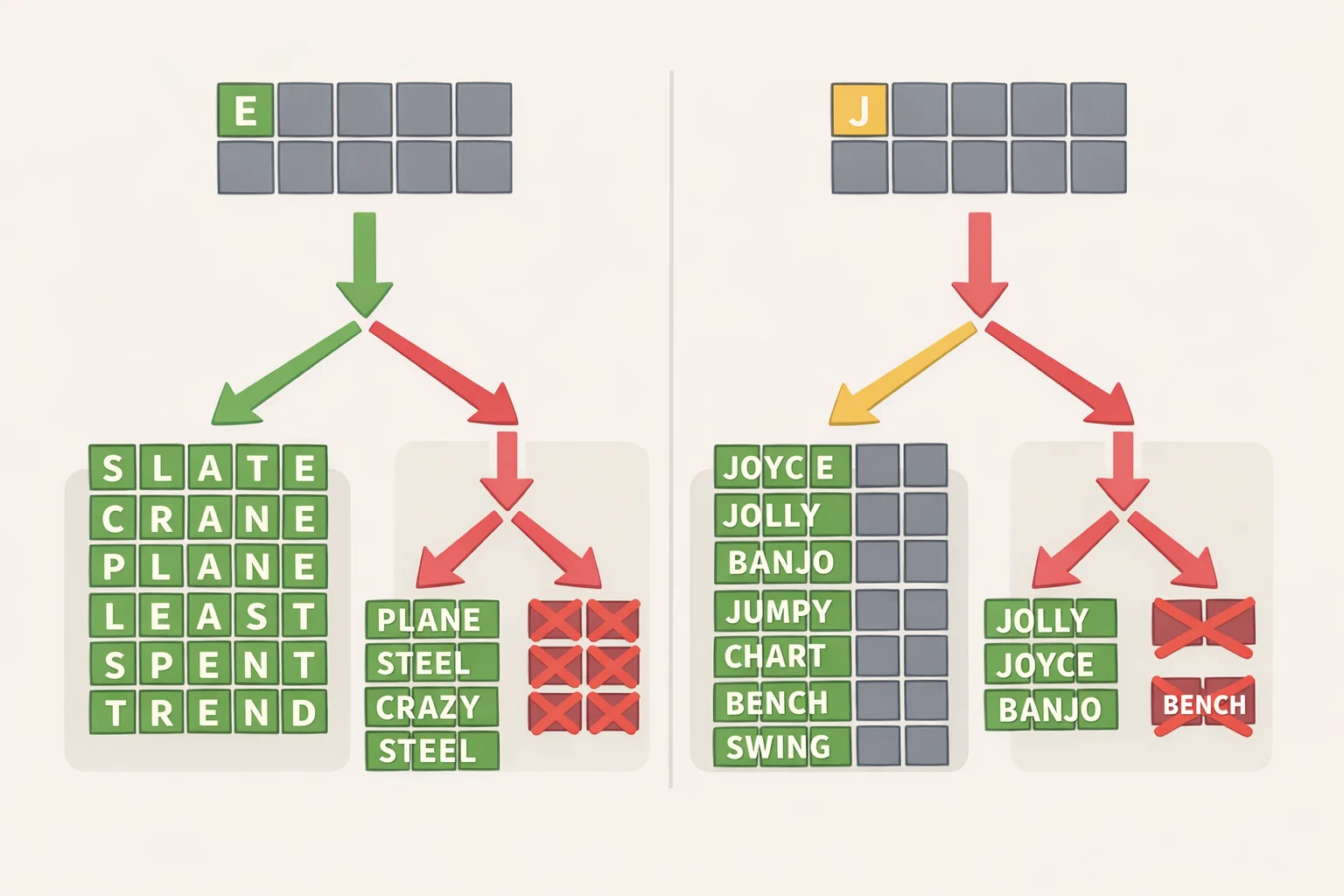
The instinct behind vowel-heavy openers is understandable. Vowels appear across a wide range of five-letter words, so testing them early feels efficient. The problem is that a letter present in a very high share of possible answers is almost useless as a filter. Learning it's present barely narrows the field. Learning it's absent eliminates very little either.
What matters is how evenly a letter divides the remaining candidate pool. A letter present in a balanced share of possible answers produces the most informative result either way: present or absent, you've made a meaningful cut. That's the logic behind Shannon entropy, a mathematical measure of how much uncertainty a given guess resolves. Researchers who built a strategy around this principle solved Wordle correctly in 99% of computer simulations, compared to roughly 90% for conventional approaches, ScienceDaily reported last month.
Think of each letter as a question. Asking whether a near-universal vowel is in the word is a weak question because either answer barely moves you forward. A mid-frequency consonant is stronger because the answer, either way, cuts the candidate pool substantially. The best first guess in Wordle is essentially five strong questions bundled into one word.
Research on answer difficulty reinforces this. A machine-learning study computed three attributes for each Wordle solution: usage frequency, word information entropy, and number of repeated letters. Repetition count and entropy carried most of the predictive signal for difficulty, while word familiarity accounted for only 10 to 12% of the variance in average solve, per an arXiv preprint from 2024. The same reasoning applies to guesses: letters that spread information efficiently across positions will outperform those that concentrate it narrowly.
Video of the Day
Best starting letters for Wordle, and which ones to skip early
High-value letters for an opening guess share two traits: they appear in a meaningful but not overwhelming share of the answer list, and they don't waste a position by repeating.
The analytically recommended starters, STARE, CRANE, SLATE, and SALET, converge on a consistent structure. CRANE and SLATE are both described as "best starters" by WordleBot and other sources, per garbagecollected.dev. Computer-optimized solvers using these words average 3.41 to 3.42 turns across the full 2,309-word answer list. All four use five distinct letters and include no more than two vowels, leaving more positions available for consonants that do the heavier filtering work.
Loading a guess with three or four vowels, as ADIEU and AUDIO do, means spending most of your positions confirming that common letters exist somewhere in the word, without learning where they go. Knowing four vowels are present still leaves a large candidate pool intact.
Rare letters, Q, X, Z, and J, create a similar problem on the other end. They appear in very few Wordle answers, so testing one on guess one or two is almost always a wasted position unless the board already points toward it. Repeated letters are the other trap. The 2024 arXiv study found that repetition count was one of the top predictors of word difficulty, with EERIE landing in the difficult tier, per the same preprint. Applying that structure to your own opening guess imposes the same handicap on yourself.
A practical framework for Wordle letter selection:
- Use five distinct letters. No repeats.
- Include one or two vowels. A and E appear across a wide range of answer patterns without crowding out more discriminating consonants.
- Fill remaining positions with mid-frequency consonants. The analytically supported openers consistently draw from S, T, R, L, N, C.
- Save Q, X, Z, J, and stacked vowels (I, O, U together) for later guesses, once the board gives you a reason to use them.
From letter principles to actual starter words
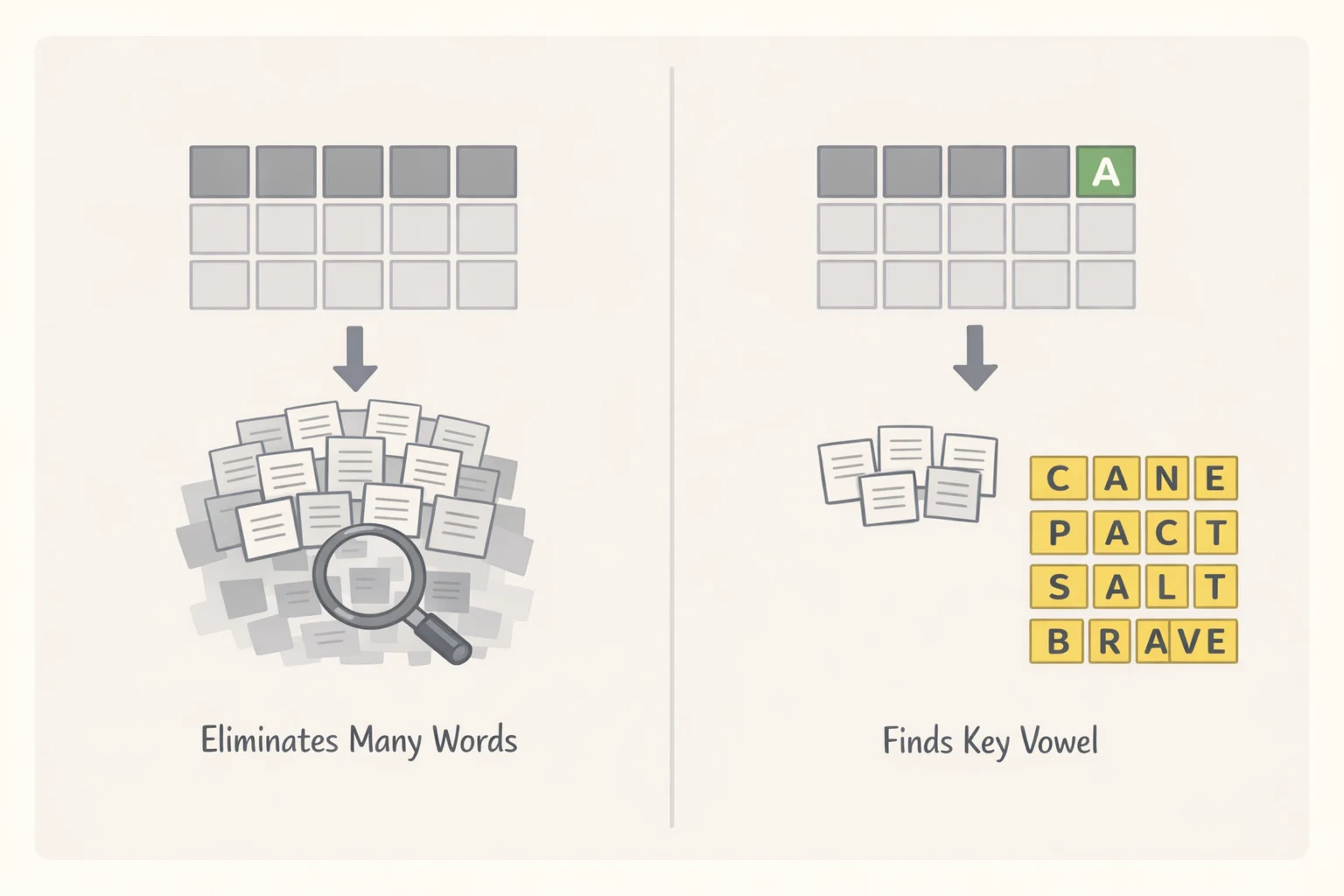
That framework produces a short list, and the research largely agrees on which words belong on it.
SALET has the strongest documented backing of any single word. A team that modeled Wordle as a Markov Decision Process, using a 64-core computer running for several days, identified it as the provably optimal starting word with a defined strategy that solves any puzzle within five guesses, per garbagecollected.dev. It never shows up in Normal Mode's top-ten player choices. STARE, CRANE, and SLATE appear consistently in computer-based analyses as high-performing alternatives and are easier to remember, per Quanta Magazine's review of the research.
The gap between these openers and the most popular choices is clearest when you put them side by side. ADIEU uses four of its five letters on vowels: A, D, I, E, U. One consonant slot, filled by D. Whatever the board returns, you've learned almost nothing about the consonant structure of the answer. SLATE tests S, L, A, T, and E: two vowels and three consonants, each in a different position. An all-gray result still eliminates five well-chosen letters. A mix of yellows and grays gives you placement constraints across multiple consonant positions. The information yield is structurally different.
ADIEU holds roughly 7% of all opening guesses, the most popular first word in the dataset, with AUDIO at 4% and RAISE at 3%, per Quanta Magazine. WordleBot has flagged ADIEU as suboptimal since at least 2023, per garbagecollected.dev, yet it holds the top spot. Player behavior tracks social momentum more than live analysis. After the NYT updated WordleBot's Hard Mode recommendation to CLASP in July 2025, that word only started appearing in the top-ten player choices in February 2026, more than six months later, per the same dataset.
One practical note on how to evaluate a starting word: don't judge it by whether it occasionally produces early greens. An all-gray result on guess one that eliminates five well-chosen letters is often more valuable than a lucky yellow, because the goal is collapsing the candidate pool as fast as possible, not looking close on the first try.
A note on Hard Mode
Hard Mode adds one significant constraint: any confirmed letter must appear in every subsequent guess. That lock-in changes which opener traits matter most, though not as much as players tend to assume.
Garbagecollected.dev's data shows Hard Mode players consistently solve puzzles faster and at higher rates than Normal Mode players, despite the added restriction. The analysis notes that the average Hard Mode player likely has a larger vocabulary, and that Hard Mode's extra constraints dilute other difficulty effects, including word frequency. The performance gap looks like a selection effect rather than a mode advantage.
It's not a reliable gap, though. On roughly 22% of days, Hard Mode players perform worse on at least one metric, average solve or non-solve rate, and on about 6% of days they underperform on both, per the same dataset. Puzzles with repeated-letter answers, or where confirmed letters funnel into many similar word patterns, create traps that lock-in rules make harder to escape.
The mode difference shows up in opener choices too. AUDIO is the second most popular Normal Mode starter but never appears in Hard Mode's top ten. ADIEU, despite its vowel excess, holds the top Hard Mode spot, per garbagecollected.dev. The data doesn't attribute this to a specific strategic advantage for Hard Mode; it aligns with the same strong vowel-preference that drives Normal Mode choices.
For Hard Mode, the same letter-quality principles apply. The main practical difference is that confirmed letters need to recombine into valid word patterns under lock-in constraints. On that basis, CRANE and SLATE are both reasonable choices: their consonant coverage is broad enough to leave meaningful options open after partial confirmation, and both carry consistent analytical support.
Putting this into practice
The research converges on one principle that doesn't change: the best letters to guess in Wordle split the remaining candidate pool most evenly, not the ones that feel most intuitive. An entropy-based strategy built on this solved 99% of simulated Wordle puzzles, versus roughly 90% for conventional approaches, ScienceDaily reported last month. That 9-point gap is the difference between guessing on familiarity and guessing on information.
Pick one well-supported opener and use it consistently. For a single default, SLATE covers two vowels, three mid-frequency consonants, and five distinct positions, with no repeats and consistent analytical backing. For Hard Mode, CRANE is the stronger choice: its consonants appear across a broader range of word patterns, giving you more room to maneuver once lock-in kicks in.
Run it for two weeks. An all-gray result on guess one is not a failure. It's five letters eliminated, and that's exactly the point.