DeWalt MagSafe charger DW2: what the manual confirms
A manual for a device called the DeWalt 141 0006 DW2 Wall-Mountable Magnetic Wireless Charger has been circulating online, already picking up shorthand as a "DeWalt MagSafe charger." Nowhere in that manual does the word MagSafe appear, nor Qi, nor Qi2 (Manuals.plus). Nowhere does it say how the unit holds up outside a clean, controlled indoor space. Those two absences matter, because they're exactly the qualities people assume the moment "DeWalt" and "magnetic phone charger" land in the same sentence.
The document itself lives on Manuals.plus, a third-party manual archive, posted about 17 months before this review (Manuals.plus). It isn't hosted on DeWalt's own site, and that distinction carries weight: an archive can preserve a manufacturer's document faithfully, but it can't stand in for an official product page, a listed price, or a warranty.
DeWalt does have a track record of turning tool-adjacent hardware into everyday device charging, which is part of why the MagSafe framing has stuck at all. Its DCB094 adapter clips onto a 20V tool battery and turns it into a 100W bidirectional USB-C power source; The Verge put it through months of hands-on testing four years ago (The Verge). That's real precedent for DeWalt building consumer charging accessories in general. It says nothing about how this specific wall-mounted unit performs, what it's made of, or whether it's actually shipping.
That leaves two separate questions: what the manual says the device does, and whether anyone outside DeWalt can confirm it as a finished, purchasable product. This piece keeps those apart, treating missing technical specs and unconfirmed claims as different kinds of gap, since casual coverage tends to flatten the two together.
What the manual confirms: a wired, wall-mounted charging setup
Video of the Day
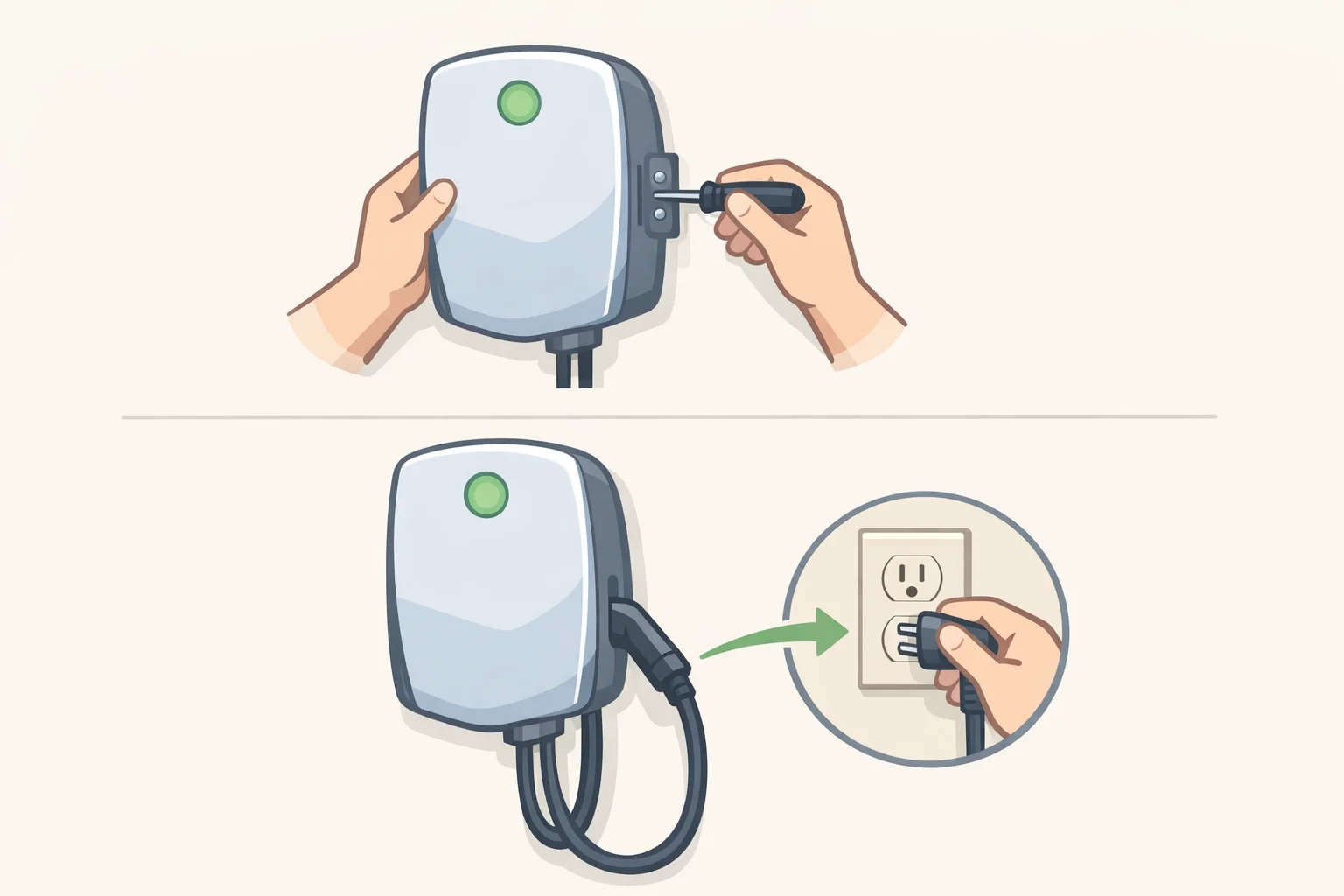
The manual is clearest, and most useful, on installation and use. Setup instructs the buyer to pick a wall location, confirm the surface is clean and dry, and secure the charger using mounting hardware included in the box (Manuals.plus). Once mounted, the unit connects to a power source with an included cable, and charging begins once a compatible device sits on the surface and lines up correctly (Manuals.plus).
Two clarifications matter here. The manual never names the power source; it doesn't confirm household AC current, and it doesn't rule out something closer to the battery-based setup DeWalt used on the DCB094. All the document actually establishes is a cable connection to an unspecified external source. The charging instructions also never use the word magnetic at all. The alignment step simply says to "ensure proper alignment for efficient charging" (Manuals.plus). It's the product's own name, Wall-Mountable Magnetic Wireless Charger, that tells buyers magnets are involved, not the instruction text itself.
The regulatory language runs deeper, and it doesn't quite agree with itself. The manual reproduces two compliance statements: FCC Part 15 Class B language covering radio-frequency interference, and Canada's RSS-Gen licence-exempt standard (Manuals.plus). Both address interference and RF exposure limits, not wireless-charging performance, wattage, or build quality. The exposure distances actually conflict: the FCC statement calls for a minimum of 20 cm between charger and body, while the IC statement and a separate safety-precautions line both specify 10 cm (Manuals.plus). That's a real discrepancy sitting in the document, not a range that averages out cleanly, and it's worth flagging rather than smoothing over.
Put together, this is the one section where the manual earns a firm, practical takeaway: a permanent, cable-connected, wall-mounted charging point, not a portable or battery-powered accessory. Everything past this point gets progressively less certain.
Video of the Day
What's missing from the DeWalt 141 0006 DW2 charger's documentation
Even granting the manual full credit for what it says, a buyer trying to work out whether this thing will actually charge a given phone runs into four unknowns almost immediately.
- No protocol named. Qi, Qi2, and MagSafe are all absent from the text, so "magnetic alignment" and "efficient charging" are phrases without a defined standard attached to them (Manuals.plus).
- No wattage. The manual gives no output figure anywhere, so charging speed can't be judged from the document alone.
- No adapter details. The manual confirms an included cable but says nothing about the paired adapter's voltage or amperage, or whether a wall adapter ships in the box at all (Manuals.plus).
- No durability rating. There's no IP rating, no drop-test figure, no stated operating-temperature range. The only relevant text is a brief safety instruction to avoid liquids and extreme temperatures and to skip disassembling the unit (Manuals.plus). That's a caution, not a certification.
Dimensions, weight, magnet strength, and case-thickness tolerance are missing too, but they carry less weight in an actual buying decision than protocol, wattage, adapter specs, and a durability rating. These are gaps in the product's own paperwork, separate from whether that paperwork can be checked against anything else, which is the next problem.
What can't be independently verified

Corroboration is a different problem from missing specs, and it earns separate treatment rather than another line on the same list. The manual sits on Manuals.plus, not on DeWalt's own site, and no DeWalt-published version of the same document turned up during a search conducted for this review this month.
That search also looked for a DeWalt product page or press release referencing model 141 0006 or "DW2," a retailer listing with a price, and a matching FCC equipment authorization filing under either identifier. None of it surfaced. That reflects the limits of one particular search, not proof the product doesn't exist: FCC filings sometimes register under an applicant name that doesn't match the model number printed on a manual, and retailer listings can lag a manual's publication by months.
Compare that to how DeWalt introduced the DCB094. The Verge's review documented months of hands-on testing across multiple battery sizes and devices, alongside direct comment from DeWalt product manager Sean Fitzgibbons about the company's thinking (The Verge, four years ago). Fitzgibbons had also given the same outlet pricing and launch details before the adapter even shipped: a $99 unit due in stores that March, built around a 100W bidirectional USB-C port (The Verge, four and a half years ago). No comparable interview, release date, or price has surfaced for the DW2.
None of this proves the DW2 doesn't exist. A gap in independent confirmation is just that: a gap. As of this review, nothing outside the manual establishes the DW2 as a purchasable product with a fixed price, a ship date, or a warranty attached to it.
What the DeWalt MagSafe charger would need to prove for workshop use
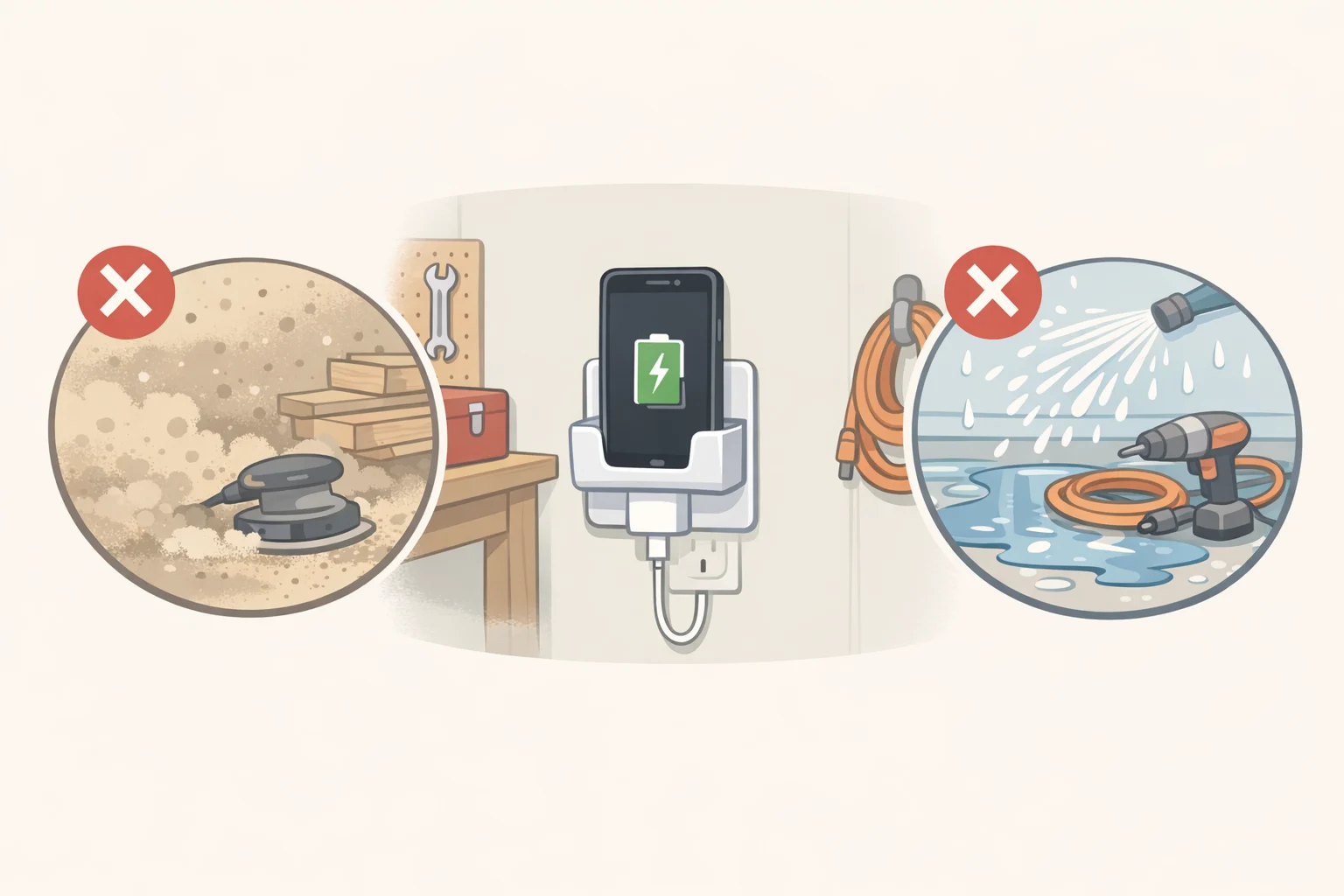
Assume, for a moment, that the DW2 is real and reasonably priced. Does the setup the manual describes actually suit a workshop? For one specific scenario, yes: a clean indoor wall in a garage or shop, where a phone needs a fixed, out-of-the-way spot to charge. Nothing in the manual supports use in dusty, wet, or temperature-extreme job-site conditions, which is exactly what "heavy-duty" implies to most buyers (Manuals.plus).
DeWalt's broader charging lineup makes a DeWalt-branded phone mount a plausible direction for the company, even if it doesn't confirm this particular unit. The DCB094 shipped with a 100W bidirectional USB-C port built around tool-battery hardware (The Verge, four years ago), and Fitzgibbons described the adapter at the time as something of a test balloon: enough customer interest, he said, could lead DeWalt to put charging ports directly on future batteries (The Verge, four and a half years ago). He also framed the shift in market terms, telling The Verge that job-site demand for USB-powered gear was a fairly recent development, one he expected to keep growing (The Verge, four and a half years ago).
DeWalt has also sold USB-C charging hardware separate from the DCB094. An independent performance review of its 65W USB Charging Kit, published just over two years ago, measured input at roughly 66W and output holding close to the rated figure, with conversion efficiency ranging from about 84 percent to 91 percent depending on load and voltage (Chargerlab). Neither that kit nor the DCB094 is the DW2, and neither involves magnets or wall mounting, but together they show a company willing to ship more than one charging accessory rather than treating the idea as a single experiment.
Plausibility still isn't confirmation. An official DeWalt listing, a retailer price, a hands-on test, and a durability rating are four separate things, and having a plausible motive to build a product isn't the same as having actually built and shipped this one.
Line up what's documented against what isn't, and the picture is simple. Documented: a wall-mounted, cable-connected wireless-charging device, mounting instructions, and radio-interference compliance statements (Manuals.plus). Not documented: charging protocol, wattage, power-adapter specification, environmental or durability rating, and any form of commercial availability. That split is the whole story here: real installation instructions sitting next to a long list of specifications nobody outside DeWalt has confirmed.
For a shop or garage wall in a dry, indoor space, the setup on paper is plausible enough. Calling it "heavy-duty," or treating "MagSafe" as a confirmed spec, describes an assumption rather than a documented feature.
If a retail listing does surface, the questions worth checking before buying are straightforward: does it support Qi, Qi2, or MagSafe specifically, and at what wattage; does a wall adapter ship in the box; will it charge through a thick case; what environmental rating, if any, applies to the space it's going in; and what does the price include in terms of warranty. None of that can be answered from the manual alone, and none of it can be answered until an actual listing exists to check against.
Where this leaves buyers
The calculus changes the moment any one of a few things appears: an official DeWalt product page, a retailer listing with a price, an FCC filing under a matching identifier, or a hands-on test measuring charging speed and checking how the unit holds up to dust and temperature swings. Until then, the DW2 is worth watching as a workshop-friendly idea DeWalt may be building toward, not treating as a finished, purchasable accessory.
The manual exists online; that much is settled. Everything attached to it since, MagSafe support, heavy-duty durability, a fixed retail price, sits outside the document and remains unconfirmed anywhere else.