Can you reuse crush washers for an oil change?
A worn crush washer doesn't strip the threads in an oil pan. The decision it provokes does. When a drain plug seeps after a refill, the instinctive fix is to crank down harder, and that extra torque is what actually ruins threads or cracks a pan. The washer itself is just the trigger.
A crush washer is the small metal ring that sits between the oil drain plug and the oil pan, sealing the joint so oil doesn't weep out once the engine is topped off (SlashGear, this week). The short answer to whether you can reuse crush washers for an oil change is no, not if it's a genuine crush washer, because the deformation that creates the seal only works once. The good news is that these washers are cheap and sold in multipacks, so keeping a few spares on the shelf costs next to nothing (SlashGear, this week).
Plenty of common vehicles, including the Toyota Camry, BMW 3 Series, and most Subarus, use this exact type of seal on their drain plugs (Hitches Guide, last year).
What follows walks through what a crush washer actually does, how to tell whether a car even has one, why reusing a true crush washer is a bad bet, and what to do if a fresh washer still leaks.
What is a crush washer?
Video of the Day
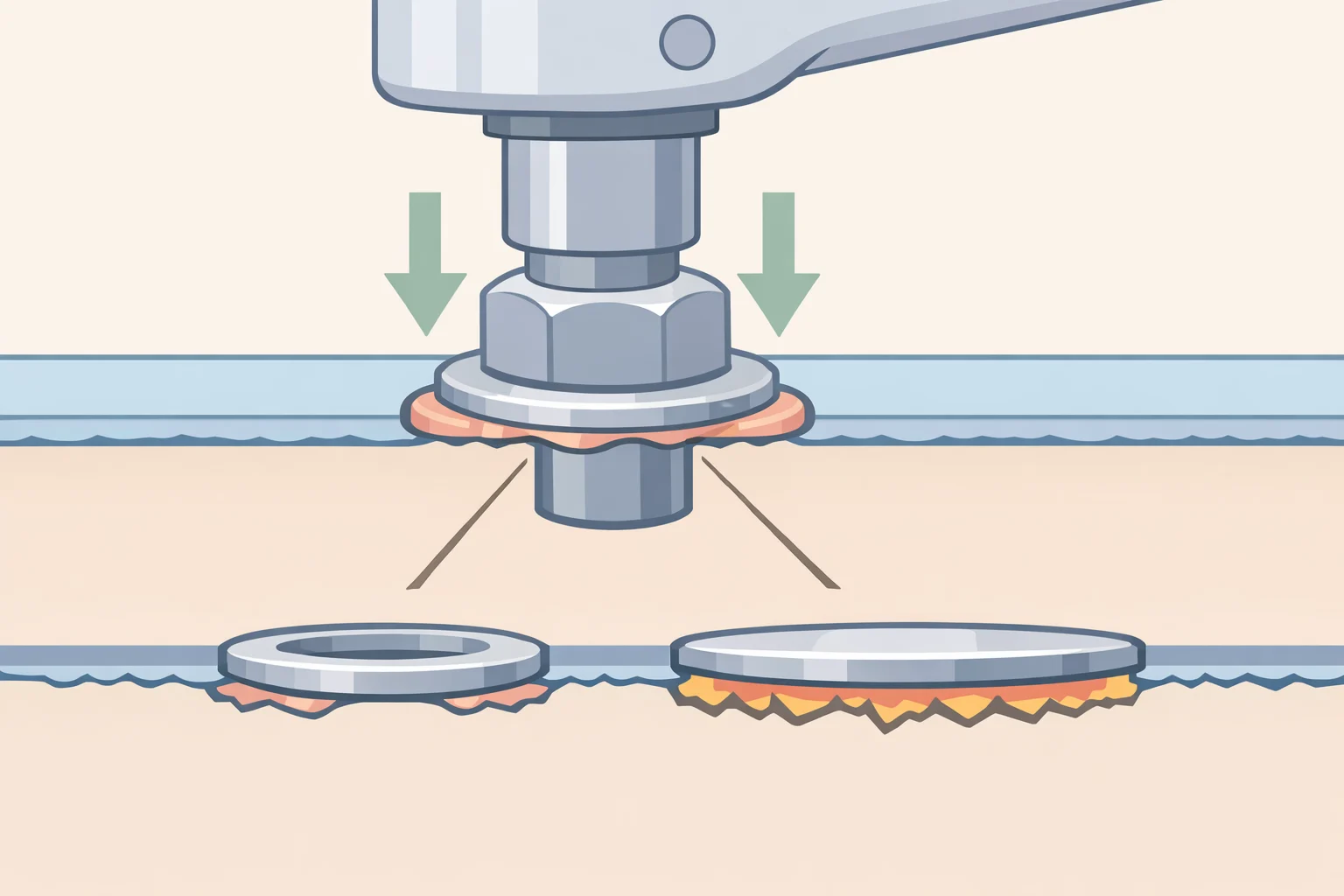
A crush washer is a thin ring of soft metal, usually aluminum or copper, that sits between the head of the drain plug and the sealing surface of the oil pan (Hitches Guide, last year; Willand Service Centre, last year). When the plug is torqued down, that soft metal doesn't just squeeze. It permanently deforms, conforming to microscopic imperfections on both surfaces until oil has nowhere left to escape. A torque analysis of copper crush gaskets in a specialized brass-plug application found compression of roughly 25 to 40 percent of the washer's original thickness, though that figure isn't a universal spec and varies by washer and joint design (Industrial Monitor Direct, 4 months ago).
That permanent give is the whole point. It lets the plug seal tightly without anyone needing to overtighten the threads to compensate, a separate and more damaging habit covered further down (Automotive Widgets, over a year ago). Think of it less like a rubber gasket and more like a piece of foil crimped tightly around a wire: once it's folded into that exact shape, flattening it out and crimping it again won't reproduce the same tight grip. A crush washer oil pan seal depends entirely on that one act of permanent deformation, and the metal has already spent it by the time it comes back out.
That one-shot mechanism is why the reuse question has a fairly consistent answer, once a driver has confirmed the vehicle actually uses this kind of seal in the first place.
Video of the Day
Crush washer or gasket: how to identify your oil drain plug seal
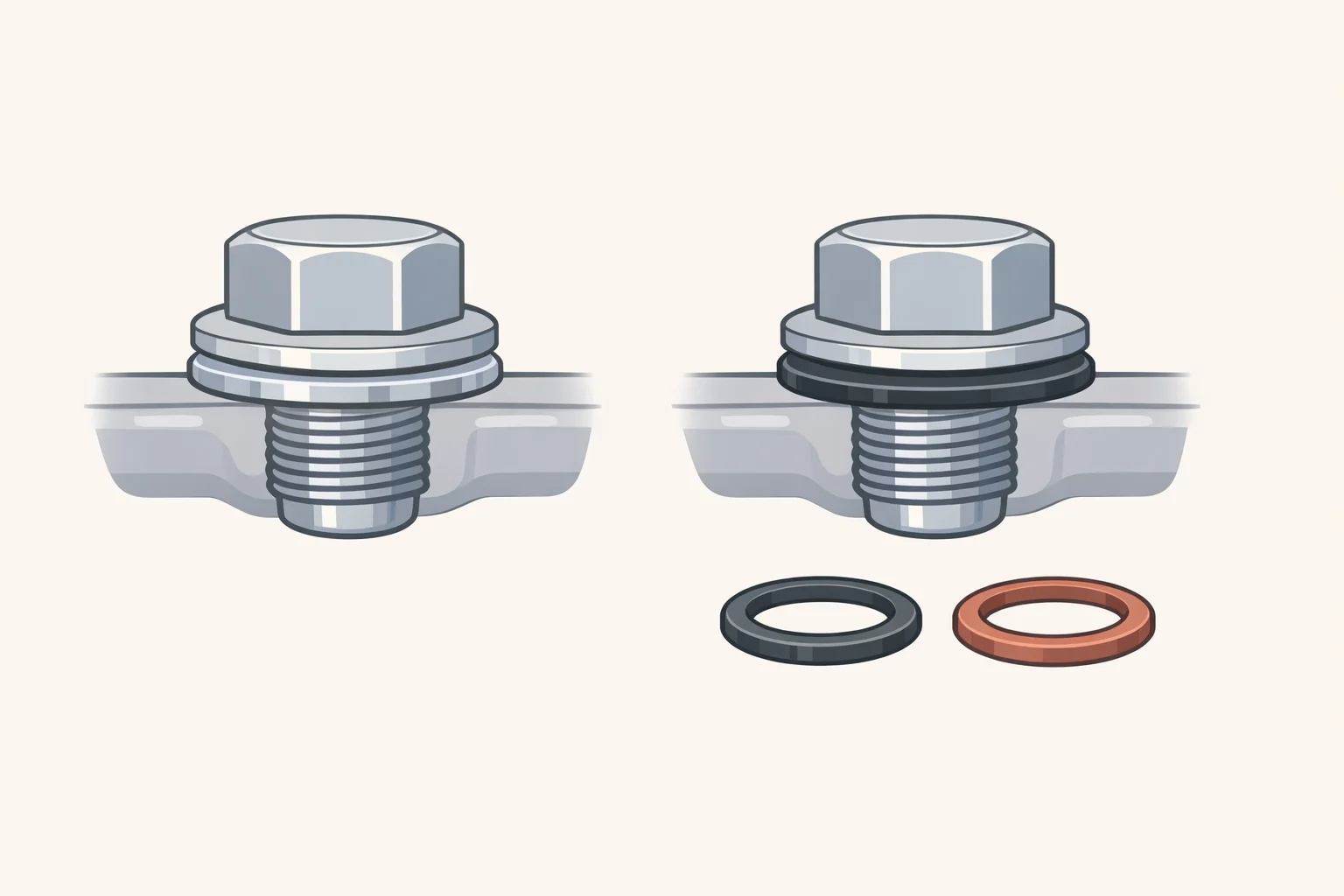
Not every drain plug uses a true crush washer. Some manufacturers use a gasket, rubber or fiber bonded to a metal ring, that deforms elastically rather than permanently and can be engineered for repeat use (Hitches Guide, last year). Older Honda Civic drain plugs are a commonly cited example: some applications reportedly used factory gaskets sturdy enough to survive more than one oil change, though that depends on the specific gasket design and still means checking for cracks, tears, or flattening before it goes back in (Hitches Guide, last year).
Telling the two apart isn't hard once someone knows what to look for. Crush washers tend to be thin, plain metal rings that look easily deformed. Gaskets usually show a visible rubber or fiber layer bonded to a metal band (Hitches Guide, last year). A glance under a shop light shouldn't be the final word, though. The vehicle's service manual typically identifies the seal type the manufacturer specifies, along with the torque figure that goes with it, and that beats a visual guess every time (Hitches Guide, last year).
Everything that follows about replacing rather than reusing applies specifically to metal crush washers. It doesn't automatically extend to every gasket sitting on a drain plug.
Should you replace a crush washer every oil change?
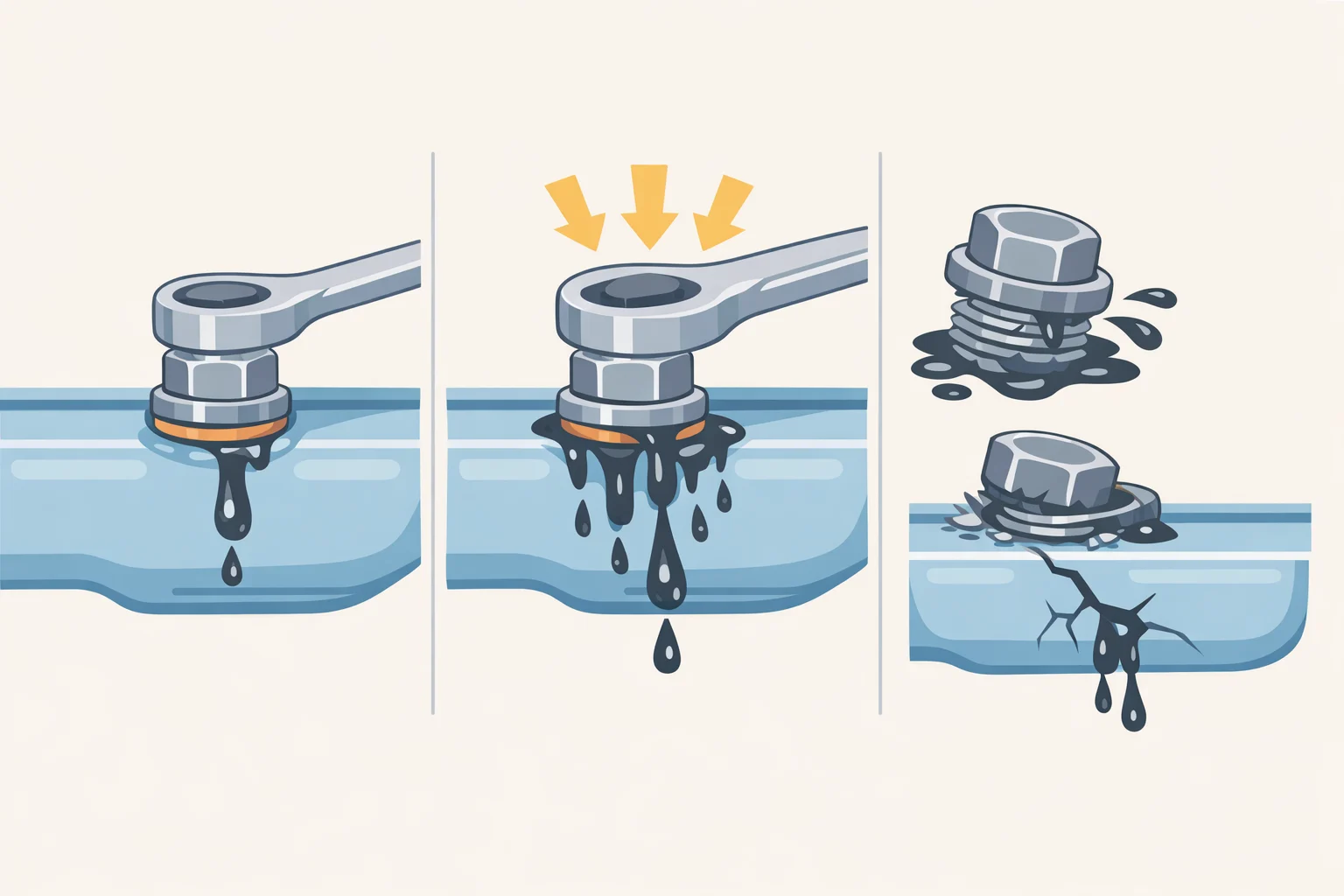
For a genuine metal crush washer, yes, every single time. Reusing an oil drain plug washer might save a quick trip to the parts store, but the deformation that creates the seal is permanent, so a washer that's already been crushed once won't reliably compress again to fill those same gaps (Industrial Monitor Direct, 4 months ago; Automotive Widgets, over a year ago). Whether you should replace a crush washer every oil change has nothing to do with how the old one looks. Put it back in, tighten it to spec, and there's a good chance oil finds its way past it anyway.
The economics back up the mechanics. A new washer runs from pennies to a few dollars, trivial next to the cost of repairing a damaged oil pan (Hitches Guide, last year). Some DIYers report squeezing three to five uses out of a single washer before it starts weeping (Willand Service Centre, last year). That's a real possibility, but it's a gamble against a part that barely registers on a repair bill.
The failure mode that actually costs money isn't the leak itself. It's what people do about it. A reused washer that seeps tempts a lot of drivers to add torque, cranking the plug down harder to force a seal the metal can no longer provide. That's what strips threads in an oil pan or, in bad cases, cracks it outright. Hitches Guide frames this with a hypothetical: reuse the washer during a routine Ford F-150 oil change, strip the threads in that truck's aluminum pan chasing a leak, and the job turns into a major repair, potentially a full oil pan replacement (Hitches Guide, last year). The washer was never the expensive part. Reaching for more torque is what makes it one.
Reconditioning a used washer: an emergency option, not routine maintenance
Some enthusiasts recondition a used washer instead of replacing it, and the source describing the practice is explicit that it's a stopgap, not a maintenance step. Sanding a washer back to its original color and smoothness, with no distortion on either face, can sometimes let it crush again close to how it did the first time, buying a slightly longer working life (SlashGear, this week). A more involved version heats the washer with a torch until it glows yellow-orange, then quenches it in cold water in a process called annealing, which softens the metal back toward its original state (SlashGear, this week). That method calls for real eye and hand protection, and an open flame has no business anywhere near an oil change in progress, spilled fluid, or a garage full of rags and solvent (SlashGear, this week). Even the source recommending these fixes is clear that a fresh washer is always the better choice when one is available (SlashGear, this week).
Getting the replacement right: size, material, and orientation
Getting the specific washer wrong causes many of the same problems as reusing an old one. A 14mm washer is common enough that some guides treat it as a default, but oil drain plug washers aren't all the same size, so it's worth confirming the size, thickness, and material called for on that particular make and model before buying a multipack (Willand Service Centre, last year; Automotive Widgets, over a year ago).
Material matters too, though not in a one-size-fits-all way. Common replacement washers are aluminum or copper, and which one a manufacturer specifies can depend on the application, the operating temperature, and the sealing pressure involved (Willand Service Centre, last year; RL Fasteners, last year). Swapping one for the other because it happened to be sitting in the parts bin isn't the same as using the washer built for that pan.
Orientation is worth checking too, but it isn't a universal rule. Some crush washers carry a small embossed arrow showing which way they should face, and where one exists, it typically points away from the fitting being sealed, with the washer sitting on the engine side of the plug (Automotive Widgets, over a year ago). Plenty of washers have no arrow at all. When in doubt, the service manual or the washer manufacturer's instructions settle it, not a guess about which way looks right.
What to do if a new washer still leaks
A fresh, correctly sized crush washer that still weeps after a proper torque isn't a signal to tighten further. It's a signal that something else in the joint needs attention.
- Stop adding torque. Overtightening a plug that's already sealing correctly doesn't fix a leak, it just shifts the risk onto the threads (Hitches Guide, last year).
- Check that the plug, the washer, and the pan's sealing surface are clean. Old gasket material or debris on the mating surface can keep a new washer from seating flat.
- Confirm the washer is genuinely the size and material specified for that vehicle, not a close substitute.
- Inspect the drain plug and the pan threads for existing damage. A washer can't compensate for a sealing face that's already nicked or worn.
- Recheck the torque specification in the service manual rather than tightening by feel.
- If the pan or plug threads turn out to be damaged, hand it to a repair shop instead of turning the wrench again.
Before you reinstall the drain plug
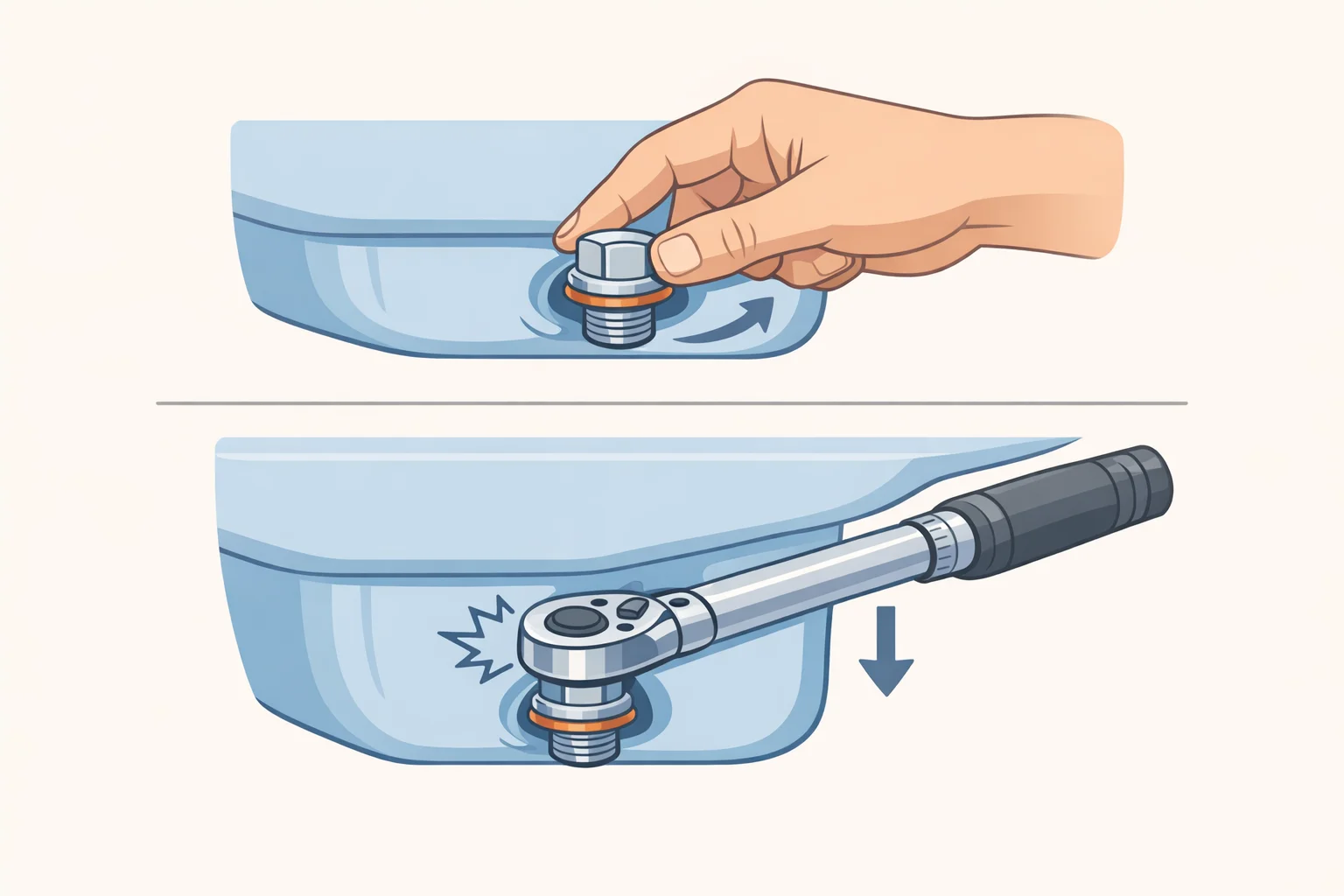
Once the correct washer is in hand, installation doesn't take long, but a few habits separate a clean job from a repeat trip under the car.
- Confirm the seal type and torque spec in the service manual before starting, rather than assuming last time's approach still applies (Hitches Guide, last year).
- Match the washer to the size and material listed for that specific vehicle instead of grabbing whatever's closest at hand (Willand Service Centre, last year).
- Wipe a light coat of fresh oil onto the new washer and thread the plug in by hand until it's finger-tight (Automotive Widgets, over a year ago).
- Check for an orientation arrow, if the washer has one, and install it facing the direction the manufacturer specifies (Automotive Widgets, over a year ago).
- Finish with a torque wrench set to the manufacturer's exact figure. Guessing by feel is how threads get stripped, whether from too little clamping force or too much (Hitches Guide, last year).
Replace it, and move on
If the seal is a true metal crush washer, install a new, vehicle-correct washer at every oil change. If it's a gasket, check the manual and inspect it before deciding whether to reuse it. Either way, torque to the specified figure, and treat any persistent leak as a sealing-surface or thread problem rather than an invitation to tighten harder.
A couple of spare washers on the shelf, bought before the old one starts weeping, is what keeps that question from coming up under the car with a wrench already in hand.