PocketMage PDA Explained: How Its Dual Screens Solve E-Paper Latency
Talisman Design's PocketMage PDA went live on Crowd Supply this week, offering a clamshell handheld with a physical QWERTY keyboard and a novel dual-display setup that pairs an E Ink main screen with a secondary OLED strip. The device starts at $185 as a DIY kit and $235 assembled. It is a crowdfunding project with no independent reviews yet, but the hardware concept is more considered than most entries in the hobbyist PDA space.
The design logic is the actual story. Typing on e-paper has a latency problem that has dogged dedicated writing devices for years. PocketMage's answer is to stop asking E Ink to handle fast input entirely. A 3.1-inch, 320×240 e-paper panel handles reading and long-form text, while a 1.8-inch OLED strip above the keyboard takes on the latency-sensitive work: keystroke feedback and menu display, per Good e-Reader and CNX Software. The result, at least in theory, is that users watch keystrokes appear immediately on the OLED, then read completed text rendered on the larger, sunlight-readable panel.
What the PocketMage e-paper PDA is, and what it refuses to be
Video of the Day

PocketMage runs PocketMageOS on FreeRTOS and ships with a Markdown editor, daily journal, calendar, task manager, dictionary, and file manager, according to Yanko Design. There is no touchscreen. A capacitive scroll bar and the physical keyboard handle all navigation, per Boing Boing.
Third-party software arrives through a community storefront called the Bazaar. The current app list mixes practical tools with hobbyist oddities: a text-mode web browser, an e-book reader, a calculator, a Tarot deck, and a dungeon-crawling RPG called Mage's Descent, per Boing Boing and Yanko Design. That catalog says something about where the early community is coming from.
Both hardware and software are released under the Apache 2.0 open-source license, and the device includes an expansion port for custom hardware add-ons, per Yanko Design and Good e-Reader. The project began as a GitHub design called "eInkPDA" by a creator known as Ashtf. The commercial version is recognizably the same device, refined through beta testing rather than redesigned from scratch, according to Boing Boing.
PocketMage is pitched to two different audiences who want different things from it. For writers and people trying to cut screen time, the appeal is what the device omits: no push notifications, no social feeds, no swipe-driven interfaces. For makers and engineers, Good e-Reader notes the device functions as a portable IDE, terminal, and hardware bridge, with Wi-Fi, Bluetooth, and an expansion port for custom add-ons. These are not the same product pitch, and whether one device can actually serve both groups will only become clear once hardware ships.
A few things are not proven at this stage. The claim that the PocketMage reduces smartphone dependency is a marketing position with no independent evidence behind it. The Bazaar's long-term developer activity is unknown. No hands-on reviews of typing feel, screen ghosting, or software stability exist from outside the development team. These gaps apply to every claim in this section and will not be repeated in each one.
Video of the Day
Why the PocketMage E Ink display uses an OLED helper screen
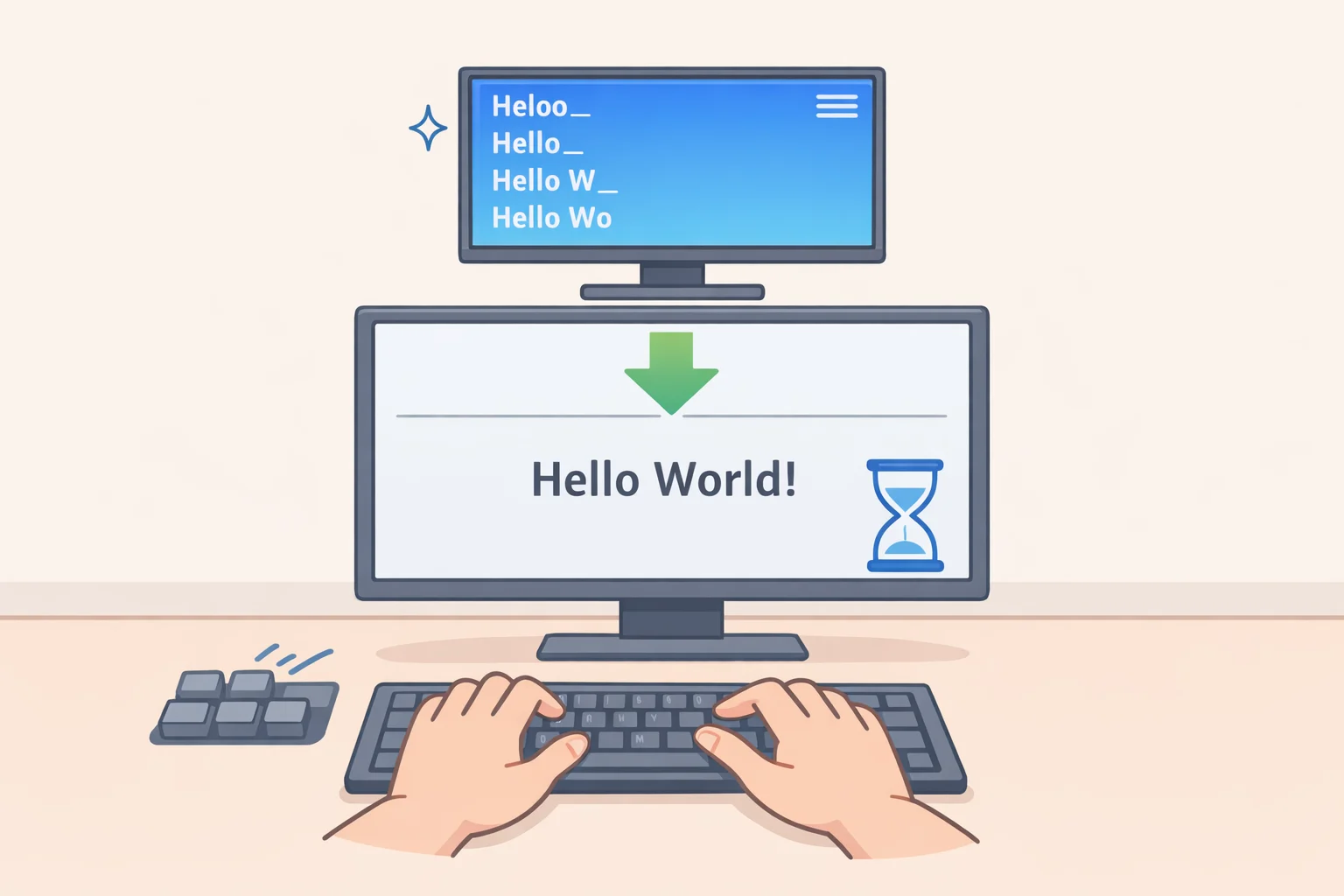
Typing latency on e-paper is a documented problem. Astrohaus, whose Freewrite line represents the commercial benchmark for dedicated E Ink writing devices, reported earlier this year that a waveform-level firmware overhaul cut input-to-display lag by 40 to 100 percent, according to the myereader Substack analysis published in April. That improvement came entirely through software optimization, not hardware changes. Onyx BOOX took a different route with its BSR (Boox Super Refresh) system, which uses a dedicated display controller to speed up screen refreshes, but the same analysis found that BSR worsens battery life and has not adequately resolved ghosting, meaning faster response came at a real cost to clarity and endurance.
PocketMage's approach avoids that tradeoff by routing around it. Instead of trying to make e-paper refresh faster, the OLED strip absorbs the tasks that demand rapid feedback, leaving the E Ink panel to do what it does well: display static text with no power draw. It is a different answer to the same problem, though whether the two-screen workflow feels seamless in practice requires hands-on testing that does not yet exist.
The underlying hardware is an ESP32-S3 microcontroller with Wi-Fi and Bluetooth, backed by 16MB flash, 2MB SRAM, a microSD slot, and USB-C charging, per Good e-Reader. Talisman Design claims approximately seven days of battery life from the 1,200mAh cell. For context, Astrohaus claims its Freewrite Traveler and Smart Typewriter last about four weeks, per the myereader Substack, but those figures are based on 30 minutes of daily use on much larger devices. PocketMage's seven-day figure is unverified and not directly comparable.
Physically, the clamshell body measures 100mm × 73mm × 21.7mm, roughly the footprint of a large credit card holder. Boing Boing noted that at under 4 by 3 inches, it fits an actual pocket, unlike similar gadgets such as the chunkier PicoCalc or the tablet-sized Freewrite Alpha. On form factor alone, it occupies a gap in the market that no current shipping product sits in.
Who the PocketMage DIY kit is for, and who should wait
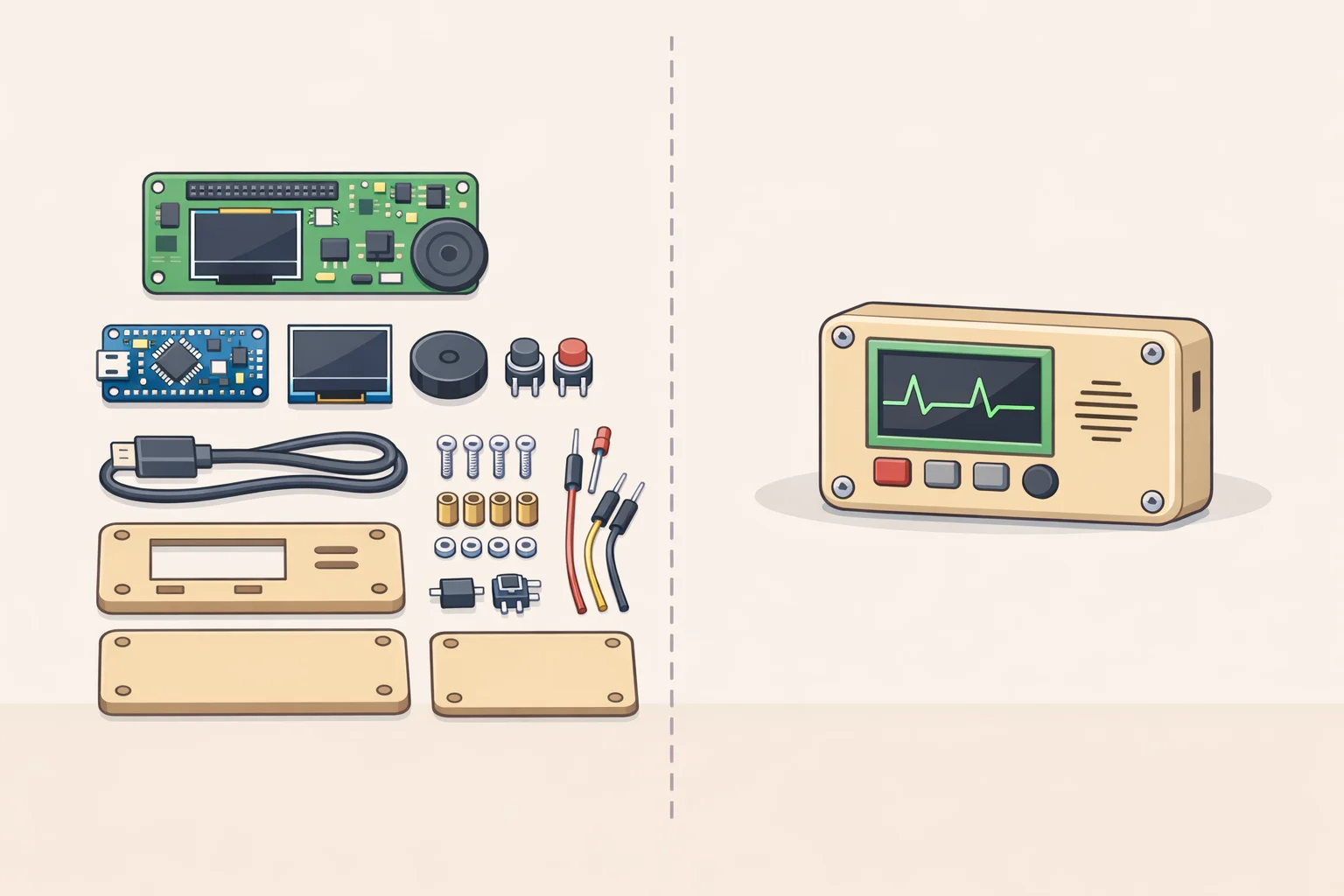
Two tiers are available on Crowd Supply. The $185 DIY kit includes PCBs, case components, a LiPo battery, a microSD card, and an assembly guide. The $235 option ships fully assembled. Both come in Parchment white or Royal Purple, with free US shipping and a $12 international flat rate.
The campaign needs to reach a $100,000 funding goal by September 2026, with deliveries projected for March 2027, per Yanko Design and Boing Boing. No reporting is available on Talisman Design's prior production history or supply-chain readiness, which is the standard execution risk for first-run crowdfunding hardware.
Prospective backers looking for a polished, day-one productivity tool should hold off. No one outside the development team has tested the device, and none of the hardware or software claims have been independently verified. Backers who are comfortable with crowdfunding risk, enjoy working within constraints, and want to participate in building out the Bazaar ecosystem are the audience the current app list suggests is already gathering around this project. Note that the DIY kit includes an assembly guide and component parts; the research data does not specify what skill level is required to build it.
At $235 assembled, the pricing is reasonable for the category. The Freewrite Alpha sells at a higher price point and offers less in terms of connectivity and open extensibility, though it carries a shipping and support record that PocketMage does not yet have.
What still has to be proven
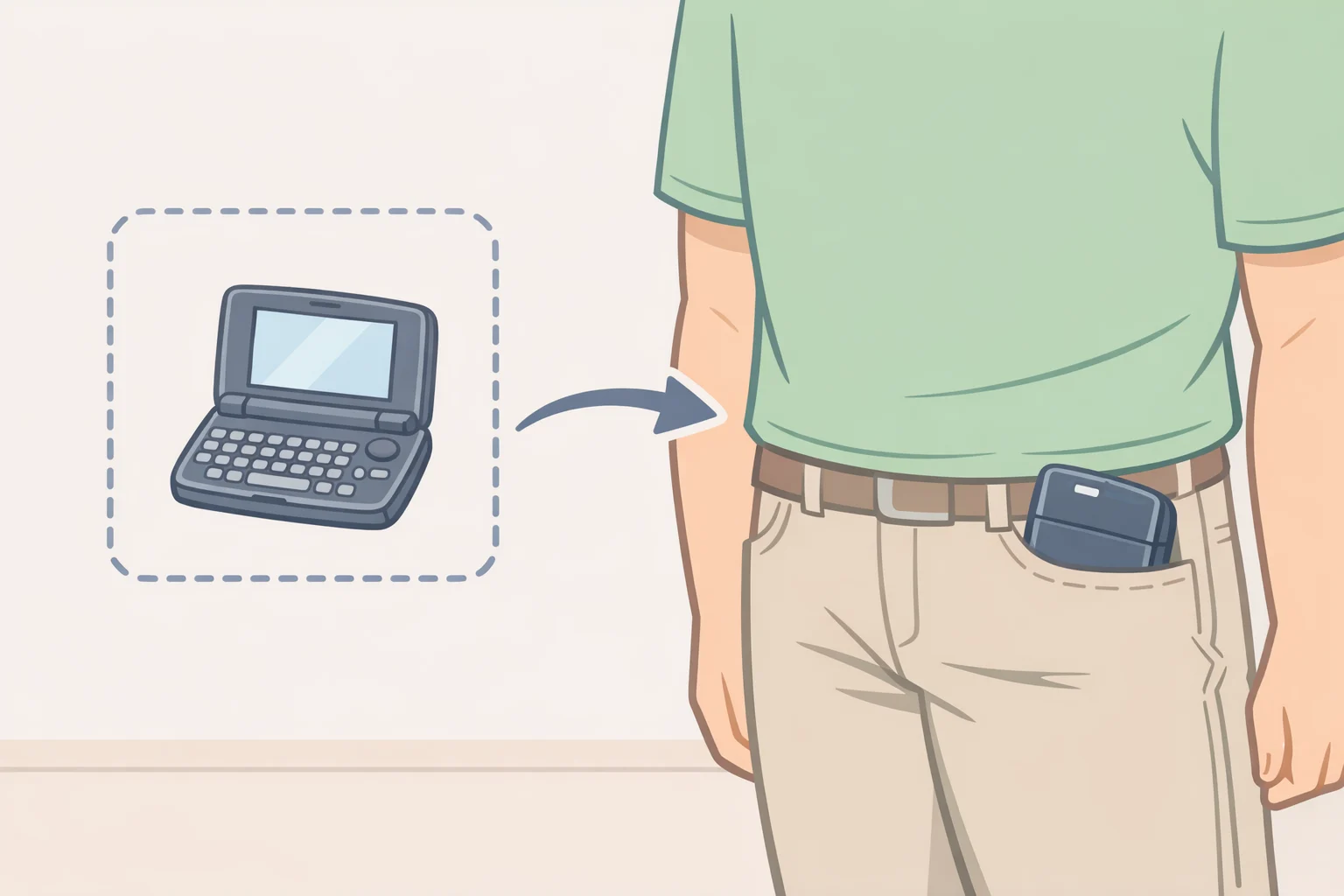
PocketMage's clearest strength is pocketability. At its stated dimensions, it is the only device in its category that Boing Boing identifies as genuinely fitting a pocket, and for a device marketed as a modern Palm Pilot alternative that goes everywhere a phone goes, that is not a trivial claim.
The dual-screen architecture is a concrete, testable idea for a problem that other manufacturers have addressed only through software patches or hardware tradeoffs with documented costs, per the myereader Substack. Whether the OLED and E Ink panels work together as fluidly as the design implies is the central question that only shipping hardware can answer.
Beyond that: can the Bazaar sustain active development through a March 2027 delivery? Can Talisman Design hit that date? The $100,000 funding goal will be the first signal about whether the maker and minimalism communities together can carry a pocketable open-source PDA from campaign to production. If they can, and the device ships on schedule, PocketMage will be one of the first products to show whether splitting fast input and slow display across two screens is a practical formula for a new class of pocketable e-paper tools, or a clever idea that works better in renders than in pockets.