Hisense XR10 Smart Projector Review: Stunning Color, Dark Room Required
Spend $6,000 on a display in 2026 and you face a genuine choice. A capable lifestyle projector like the XGIMI Titan or Horizon 20 Max runs £2,600–£3,500. A large-format OLED or MiniLED TV sidesteps the ambient-light problem entirely. A dedicated home theater projector sacrifices placement flexibility for cinema-grade performance. The real question in any Hisense XR10 smart projector review is whether Hisense has found a fourth path: enthusiast-grade image quality in a box that can move between rooms, without giving up either. The answer is yes but only if you can control the light in your room.
The XR10 launched in May 2026 as Hisense's 2026 flagship lifestyle projector, with an MSRP of $6,999 and street prices typically closer to $5,500, per ProjectorCentral. Its hardware is unusually serious for the category: a dual RGB triple-laser light engine, a 17-element all-glass optical system, and a motorized 2.38x zoom with ±130% vertical lens shift components normally found in far more expensive dedicated theater units. This is one of the first credible projector implementations of RGB triple-laser technology, which transformed the TV market before finding its way into projection, as WIRED noted in its review this week.
Independent reviews from WIRED, Trusted Reviews, Expert Reviews, and ProjectorCentral broadly agree on the verdict: outstanding color accuracy and genuine placement flexibility, but headline specs that overstate what instrumented testing finds, and bright-room performance that falls well short of Hisense's marketing language.
That gap between spec sheet and reality defines the entire buying decision.
What the XR10 gets genuinely right: color, contrast, and cinematic accuracy
Video of the Day

The XR10's strongest claim is color and that claim largely holds up under independent testing, even when the specific headline figures don't.
Expert Reviews measured DCI-P3 coverage at 96.9% with a 147.4% gamut volume, placing the XR10 ahead of both the XGIMI Titan (90.1% DCI-P3) and the Horizon 20 Max (94.3%) its primary lifestyle rivals at roughly half the price. ProjectorCentral confirmed 100% coverage of both DCI-P3 and Rec.709 in calibrated testing. For wide-gamut film content, the advantage over cheaper competitors is real and visible on screen.
Native contrast came in at 5,633:1 at maximum throw with the iris closed to its tightest setting, per ProjectorCentral just below Hisense's claimed 6,000:1, but genuinely strong for a lifestyle projector. That contrast, combined with the seven-step manual iris, makes the XR10 particularly well-suited to dark scenes and cinema content in a controlled environment. WIRED noted convincing contrast in water and surface detail rendering during Hellblade II on Xbox Series X.
Color accuracy holds up when the projector is properly configured. Before calibration, ProjectorCentral measured average Delta E errors in the 2.1–3.3 range in Filmmaker mode for SDR acceptable for an out-of-box experience. After professional calibration using Calman Ultimate software, grayscale error dropped to an average of 1.5 dE for SDR and 1.3 dE for HDR. Those numbers indicate genuine accuracy potential, not wide-gamut performance built on miscalibrated primaries.
HDR format support covers the full stack: Dolby Vision, HDR10+, HDR10, HLG, and IMAX Enhanced, per ProjectorCentral. The XR10 also includes its own built-in dynamic tone mapping for HDR10 content, which ProjectorCentral found performed well in practice that matters because most streaming content tops out at HDR10 and relies entirely on the projector's processing rather than scene-by-scene metadata. WIRED found that films like Inside Out and Guardians of the Galaxy Vol. 2 rendered purples, reds, and yellows with a vividness that "justifies the high price."
That makes the XR10 easy to admire in a dark room. It also makes Hisense's brightness marketing harder to forgive.
Video of the Day
Hisense XR10 brightness and contrast: what the numbers really mean
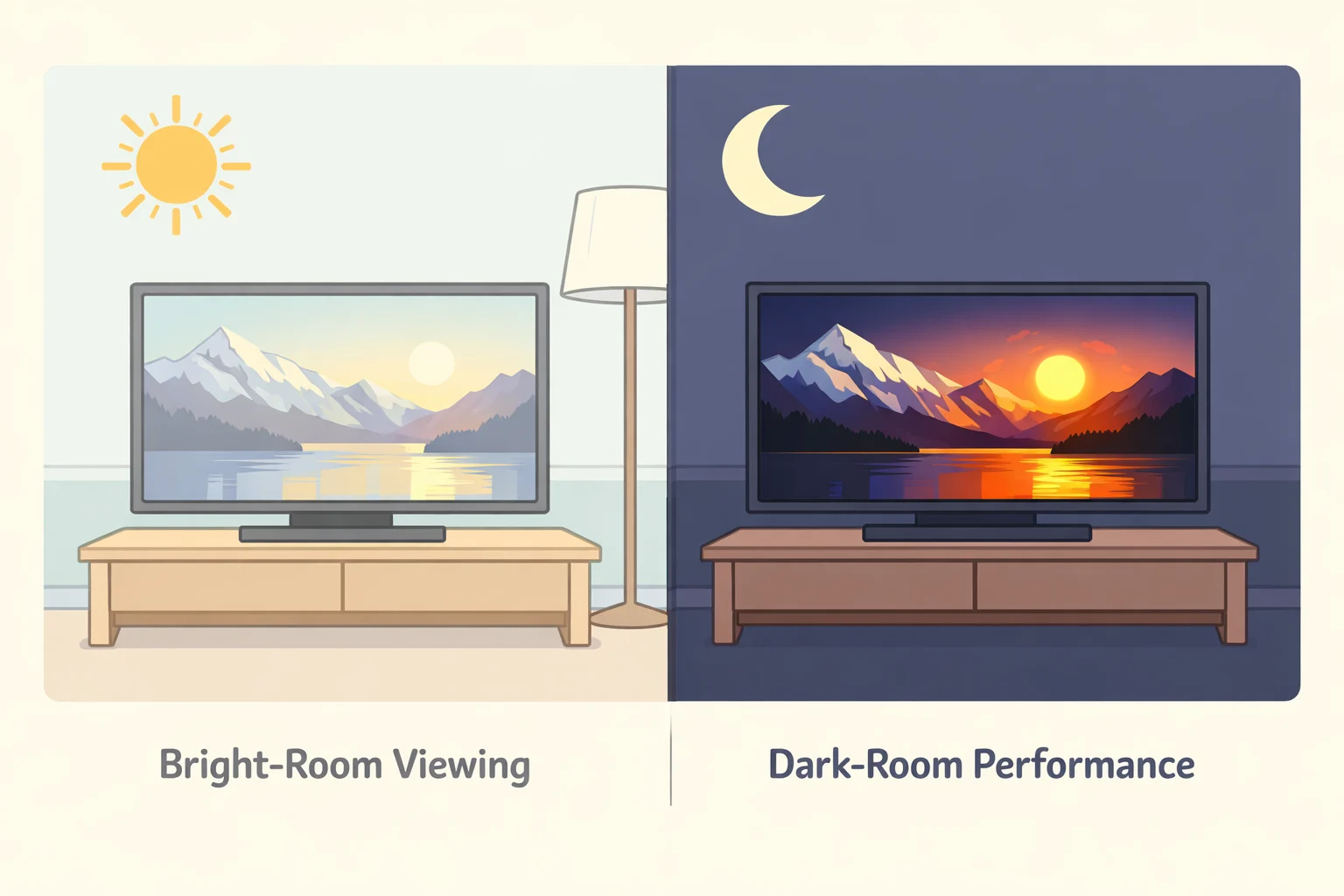
The XR10's marketing relies on three figures that independent testing consistently softens. Buyers should understand the gap before committing.
Hisense rates the XR10 at 6,000 ANSI lumens. ProjectorCentral measured a peak of 5,288 lumens roughly 12% below spec achieved only in the brightest Vivid mode with the Brightness Enhancer set to maximum. Without the enhancer, output fell to 3,930 lumens, approximately 34% short of the advertised figure. ProjectorCentral's spec page carries an explicit buyer caution that the cited brightness specification appears inconsistent with standard ANSI measurement methodology.
BT.2020 coverage follows the same pattern. Hisense claims 118% of the BT.2020 color gamut a figure that implies the projector exceeds the entire standard, which is physically possible with saturated laser primaries. What independent testing finds is different. ProjectorCentral measured 95.5–96.6% depending on methodology; Trusted Reviews independently arrived at 95.6%. Those are excellent results. They are not 118%. At reduced luminance levels, BT.2020 coverage falls further, to around 72%, which matters for dark scenes where the projector's primaries are working hardest.
Bright-room performance is where marketing and reality diverge most sharply. Hisense describes the XR10 as delivering crystal-clear content even in well-lit rooms. WIRED calls daytime viewing "one of the XR10's biggest struggles." Even at nearly 5,300 measured lumens, this projector competes against sunlight poorly as all projectors at this throw ratio do. That marketing claim should not be taken at face value.
Out-of-box Dolby Vision adds another wrinkle. Trusted Reviews found the default Dolby Vision Bright mode over-saturated and unstable, with distracting black-level fluctuations. Switching to Dolby Vision Dark and reducing the iris resolved the issue but reaching the best-case result requires deliberate manual setup, not out-of-box performance. A related spec discrepancy: Hisense's product materials describe a "dynamic iris," but every independent reviewer confirms the iris is a seven-step manual control, not an automatic scene-by-scene adjustment.
Optics and placement flexibility: the hardware case for the price
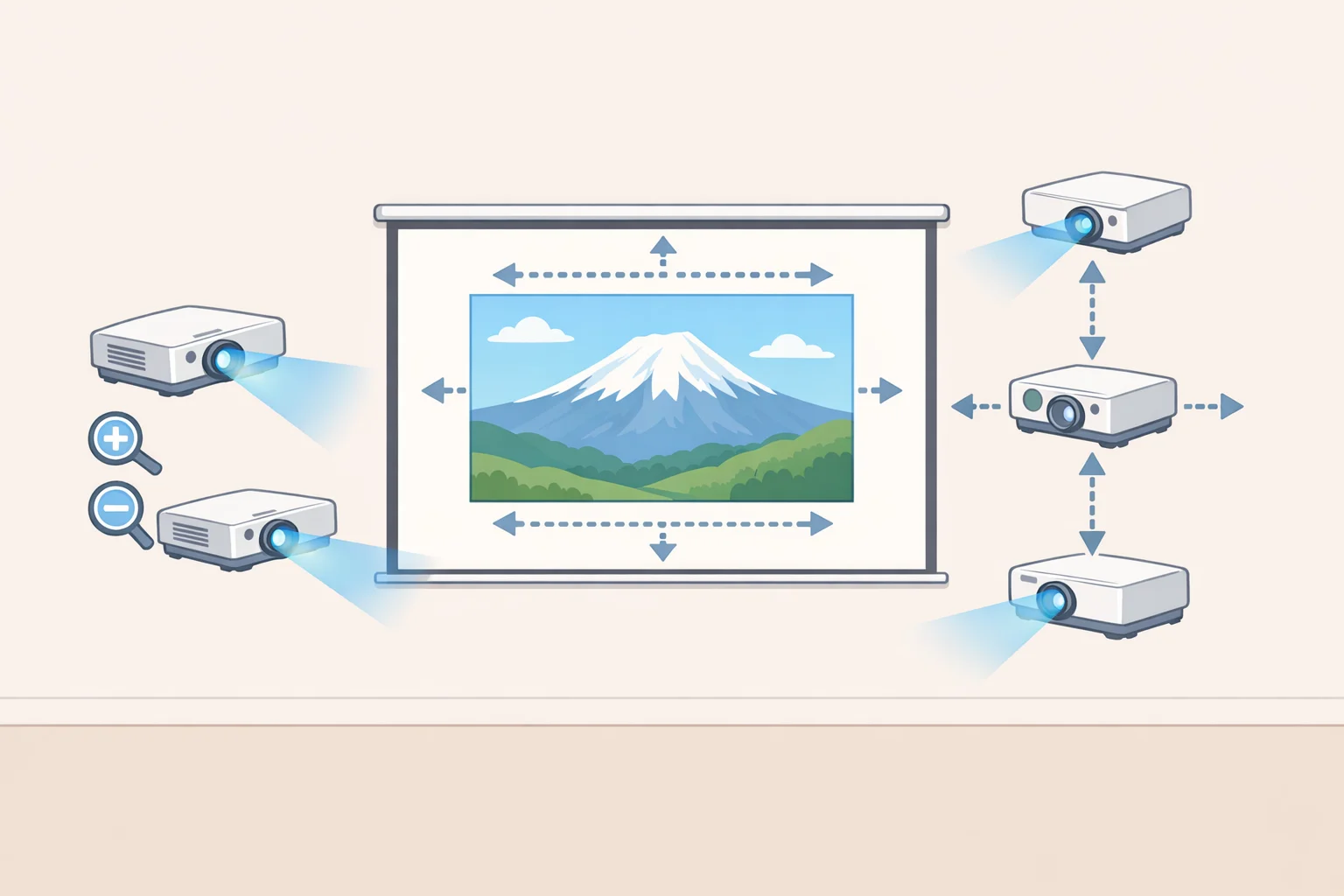
Where the brightness spec disappoints, the optical engineering delivers. The XR10's lens system is the clearest hardware differentiator over cheaper alternatives.
The 17-element all-glass lens supports a 2.38x motorized optical zoom with motorized lens shift of ±130% vertical and ±46% horizontal, per ProjectorCentral a combination that allows the XR10 to be placed in a wide range of positions without digital correction degrading the image. Screen sizes from 60 to 300 inches are supported, including a 100-inch image from 1.86 meters, per Expert Reviews. The XGIMI Titan and Horizon 20 Max, the XR10's primary rivals at roughly half the price, lack motorized lens shift entirely a meaningful gap if placement flexibility is a priority.
Setup is fast for a projector at this complexity level. An 8MP camera paired with dual time-of-flight sensors drives automatic keystone correction, autofocus, obstacle avoidance, and image-to-screen mapping. WIRED completed initial setup including app installation and calibration in approximately ten minutes, though the auto-mapping worked most of the time and required some manual tweaks for size and focus. Expert Reviews estimated unboxing-to-watching at around half an hour. Reliable enough that repositioning between rooms is a realistic use case, not just a theoretical one though users should expect the occasional manual correction.
Liquid cooling a first for this projector category, per Trusted Reviews keeps fan noise minimal at standard output levels, rising only when Brightness Enhancer modes push the laser harder. That matters for quiet scenes and low-volume content, where competing high-lumen projectors can become intrusive. The laser light source is rated for 25,000 hours, per ProjectorCentral specs, eliminating lamp replacement from the long-term cost calculus.
The 31-watt 2.1-channel audio system, tuned by Devialet with two 8-watt drivers and a 15-watt subwoofer, outperforms virtually everything else in this product category without external speakers, per Expert Reviews. Usable listening sat between 40–50% volume before it became too loud for a typical room. The notable gap: no Dolby Atmos decoding, which Trusted Reviews flags as a meaningful omission at this price point.
Hisense XR10 for gaming: fast enough to justify the price?
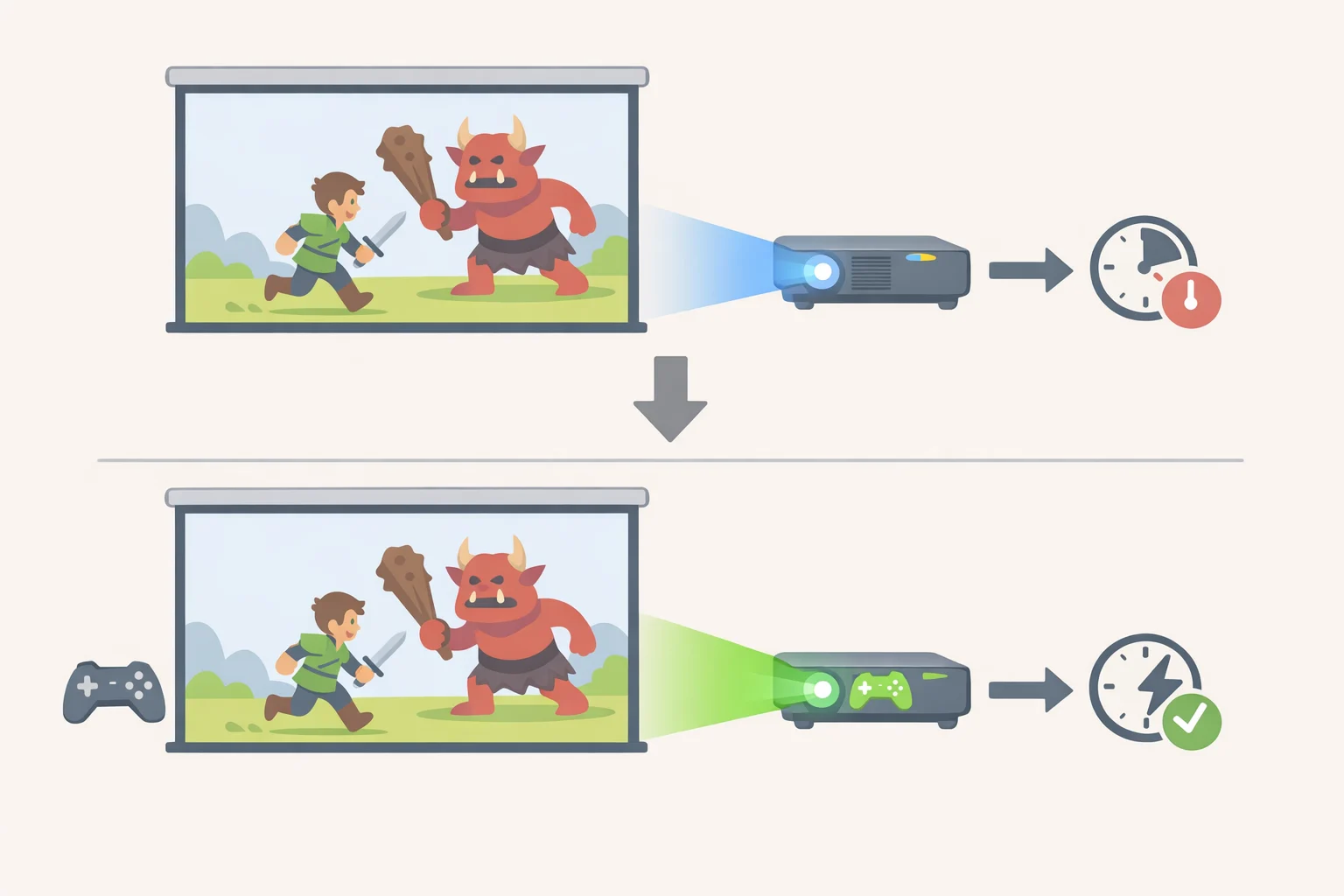
Gaming performance is a genuine XR10 strength though the HDMI 2.1 labeling, the eARC implementation, and VIDAA OS each come with specific qualifications worth reading carefully.
ProjectorCentral measured input lag at 5ms in Game Mode at 1080p/240Hz a figure competitive with mid-range gaming monitors, not just other projectors. At 1080p/120Hz the figure rises to 13ms; at 4K/60Hz, 21ms. The XR10 switches to low-latency mode automatically when a game source is detected, per WIRED. WIRED found the projector responsive and convincing across Crimson Desert, Hellblade II, and Forza Horizon 6 on both Xbox Series X and PC. For a large-screen gaming setup in a darkened room, these numbers are hard to argue with.
The HDMI 2.1 labeling requires careful reading. Two of the three HDMI ports carry the 2.1 designation; the third runs at HDMI 2.0. But Trusted Reviews found that practical 2.1 support on those ports appears limited to Auto Low Latency Mode switching buyers expecting variable refresh rate or full-bandwidth next-gen console features based on the label should not assume those are present. The eARC port caused persistent problems for WIRED with an Onkyo TX-RZ50 AV receiver, producing dropped audio and black screen flashes, with Hisense investigating at the time of WIRED's review. Buyers routing audio through a receiver via eARC should treat that as an open question.
VIDAA OS ships with Netflix, Prime Video, YouTube, Apple TV, and Crunchyroll pre-installed and covers the major streaming needs. ProjectorCentral considers it a capable alternative to Google TV. WIRED found voice control underpowered and the backlit remote cluttered with too many buttons for comfortable daily navigation. Buyers who rely on voice commands extensively would likely benefit from attaching an external streaming device rather than depending on VIDAA alone.
Who should buy the Hisense XR10 and who shouldn't
The XR10's strengths are real. So is the condition they come with.
Dark-room film enthusiasts are the clearest fit. The XR10's color accuracy, contrast, and optical flexibility deliver a genuinely cinematic image in a media room or basement with limited natural light, a living room with blackout curtains, or any space used primarily after dark. In those environments, it outperforms cheaper rivals in the categories that matter most: DCI-P3 coverage (96.9% vs. the Titan's 90.1% and the Horizon 20 Max's 94.3%, per Expert Reviews), motorized lens shift that cheaper rivals simply don't offer, and calibration potential that approaches dedicated theater projectors.
Big-screen gamers have a strong case too. The 5ms input lag at 1080p/240Hz is exceptional for any large-screen display. The automatic low-latency switching removes friction. The color depth that makes Guardians of the Galaxy vivid does the same for Crimson Desert. If a darkened gaming room is the use case, the XR10 is among the best large-screen options available regardless of price category.
Living-room casual viewers the ones watching weekend afternoons in a sun-filled room, or who want a set-and-forget experience with minimal configuration should look elsewhere. A large OLED or MiniLED TV will deliver a more reliable image for less money in ambient light, and no amount of lumens will fully compensate at this throw ratio. The XGIMI Titan at roughly £3,499 or Horizon 20 Max at £2,599, per Expert Reviews, deliver excellent images in controlled rooms for considerably less. WIRED found the two flagship-tier projectors broadly competitive across real-world content, with the Titan's dynamic iris giving it an edge in automatic contrast optimization.
RGB triple-laser projection is still in early innings. Buyers who can wait may find prices fall and software matures faster than expected. Buyers who want the best currently available combination of cinematic color, placement flexibility, strong gaming performance, and a room they can darken will find the XR10 is the most complete answer to that specific question provided they go in with accurate expectations about what the spec sheet actually delivers.