Canon EOS R6 V review: full-frame video for solo creators
At $2,499, the Canon EOS R6 V removes the viewfinder, ditches the mechanical shutter, and adds cinema-oriented tools in their place. This Canon EOS R6 V review breaks down exactly who benefits from that trade-off and who should look elsewhere.
Camera companies rarely make deliberate products. Most bodies try to serve everyone: a viewfinder for the stills shooter, video modes for the hybrid user, enough specs on paper to justify the price to both. The Canon EOS R6 V is different. The "V" stands for video-first, and Canon means it. Digital Camera Guru calls it the first Canon EOS body to openly present itself as a video-first tool rather than a traditional hybrid compromise. Canon's announcement describes it as "specifically built for video capture" for creators who shoot daily and want "control, operability, and reliability."
The quick answer for buyers at the decision point: the R6 V is the better choice over the R6 Mark III if recording stamina, solo-operator design, and streaming reliability matter more to you than a viewfinder and mechanical shutter. Against the Cinema EOS C50, it trades codec depth and cinema workflow complexity for built-in stabilization and a substantially lower price. Neither trade favors everyone. The rest of this review is built to help you figure out which trade is yours.
The central argument: the R6 V succeeds precisely because Canon removed photographer-first features, but that same focus makes it the wrong body for hybrid shooters. Understanding what you gain and lose in each direction is the real decision.
A note on sourcing: this assessment draws from Canon's official announcement (two months ago), lab testing and hands-on review from Photo Review (this week), and findings from PCMag (today), Fstoppers (ten days ago), Digital Camera World (three weeks ago), and Digital Camera Guru (about two months ago). Where only a single reviewer has tested a specific claim, those findings are framed as observed, not settled.
Canon EOS R6 V video performance: what you actually get
Video of the Day

The headline spec is 7K open-gate recording in a native 3:2 aspect ratio at up to 30p, plus 7K 60p in RAW Light format. That resolution headroom lets a single take be reframed for YouTube's 16:9 and TikTok's 9:16 without a second setup a legitimate workflow advantage, not a marketing footnote, as Photo Review documents. Below 7K, the camera offers oversampled 4K up to 60p and uncropped 4K up to 120p for slow motion. No sensor crop on the latter is a genuinely useful distinction from bodies that penalize you with a crop factor the moment you reach for slow-motion modes, per Canon's announcement.
Not every spec holds up equally at the extremes. Fstoppers notes that the 4K 120p and 2K 180p modes show meaningful quality trade-offs, and open-gate mode carries moderate rolling shutter. That finding comes from a single reviewer and hasn't yet been corroborated across multiple sources worth knowing before treating it as settled.
On color and grading, the picture is cleaner. Canon Log 2 captures approximately 15 stops of dynamic range; Canon Log 3 is a gentler curve better suited to fast turnarounds or less experienced editors, per both Photo Review and Fstoppers. Internal 10-bit recording grades without banding. PCMag highlights a deep set of stylized color profiles for creators who want a finished look without touching a color panel. The simultaneous dual-card workflow 7K RAW to CFexpress Type B while a 2K proxy writes to SD is the kind of detail that barely registers in spec sheets but matters considerably in a solo edit session, as Fstoppers points out.
The stills performance warrants honesty, because it creates the central tension of this camera. The R6 V captures 32.5MP frames at up to 40fps continuous. Photo Review lab testing recorded 142 Large/Fine JPEGs in 3.0 seconds, with the buffer clearing in roughly 30 seconds strong burst performance by any standard. Fstoppers found noise stays controlled through ISO 1600 and remains usable through ISO 6400, with steeper degradation above ISO 12,800. Photo Review scores still image quality at 9.0 out of 10 in lab testing.
The contradiction is deliberate. Canon stripped photographer-friendly hardware from a camera that still shoots excellent 32.5MP stills at 40fps. The R6 V is not a camera that can't shoot stills well; it's a camera that removed the ergonomics for doing so by design. That distinction matters when you get to the comparison section.
Video of the Day
Canon EOS R6 V for content creators: design, thermals, and workflow
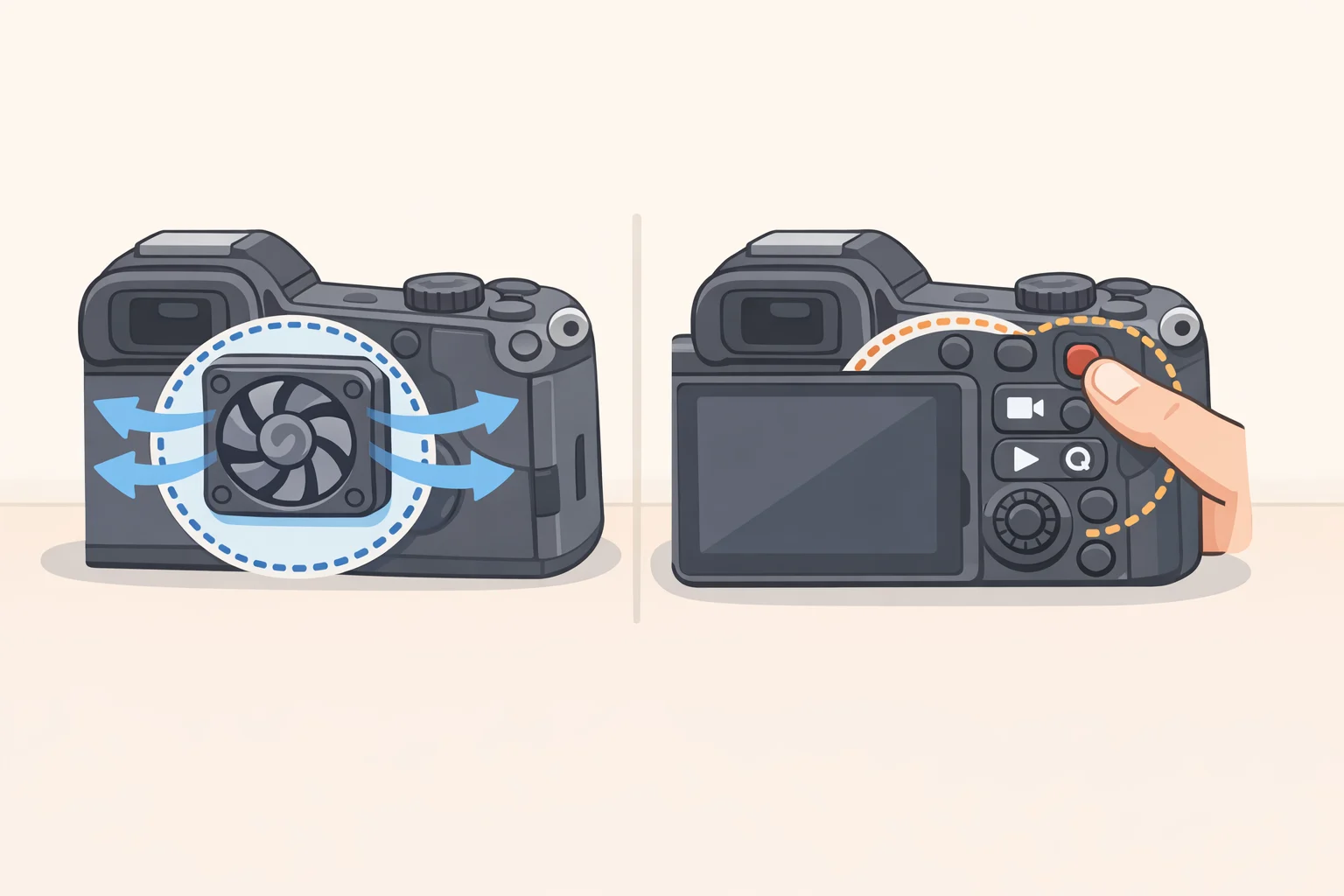
The active cooling fan isn't a secondary feature it occupies the space a viewfinder would normally use, and the trade-off is direct. Fstoppers reports the R6 V sustains over two hours of 7K recording without overheating, where earlier EOS hybrid bodies couldn't manage that in high-quality modes. Digital Camera Guru frames the practical implication: multi-hour livestreams, full-length interview recordings, and full-day B-roll capture with far fewer thermal interruptions than previous hybrid EOS bodies.
For solo creators, this is the clearest functional argument for the R6 V over the R6 Mark III. The Mark III has no fan. That's not a spec difference it's a production constraint that shows up during long interviews and all-day shoots. Against the C50 in handheld scenarios, the R6 V's thermal stamina is a real advantage too, per Photo Review.
The physical design follows the same logic. A flat body profile, side-mounted vertical tripod socket, front-facing tally lamp, second record button, body-integrated zoom lever compatible with the RF 20-50mm power zoom lens, and 12 customizable buttons: these aren't extras bolted on, they're the architecture of a one-person shoot, per Canon's announcement and Fstoppers. Dual mounting points for landscape and vertical shooting, plus a vertical UI the R6 Mark III lacks entirely, round out a control layout built around how solo creators actually work, as PCMag and Photo Review both note. One friction point worth flagging: Fstoppers observed a rear control dial prone to accidental activation. Single-reviewer finding, not yet reported elsewhere.
Connectivity is purpose-built. Full-size HDMI with clean output, USB-C with Power Delivery support, and more reliable USB livestreaming than previous EOS bodies, per Digital Camera Guru and Photo Review. USB-PD support matters specifically for streaming: with external power connected, recording time becomes limited by storage and workflow rather than battery life. What remains sparse is real-world video endurance data Photo Review CIPA rates approximately 520 shots per charge in stills mode, but sustained performance during hours-long 7K recording or livestreams hasn't been independently tested across multiple reviewers yet.
On stabilization and autofocus, the R6 V delivers solidly if not perfectly. IBIS is rated at up to 7.5 stops, one full stop behind the R6 Mark III's 8.5 stops per Canon's own published spec comparison, via Photo Review. Against the C50, the R6 V holds a straightforward advantage: the C50 has no built-in stabilization at all. Dual Pixel CMOS AF II with subject and eye tracking earns a 9.0 from Photo Review lab testing. Digital Camera Guru reports reliable face tracking at 4K 120fps during handheld walking though again, a single-reviewer observation. One practical note on batteries: the newer LP-E6P is required to unlock 40fps continuous shooting and pre-capture mode. Users carrying the older LP-E6NH will find those features unavailable, per Fstoppers.
The design is coherent and intentional. Every decision maps directly to how solo creators and documentary-style shooters work. Nothing was subtracted at random.
R6 V vs. R6 Mark III vs. C50: the buying decision in plain terms
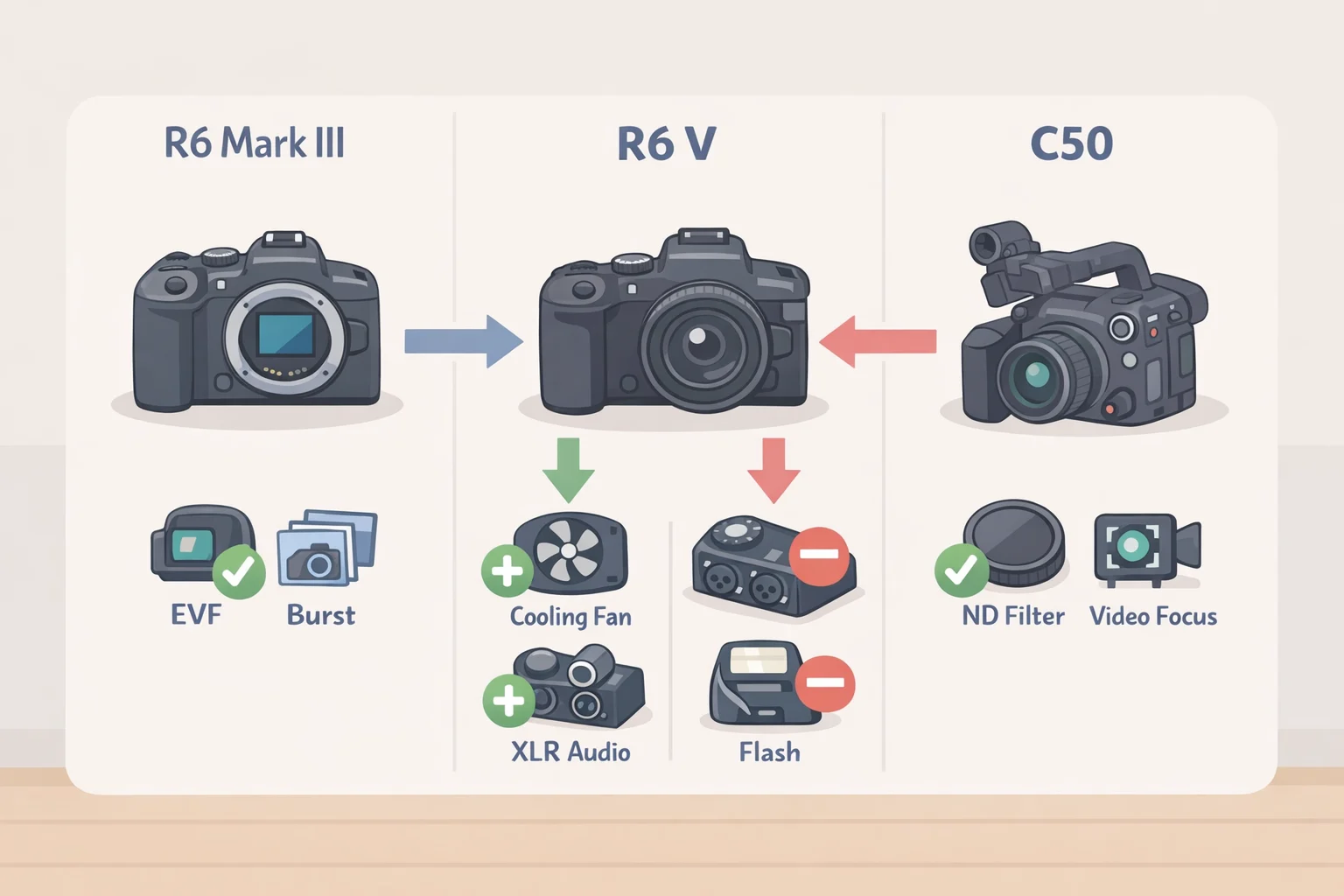
The R6 V sits deliberately between two cameras that share its 32.5MP sensor, Dual Pixel CMOS AF II, dual card slots, and RF mount: the R6 Mark III and the Cinema EOS C50, as Photo Review documents. Fstoppers frames the R6 V as the R6 Mark III stripped of photographer staples, then rebuilt with video-specific features added a characterization that maps cleanly onto the spec differences.
What the R6 V adds over the R6 Mark III:
- Active cooling fan enabling 2+ hours of 7K without thermal interruption (the R6 Mark III has no fan)
- Vertical UI, side tripod socket, tally lamp, body-integrated zoom lever
- USB Power Delivery for sustained external power during streaming
- Simultaneous 7K RAW + 2K proxy dual-card recording
What the R6 Mark III keeps that the R6 V loses:
- 3.69-million-dot EVF (the R6 V has none; Digital Camera World confirms there is no option to add an external viewfinder as an accessory)
- Mechanical shutter rated to 500,000 actuations (the R6 V is electronic-only)
- 8.5-stop IBIS vs. 7.5-stop IBIS
- On-camera flash support (Canon has confirmed a firmware fix for flash compatibility is planned, per Fstoppers, but it hasn't shipped)
Against the C50, the calculation shifts differently. The R6 V undercuts the C50 on price while adding IBIS the C50 lacks a real advantage for rig-free handheld work, per Photo Review. But Photo Review is also direct on where the ceiling sits: the R6 V cannot fully replace the C50 in professional productions, where codec depth, audio routing, and cinema workflow complexity favor the C50 for multi-person or crew-assisted shoots. Best understood as a C50 substitute for solo shooters, not a C50 replacement for productions.
One competitive gap worth noting: PCMag points out the R6 V has no equivalent to Sony ZV-E1's AI camera assistant, which may matter to less experienced creators relying on automated guidance. Direct head-to-head testing against Sony, Panasonic, Nikon, and Fujifilm creator-focused bodies on rolling shutter, battery endurance during video recording, and audio workflow specifically hasn't been published across multiple review sources at time of writing. Those remain open questions for buyers weighing alternatives outside Canon's lineup.
Who should buy the Canon EOS R6 V
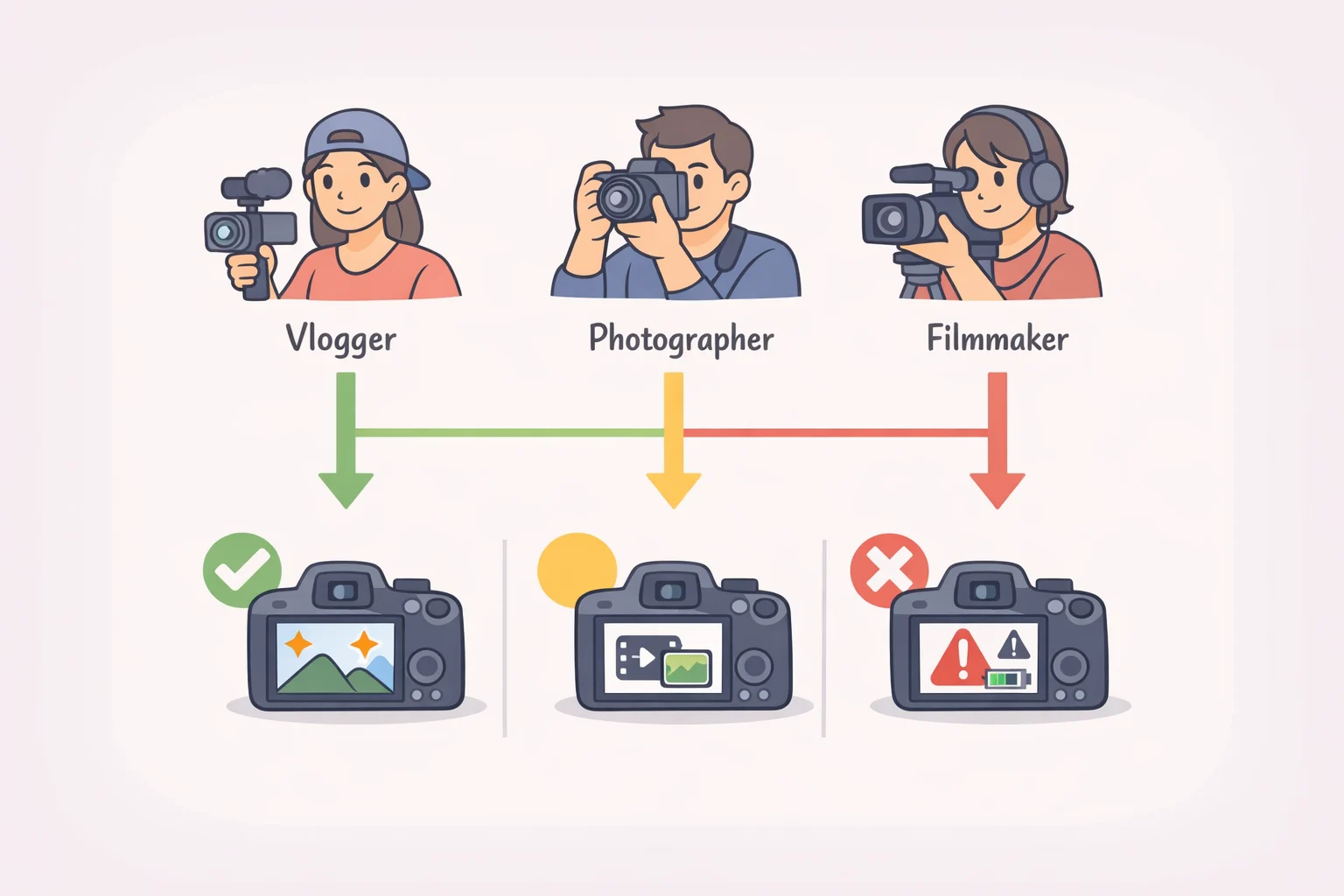
The missing viewfinder and electronic-only shutter aren't dealbreakers in the abstract they depend entirely on your ratio of video to stills work. If you're shooting 80% video and 20% stills, the absent EVF is an occasional inconvenience. If that ratio flips, it becomes disqualifying. No amount of 7K footage quality compensates for a missing viewfinder when you're tracking a moving subject through an eye-level finder you no longer have.
Buy this camera if:
- You shoot solo YouTube, documentary, or long-form interview content handheld or on a mini tripod. The cooling stamina, vertical UI, tally lamp, and one-person control layout are genuinely designed for this workflow.
- You livestream regularly and want to power the camera externally via USB-C while running clean HDMI to a capture card. Per Digital Camera Guru, the R6 V's connectivity package addresses this directly.
- You produce for multiple social platforms and want to shoot once in 7K open gate and reframe for YouTube and TikTok in post. That's a legitimate workflow advantage over standard 16:9-locked hybrid cameras, per Photo Review.
- You need strong stills for thumbnails or campaign imagery alongside video. The 9.0/10 still image quality score and 40fps burst capability are real, even without a viewfinder.
Consider something else if:
- You shoot events or client work requiring flash. The R6 V currently has no on-camera flash support, and the planned firmware fix hasn't shipped.
- An eye-level viewfinder is part of how you shoot stills. There is no option to add one externally a firm limit of the body design, as Digital Camera World notes plainly.
- You shoot a meaningful mix of sports, wildlife, or fast action alongside video. The electronic-only shutter introduces rolling shutter risk in certain scenarios, and the IBIS trails the R6 Mark III by a full stop.
- You're expecting a full cinema-camera replacement. The C50 remains the better tool for professional multi-camera or crew-assisted productions, per Photo Review.
Photo Review gives the R6 V an overall score of 8.9 out of 10, with autofocus and still image quality each rated 9.0. That's a strong verdict for a camera one generation into a new product line. Whether Canon's competitors follow the same logic removing hybrid compromises to serve creators specifically remains to be seen.
At $2,499, this is a serious tool built for a specific kind of shooter. Worth it if your workflow is solo and video-first. A poor fit if you still think in hybrid-camera terms.