MANGMI Air Y specs breakdown: Snapdragon 662 vs 865
MANGMI published the complete MANGMI Air Y specs this week for both the Air Y and Air Y Pro, a pair of vertical, Game Boy-style Android handhelds, according to iXBT Games. No pricing. No release date. Just the full hardware breakdown for two devices that, on paper, are aimed at meaningfully different buyers.
The spec disclosure is the latest in a series of staged reveals. Ten days ago, Notebookcheck reported that MANGMI had told Retro Dodo that pricing and a release timeline would follow in July, with pre-orders possibly opening July 30. That date remains unconfirmed.
What the specs do make clear: the two handhelds share a chassis but diverge on almost everything that determines what they can actually do.
MANGMI Air Y specs vs. MANGMI Air Y Pro specs
Video of the Day
The most immediate difference is physical. The standard Air Y ships with one analog stick; the Air Y Pro has two, Android Authority confirmed last week. For 2D retro titles and pre-analog systems, one stick is sufficient. For anything built around dual-stick input, the base model is a non-starter on ergonomic grounds before the chipset even enters the conversation.
The chipset gap is substantial. The Air Y runs the Snapdragon 662, a budget processor introduced in 2020 that carries the same CPU layout as 2017's Snapdragon 660. The Air Y Pro gets the Snapdragon 865, a 2020 mobile flagship, Android Authority reported this week. These are not adjacent tiers; they represent different categories of device.
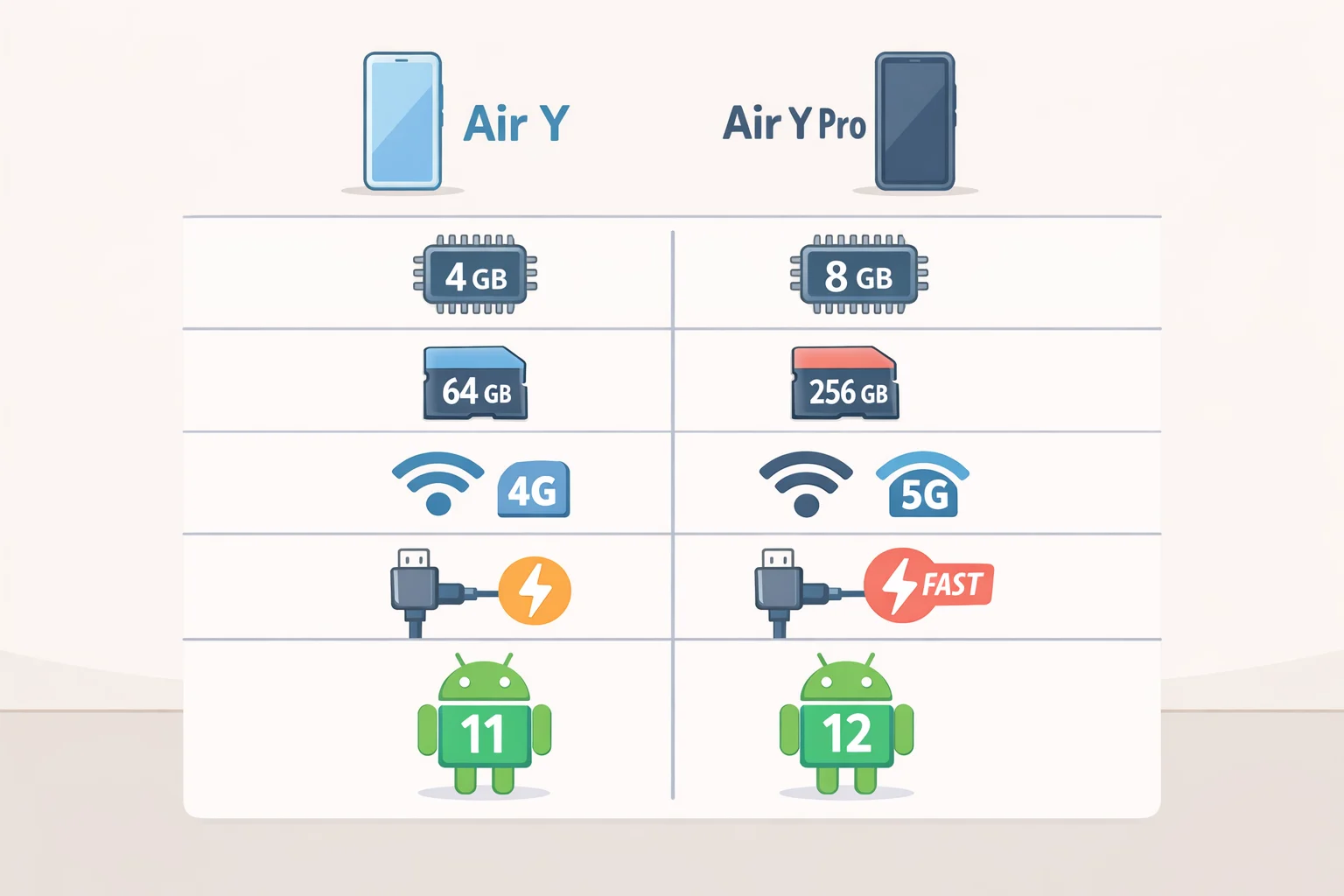
The rest of the spec sheet splits along the same line at every point, per iXBT Games:
- Air Y: 3GB RAM, 32GB eMMC storage, Wi-Fi 5, Bluetooth 5.0, single speaker, 15W charging, Android 14
- Air Y Pro: 4-8GB RAM, 64GB UFS 2.1 or 128GB UFS 3.1 storage (SKU-dependent), Wi-Fi 6, Bluetooth 5.1, dual stereo speakers, 18W charging, Android 13
That storage split on the Pro is worth noting. Not every Pro buyer gets UFS 3.1 the faster tier only comes with the 128GB configuration.
One detail MANGMI has not explained: the base Air Y ships with the newer Android 14, while the more expensive Pro runs Android 13. No rationale has been offered.
Both models share a 5000mAh battery and active cooling. Battery life remains an open question given the very different power demands of the two chipsets.
Video of the Day
What the MANGMI Air Y Snapdragon 662 and Air Y Pro Snapdragon 865 suggest about performance
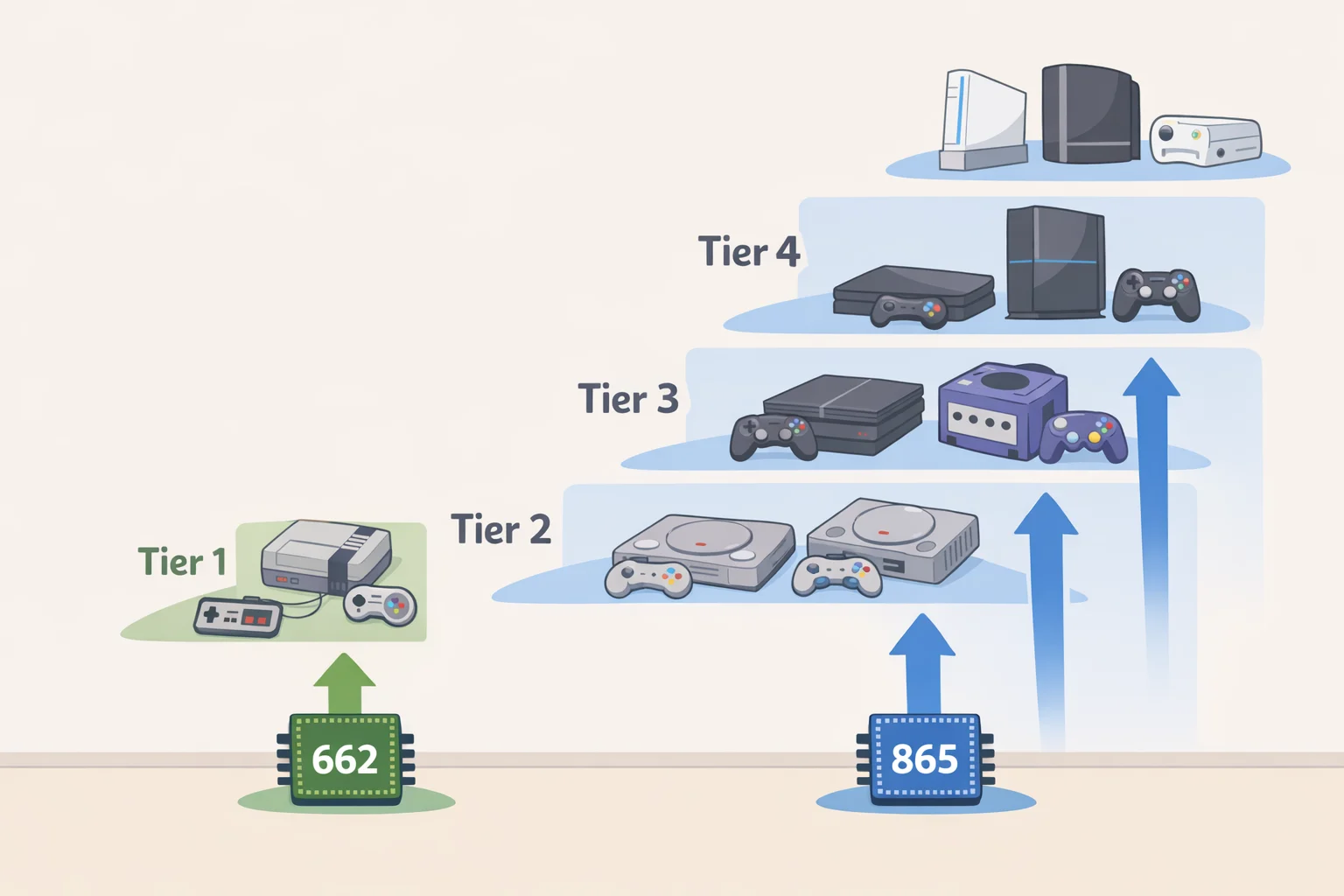
The Air Y's range is reasonably well defined by a direct predecessor. MANGMI's earlier Air X used the same Snapdragon 662, and Android Authority found that sub-$100 device handled everything up to and including PSP emulation. That's a useful baseline for the Air Y: the full 2D retro catalog from Game Boy through GBA, NES, SNES, and Genesis should be well within reach, with PSP workable. Beyond that, the 662's limits, combined with a single analog stick, constrain the device well before it reaches sixth-generation 3D territory.
The Air Y Pro's Snapdragon 865 is a different proposition. Android Authority notes the chip should handle PS2, GameCube, and some PC emulation though those estimates are drawn from the chip's track record in other hardware, not from hands-on testing of the Air Y Pro itself. Two sticks and faster UFS storage on the higher-tier SKU make those targets practically reachable in a way the base model structurally cannot match.
Qualcomm silicon in both models also carries a longer-term advantage: the possibility of custom GPU drivers and stronger developer tooling, per Android Authority. For emulation-focused hardware, driver support can compound over time in ways that raw launch specs don't capture.
MANGMI has existing experience with the 865. The Pocket Max, which launched earlier this year, runs the same chip alongside Android 13, Wi-Fi 6, and UFS 3.1 storage, per the MANGMI Pocket Max product page. That reduces some uncertainty around driver work and board-level integration for the Air Y Pro, though it says nothing directly about how the smaller device will perform or sustain under load.
The display, shell, and what's still missing
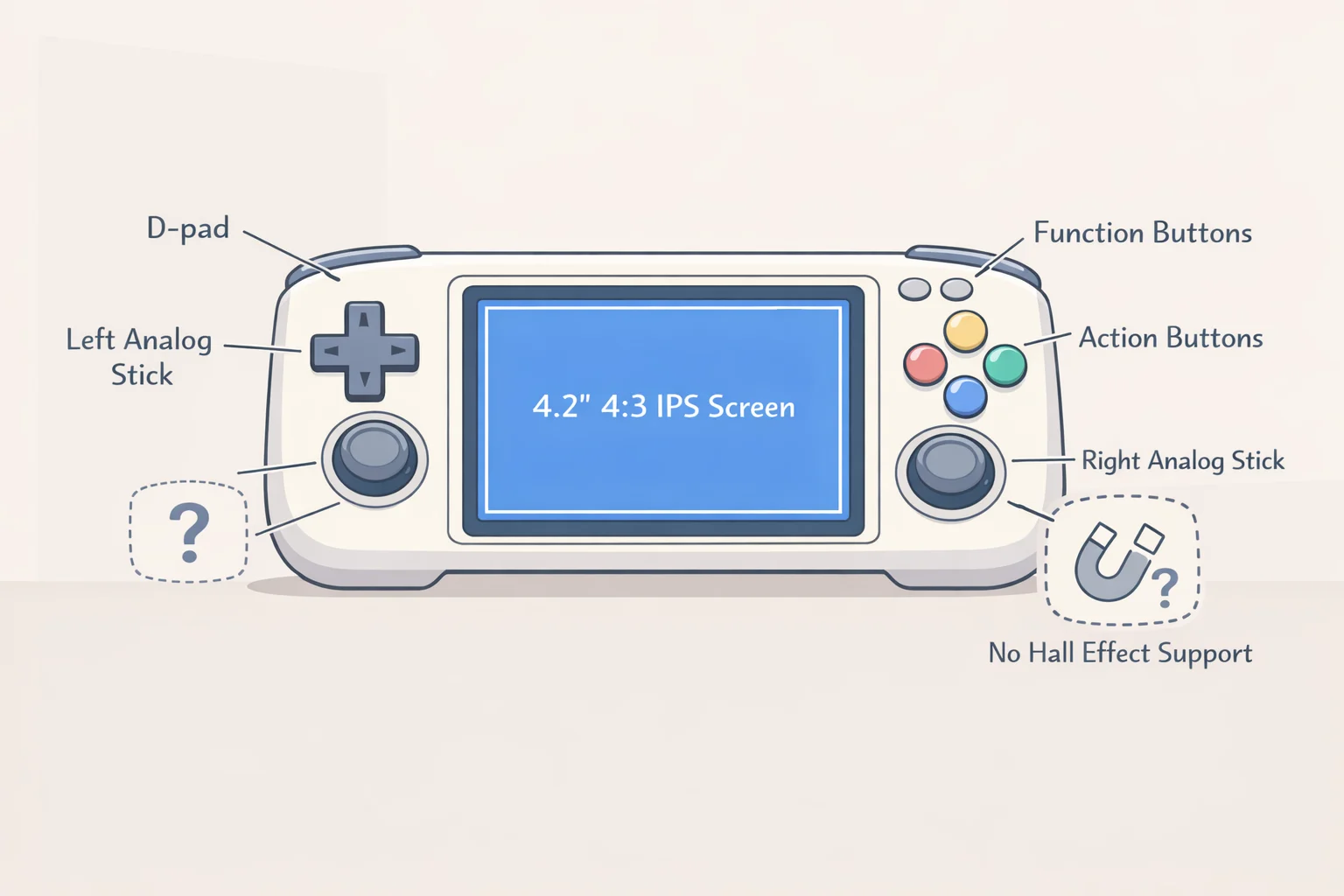
Both handhelds share the same 4.2-inch IPS touchscreen: 1280x960 resolution, native 4:3 aspect ratio, 500 nits, and 110% sRGB coverage, per Android Authority. The 4:3 ratio is a practical choice, not just an aesthetic one. It matches the native output of virtually every system produced before the widescreen era, which means no letterboxing or distortion for the retro content these devices are built around. Touch support handles Android navigation and emulator setup without the workarounds that non-touch handhelds require.
What the spec sheet doesn't confirm: refresh rate, response time, panel lamination, and outdoor legibility beyond the 500-nit figure. Hall-effect sticks and triggers are also absent from the Air Y spec list, which is notable given that MANGMI used Hall-effect hardware on the Pocket Max, per the MANGMI Pocket Max product page.
Physically, the two models are nearly identical. Same dimensions (144.84 x 94.64 x 23mm), weights within 7 grams of each other at 279g and 286g, and a shared hardware list that includes active cooling, USB-C, microSD slot, 3.5mm jack, customizable button, volume wheel, and 6-axis gyroscope, per iXBT Games. A design teaser showed curved shoulder buttons, a metallic side wheel, contrasting face buttons, and a front logo with a breathing light, Android Authority reported last week signals that MANGMI is treating this as a styled product rather than a bare-bones retro box.
What pricing will determine

The spec sheet draws a clear enough line. The Air Y is a compact 2D retro device with a ceiling around PSP. The Air Y Pro has the chipset, controls, and storage configuration to reach meaningfully higher, assuming the performance estimates for the 865 hold in practice.
The practical questions that remain unanswered are price, release timing, SKU clarity on the Pro's storage tiers, and real-world battery figures for two chips drawing against the same cell. Android Authority noted the Air X, which shared the 662, landed under $100. Whether MANGMI hits a similar mark with the Air Y, and how it prices the Pro against other Snapdragon 865 hardware already on the market, will determine whether either device is actually competitive.
Pre-orders may open July 30, per Notebookcheck unconfirmed, and still nine days out. That's when the real comparison starts.