Online Scam Losses 2025: Why 8B Dwarfs FBI's .8B Count
Americans lost an estimated $148.2 billion to online scams and fraud in 2025, according to a Consumer Federation of America report published this week more than seven times the $20.8 billion the FBI's Internet Crime Complaint Center recorded for the same year. That gap isn't a measurement dispute. It reflects something more fundamental: official tallies count victims who reported, not victims who were harmed.
The FTC, which runs a separate complaint system, recorded roughly $16 billion in reported fraud losses in 2025 a record for that agency, up about 25% from 2024, per FTC data from last month. The FTC and FBI numbers aren't directly comparable; each captures a different population of victims who chose different agencies to report to. Together they define a floor for formally documented harm. CFA's $148.2 billion figure attempts to project what lies above it.
That estimate is a modeled extrapolation built on IC3 complaint data, scaled upward to account for the large share of victims who never file a formal report. The full methodology, including specific multipliers, is not publicly detailed in CFA's press release so treat it as an indicator of likely scale, not a precise accounting, per CFA.
Why FBI IC3 online scam losses 2025 understate the damage
Video of the Day
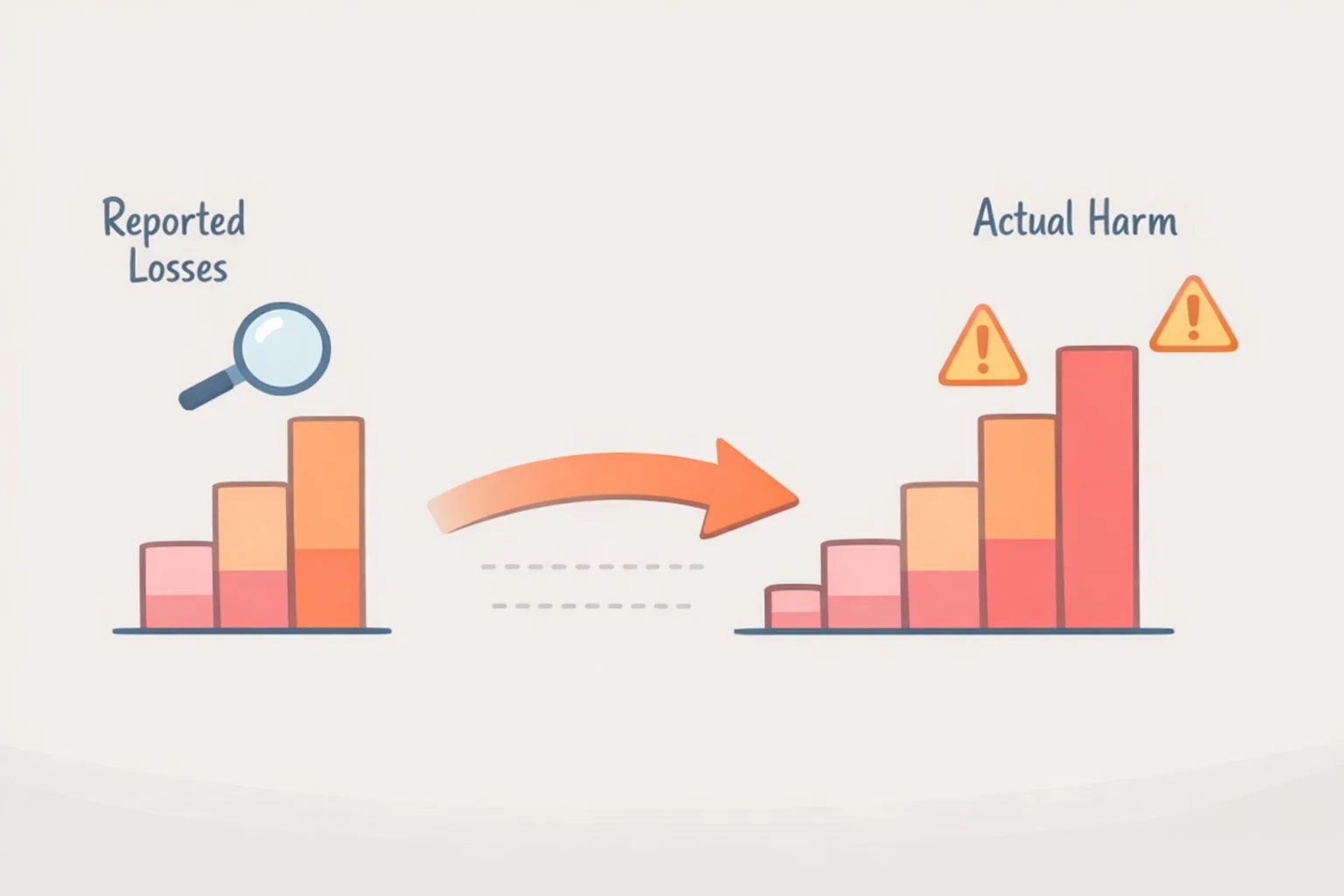
The FTC's $16 billion and the IC3's $20.8 billion diverge because the two agencies use different intake systems, complaint categories, and reporting populations not because they're measuring the same victims twice. Both figures are floors, built from whoever chose to report.
FTC complaint patterns help explain why those floors stay low. The agency received 2.6 million fraud reports in 2024, roughly flat from 2023, but the share of reporters who said they actually lost money jumped from 27% to 38%, per FTC data from last year. Report volume held steady; per-victim losses climbed sharply. Scams aren't just spreading they're getting better at extracting money from the people they reach.
Victims who don't realize they've been defrauded, who feel embarrassed, or who don't know where to report never appear in those figures. The official counts measure willingness to report. CFA's estimate attempts to model everyone else.
Video of the Day
Where losses concentrate: social platforms and payments that can't be undone

Social media is now the dominant scam channel by reported dollar losses. Nearly 30% of people who told the FTC they lost money to a scam in 2025 said the contact started on social media, with reported losses from those scams reaching $2.1 billion more than any other contact method, and about eight times the figure from 2020, per FTC data from three months ago. Facebook alone generated more reported losses from social-media-originated scams than text messages and email combined. WhatsApp and Instagram were a distant second and third, per the FTC.
Social media's reach spans nearly every generation. FTC data show that every age group from 18 to 29, and from 50 to 79, ranked social media as the top contact method by dollar losses. For adults 30 to 49, it was second, behind websites and apps. Only those 80 and older ranked it third, behind phone calls and websites, per FTC data from three months ago. This exposure runs across generations and levels of digital experience.
Payment method explains why so many of those losses stick. In 2024, consumers reported losing more to scams paid via bank transfer or cryptocurrency than through all other payment methods combined, per the FTC. On the crypto side specifically, IC3 recorded $11.4 billion in reported cryptocurrency fraud losses in 2025; CFA's modeled estimate places the true figure near $80.7 billion, per CFA. Crypto and bank wire transfers share one critical feature: transactions are extremely difficult to reverse once the money moves.
That irreversibility also suppresses reporting. A scam that begins on a social platform, migrates to a direct message, then routes payment through a crypto wallet leaves victims with limited recovery options and, often, limited incentive to file a formal complaint.
AI-enabled fraud losses 2025 and the impersonation surge

Imposter scams fraudsters posing as government agencies, banks, or familiar businesses were the single most reported fraud category in 2025, accounting for $3.5 billion in reported losses and nearly one in three FTC fraud reports. Reported losses from imposter scams have nearly tripled since 2020, per the FTC. Bank impersonation alone approached $1 billion; government impersonation added another $920 million.
CFA tracked AI-enabled fraud as a distinct category for the first time in this report, attributing $6.3 billion to technology that generates synthetic identities, fake social profiles, and personalized outreach at scale, per CFA. Because 2025 is the first year this category was measured, no trend comparison exists. The figure is a baseline.
What the AI category points to is a capacity shift. Traditional fraud operations were constrained by how many convincing personas a human team could sustain. Automated tools that generate synthetic profiles and maintain personalized conversations at scale remove that constraint. Nearly 60% of people who reported romance scam losses in 2025 said the scam originated on social media, per the FTC. Consumer advocates say romance scams are a plausible use case for AI-generated personas the kind of extended, individualized interaction that makes those scams convincing enough that victims often don't recognize what's happening until after the money is gone.
Who absorbs the losses
Adults 60 and older accounted for the largest reported losses of any age group in 2025. Their reported losses grew more than 60% year-over-year, with the average reported loss per incident reaching $38,500, per CFA. Senator Mark Kelly cited the findings in connection with his bipartisan Senior Chatbot Protection Act, which would require companies to disclose when consumers are interacting with AI rather than a person. "Seniors are the top target for online scams, and AI is making those scams more convincing and harder to spot," Kelly said.
The fastest-growing exposure, by percentage, sits at the other end of the age spectrum. The under-20 group saw a 198% surge in reported losses from 2024 to 2025 the largest percentage increase across any demographic though total dollar losses for that group remain the smallest of any age bracket, per CFA.
The demographic spread matters for the underreporting problem. Younger victims and older victims both have well-documented reasons not to file formal complaints embarrassment, unfamiliarity with reporting systems, uncertainty about whether they were actually defrauded. As exposure widens across age groups, the gap between what's reported and what actually happened widens with it.
The enforcement gap

The FTC's Impersonation Rule, finalized in 2024, has produced roughly a dozen enforcement actions and returned more than $70 million to defrauded consumers, per the FTC. Set that against $3.5 billion in reported impersonation losses alone in 2025, and the math is blunt: about two cents recovered for every dollar reported lost, based on FTC figures. Against CFA's modeled total, the ratio gets considerably worse.
The policy pipeline is active. CFA identifies the SCAM Act in Congress, the Senior Chatbot Protection Act, and legislative activity in multiple state capitals as responses to the crisis, per CFA. Platform accountability requiring social media companies to bear more responsibility for fraud that originates on their services is a central and unresolved question across each of those efforts. "Tech companies are too often allowed to avoid accountability," said Ben Winters, CFA's Director of AI and Privacy, per CFA. Whether that characterization becomes the basis for law remains to be seen.
An AP-NORC poll cited by CFA found that 58% of American adults now report receiving a suspected scam attempt every day. Enforcement actions that shut down individual schemes don't address that frequency they remove specific operators from an infrastructure that remains intact.
What the 2026 data will tell us
Three conditions characterize the highest-risk encounters in this data: initial contact through social media or direct messaging, pressure to move the conversation off-platform, and a request to pay via cryptocurrency or bank transfer. Each step moves a victim further from any recovery mechanism, per FTC data.
The AI-enabled fraud figure is the number to watch going forward. At $6.3 billion, it's a first measurement, not a trend. When 2026 data arrives, whether that number grows, plateaus, or gets revised will be the clearest early signal of whether AI is genuinely reshaping the fraud economy or whether the initial measurement captured something narrower than the label suggests, per CFA. The SCAM Act, the Senior Chatbot Protection Act, and state-level legislation represent a real policy response but the distance between $70 million in consumer redress and hundreds of billions in estimated losses defines how much ground that response still needs to cover.
Victims who encounter that three-step pattern can report to the FTC at ReportFraud.ftc.gov. It moves the official floor a little closer to the ceiling.