How Often Should You Replace Household Appliances: Repair vs. Replace
Most people replace appliances the wrong way: they wait for a breakdown, panic, and buy whatever ships fastest. Appliance News reported this month on Consumer Reports survey data showing 60% of households had a large appliance stop working in the previous five years of those who replaced it, 26% had already tried to repair it and failed. That's a lot of money spent without a plan.
The question itself has no calendar answer. Appliances don't expire on a schedule. A refrigerator still running at year 13 isn't due for replacement; it's earning its keep. The useful question is whether an appliance has enough reliable life left to justify fixing it. Right now, with major manufacturers raising prices 3.5% to 12%, that math is shifting toward the service call more often than the sticker shock suggests.
This guide covers expected lifespan by appliance type, a practical repair-vs.-replace decision framework, and the specific maintenance habits that extend appliance life most reliably.
How long do household appliances last, by type
Video of the Day
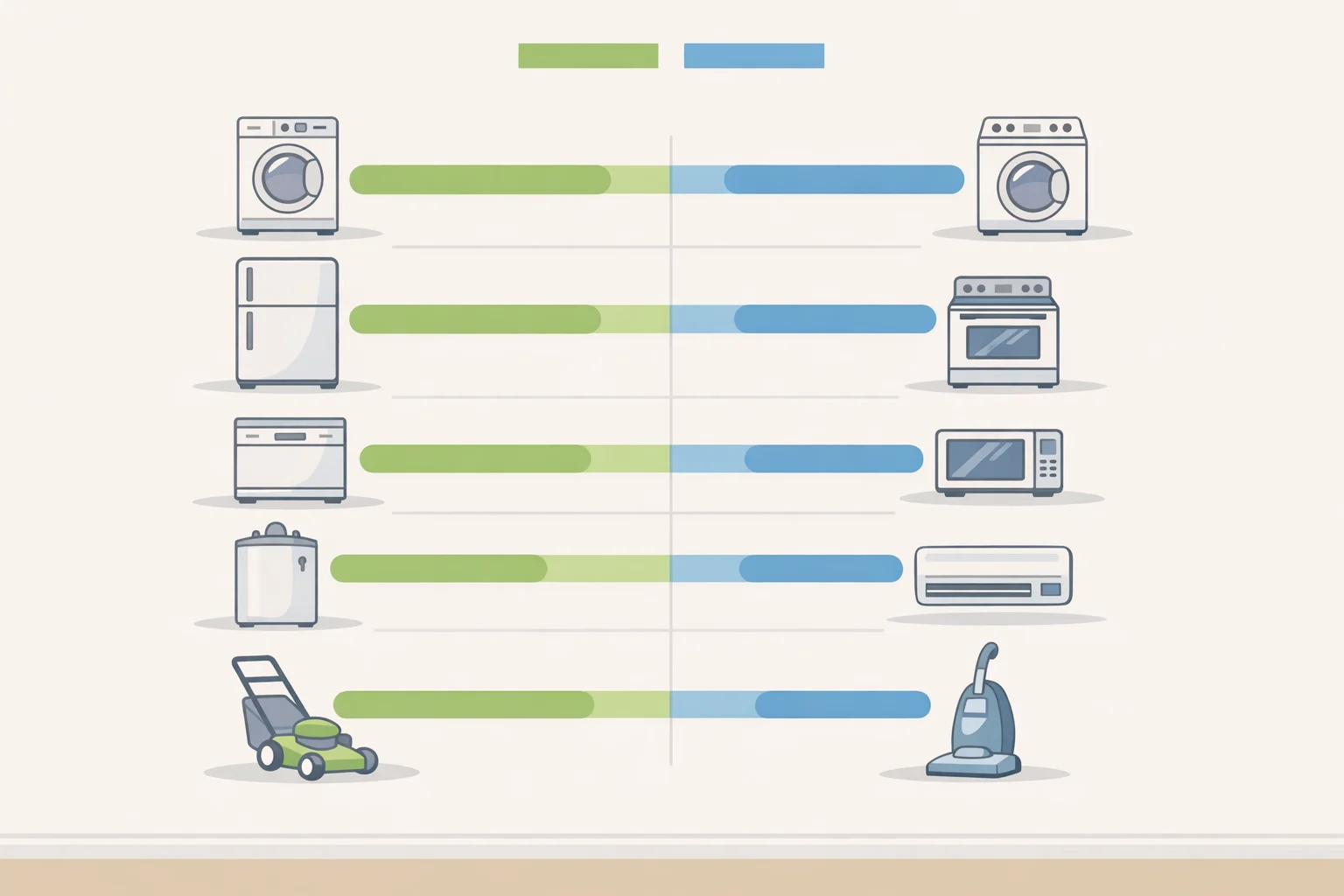
The ranges below aren't retirement dates. They're spans that maintenance, water quality, and usage patterns can compress or stretch considerably.
| Appliance | Typical range | Best-case (well maintained) |
|---|---|---|
| Refrigerator (standard) | 10–15 years | 18–20 years |
| Washing machine | 10–13 years | 18 years |
| Clothes dryer (gas) | 13 years | 18 years |
| Clothes dryer (electric) | 13 years | 16 years |
| Dishwasher | 9–12 years | 15 years |
| Gas range | 15+ years | 20+ years |
| Electric range | 13 years | 18 years |
| Microwave (over-range) | 9 years | 12 years |
| Tank water heater | 10–12 years | 15 years |
| Tankless water heater | 18–20 years | 25 years |
| Central AC / heat pump | 12–15 years | 20 years |
| Gas furnace | 18 years | 25 years |
Sources: Remove and Replace, Appliance News both published this month
The National Association of Home Builders puts refrigerators and dryers at around 13 years, washing machines at 10, dishwashers and microwaves at roughly 9, electric ranges at 13, and gas ranges at 15, per Appliance News this month. At the far end of the durability spectrum, gas furnaces and tankless water heaters reach 18 to 25 years; central AC and heat pumps land at 12 to 15; tank water heaters typically clock out at 10 to 12, per Remove and Replace this month.
The gap between average and best-case is mostly explained by maintenance and water chemistry, not brand. A refrigerator that averages 13 years can push 18 to 20 with regular coil cleaning; soft-water homes routinely get a washing machine to 18 years, per Remove and Replace.
Modern appliances are also more complex and, by many measures, shorter-lived than older ones. An industrial designer at RKS Design, a firm that has worked with nearly every major appliance brand, told Wirecutter last year that today's refrigerators, packed with circuit boards, electronics, and pressurized systems, rank among the most complex consumer products made, and that appliance life cycles keep shrinking. A feature-heavy model with an in-door ice and water dispenser may fail in as few as five years, per Checkbook last month. Manufacturers have told Consumer Reports they expect their products to last roughly 10 to 12 years, a lower bar than most buyers assume, per Checkbook. Washing machine projected lifespan has dropped from around 10,000 cycles historically to somewhere between 2,000 and 3,000 cycles today.
Worth keeping in mind: appliances built around fewer electronic components, gas ranges, chest freezers, gas furnaces, consistently outlast their feature-heavy counterparts. Simpler machines break less.
Video of the Day
When to replace major household appliances: the repair-or-replace decision
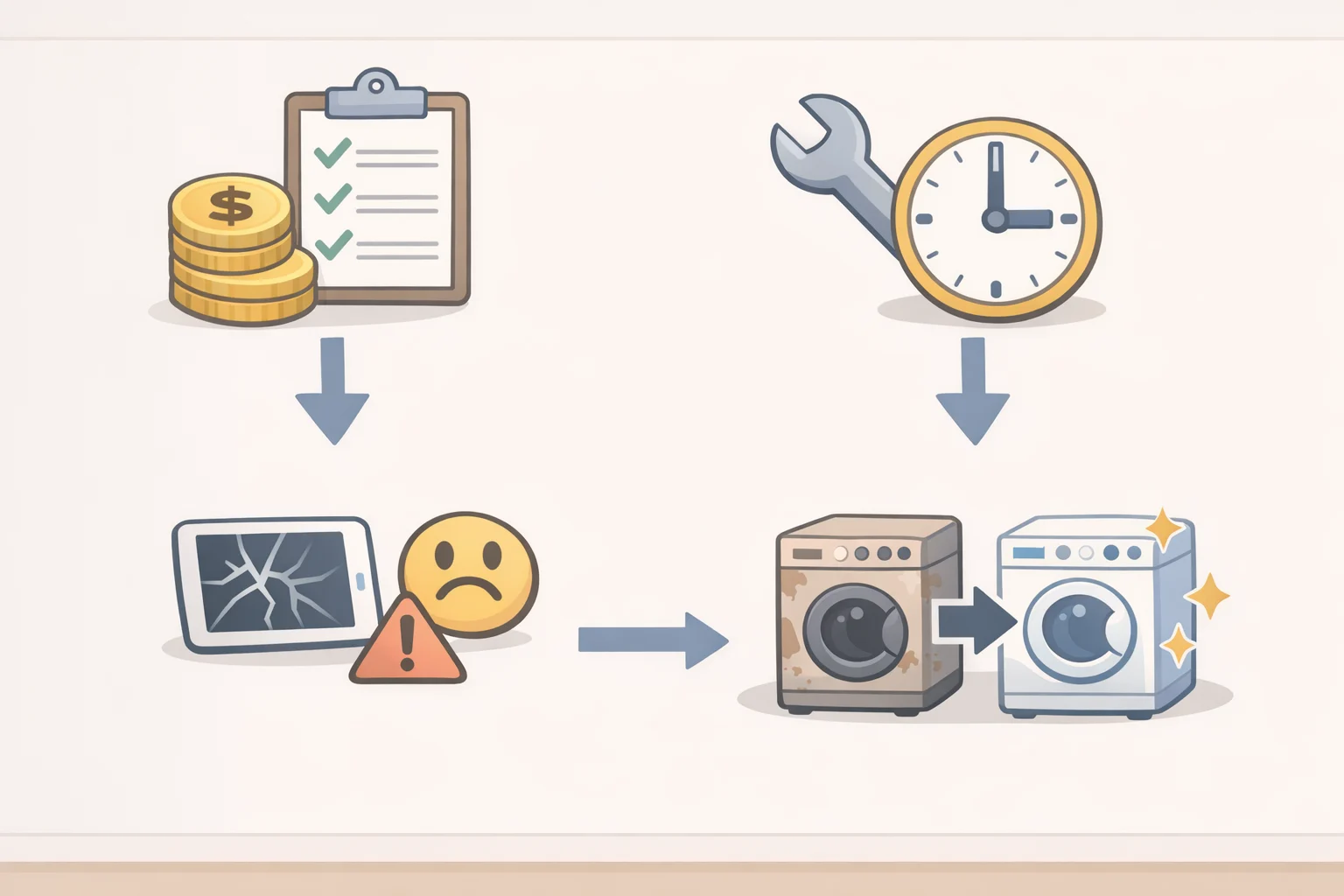
When something breaks, run through these four checks before calling for a delivery truck.
Step 1: Check the age. If the appliance is under roughly 70% of its expected lifespan, repair almost always deserves a serious look, per Appliance News this month. A 10-year-old dishwasher with a 12-year lifespan is at 83%; the calculus tightens considerably. A 6-year-old washer with a 13-year lifespan is at 46%; repair is strongly favored before running any other numbers.
Step 2: Compare repair cost to total replacement cost. The standard rule: if the repair runs more than about 50% of what a comparable new unit would cost, and the appliance is past the midpoint of its expected life, replacement deserves serious consideration, per Appliance News. That replacement cost is not the shelf price. Delivery, haul-away, water line or gas hookup work, and electrical changes can all add $150 to $400 on top of what's listed, per Appliance News.
Current pricing is shifting this math. Yale Appliance data cited by Appliance News this month showed six major manufacturers, ASKO, GE, KitchenAid, LG, Whirlpool, and Bosch/Thermador, raised prices between 3.5% and 12% between June 1 and August 1, driven by tariffs. The practical effect: a six-year-old front-load washer with an $850 replacement cost and a $375 repair sits at 44%, already under the threshold. Add a 9% price increase and that replacement runs about $927; the same repair now represents roughly 40% of replacement cost, per Appliance News.
Step 3: Identify the failure type. Not all repairs are created equal. Parts under $60, a fridge start relay ($15), a dishwasher drain pump ($30–60), a washer door seal ($40–80), a water heater anode rod ($20–40), are nearly always worth fixing on a unit under 10 years old, per Remove and Replace. The parts that push toward replacement: compressors ($100–500 plus labor), sealed-system refrigerant work ($400–1,200, which requires a licensed technician), and control boards over $250, per Remove and Replace.
For refrigerators specifically, Consumer Reports found repairs succeed on the first attempt about 62% of the time, with another 25% fixed after a second try. Repair typically makes economic sense up to 10 years into ownership, with one exception: budget top-freezer models under $400 approaching a decade of use are often better replaced even at relatively low repair costs.
It also helps to know what's actually failing inside a refrigerator. About 45% of failures trace to the start relay or overload, another 25% to a failed evaporator or condenser fan, around 15% to a control board, and only about 15% to a genuine sealed-system or compressor failure that justifies replacement, per Remove and Replace. Most fridge problems are cheap if caught early.
Step 4: Check parts availability and failure history. A solid repair estimate is worthless if the part is on a six-week backorder. Confirm availability before committing. On failure history: age matters most when it combines with repeat breakdowns, expensive repairs, or safety concerns, per Appliance News. One repair is a data point. A second one on the same appliance is a pattern worth taking seriously.
The strongest repair case has four traits: the appliance isn't near the end of its expected life, the failure is isolated, parts are available, and the repair doesn't involve a known design weakness likely to recur, per Appliance News. The weakest case is an old unit with a major sealed-system failure, multiple prior repairs, and scarce parts.
A reframe that consistently produces better decisions: instead of asking "is it broken enough to replace?", ask "what will it cost to get three to five more reliable years out of it?", per Appliance News.
The maintenance habits that most reliably extend appliance life
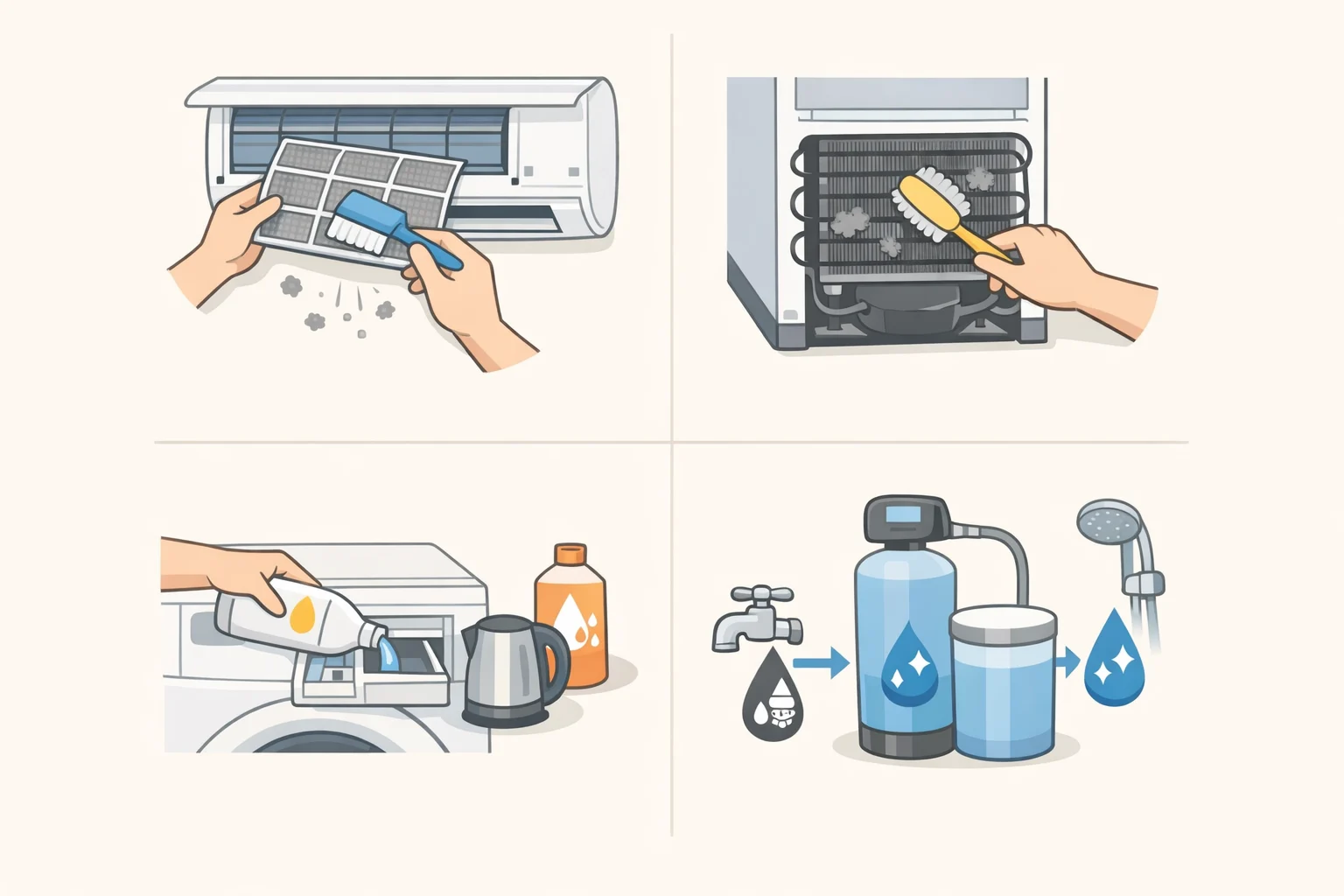
A technician's-eye view of the data is clarifying: roughly 60% of appliances diagnosed as dead had a sub-$50 part failure, not a genuinely worn-out machine, per Remove and Replace this month. Hard water is the single biggest lifespan killer for dishwashers, water heaters, and washing machines; overloading washers while neglecting filters is a close second, per Remove and Replace. Most of what follows targets exactly those failure modes.
Clean filters and coils
Pull the dishwasher filter basket monthly and check the sump for debris, glass shards, bones, label fragments. About 50% of "dead" dishwashers opened by technicians had a failed drain pump or clogged filter, another 20% had a bad heating element, and only about 15% had a control board failure serious enough to justify scrapping the machine, per Remove and Replace this month. The monthly filter check is the single most common thing that prevents a premature drain pump replacement.
Refrigerator condenser coils should be cleaned annually, or every six months in a home with pets. A fridge that clicks on and off or runs constantly may be signaling a fan issue, often a $30–80 fix rather than something more serious. About 45% of refrigerator failures trace to the start relay or overload and another 25% to a failed evaporator or condenser fan, per Remove and Replace. Catch either early and the repair stays cheap.
Control water quality
In hard-water areas, run a descaling cycle in the dishwasher every few months, use a water softener or descaling treatment for the washer, and treat the water heater as a priority.
For tank water heaters, swap the anode rod around year five. It's a $20–40 part, and replacing it can effectively double the tank's useful life, per Remove and Replace, which is precisely why the average sits at 10 to 12 years while well-maintained units reach 15. Flush the tank annually to clear sediment. Skip the anode rod and water chemistry degrades the tank lining on a predictable schedule; there's nothing surprising about the failure when it comes.
Avoid overloading and short-cycling
About 40% of early washing machine deaths traced to bearing failures accelerated by overloading, and another 30% to drain pumps clogged with coins and lint, per Remove and Replace this month. Run a monthly cleaning cycle, don't exceed the drum's rated capacity, and use rinse aid in the dishwasher consistently to protect the heating element.
For AC and heat pumps, address short-cycling immediately. Each unnecessary start cycle is cumulative wear that compounds over years. Central AC runs 12 to 15 years on average; well-maintained units can reach 20, per Remove and Replace. Annual professional maintenance is what keeps a unit in that upper range rather than the lower one.
What to do when an appliance breaks down
Use this sequence before making any purchase decision:
- Age check. Compare the appliance's age to its typical lifespan from the table above. Under 70% of expected life? Repair strongly favored, per Appliance News this month.
- Repair estimate vs. true replacement cost. Get a repair quote, then price out the actual replacement including delivery, installation, hookups, and haul-away. Apply the 50% rule to the real number, not the shelf price, per Appliance News.
- Failure type. Cheap, isolated parts favor repair. Compressors, sealed systems, and control boards over $250 shift the equation toward replacement, per Remove and Replace.
- Parts lead time. Confirm availability before committing to the repair, per Appliance News.
- Failure history. Repeated breakdowns outweigh age as a replacement signal, per Appliance News.
Replacement costs are higher than they were a year ago. With six major manufacturers having raised prices up to 12% this summer, the figure in any mental math about a new appliance may already be stale, per Yale Appliance data cited by Appliance News this month. Manufacturers build for 10 to 12 years, per Checkbook last month, which makes proactive maintenance more valuable now than it used to be. The anode rod, the filter basket, the condenser coils: none of it is complicated, and the gap between average and best-case lifespan is largely explained by whether anyone bothered.
The first question when something breaks isn't "should I replace this?" It's "what will it cost to get three to five more reliable years out of it?"