TikTok Perez Hilton Livestream Moderator Error: What We Know
TikTok says a "moderator error" delayed the removal of a livestream that appeared to show blogger Perez Hilton harming himself, and the company has not publicly described what the error involved. Automated systems flagged the video within minutes, according to TikTok spokesperson Jamie Favazza, but the stream stayed up for roughly 15 minutes before it came down (The Verge). That gap between detection and removal is the core of the TikTok Perez Hilton livestream moderator error story, and it's the part TikTok has yet to explain.
TikTok says it alerted law enforcement right away and banned Hilton's account for violating its Community Guidelines (The Verge; FOX Business). Separately, sheriff's deputies in the Miami area said they responded to multiple calls, located Hilton at his home, spoke with family members on scene, confirmed he was alone, and had Miami-Dade Fire Rescue transport him to a hospital (TheWrap). Hilton's family posted a statement on his site saying he is receiving medical care and asking for privacy.
This isn't a diagnosis of what "moderator error" means. TikTok hasn't said, and the cited reports do not fill that gap. What follows is a look at what the company disclosed this week, what its own transparency data does and doesn't establish about how moderation performs under pressure, and how a separate round of layoffs, reported the same day, complicates the picture without explaining it.
Why TikTok's delayed removal of the Perez Hilton livestream remains unexplained
Video of the Day
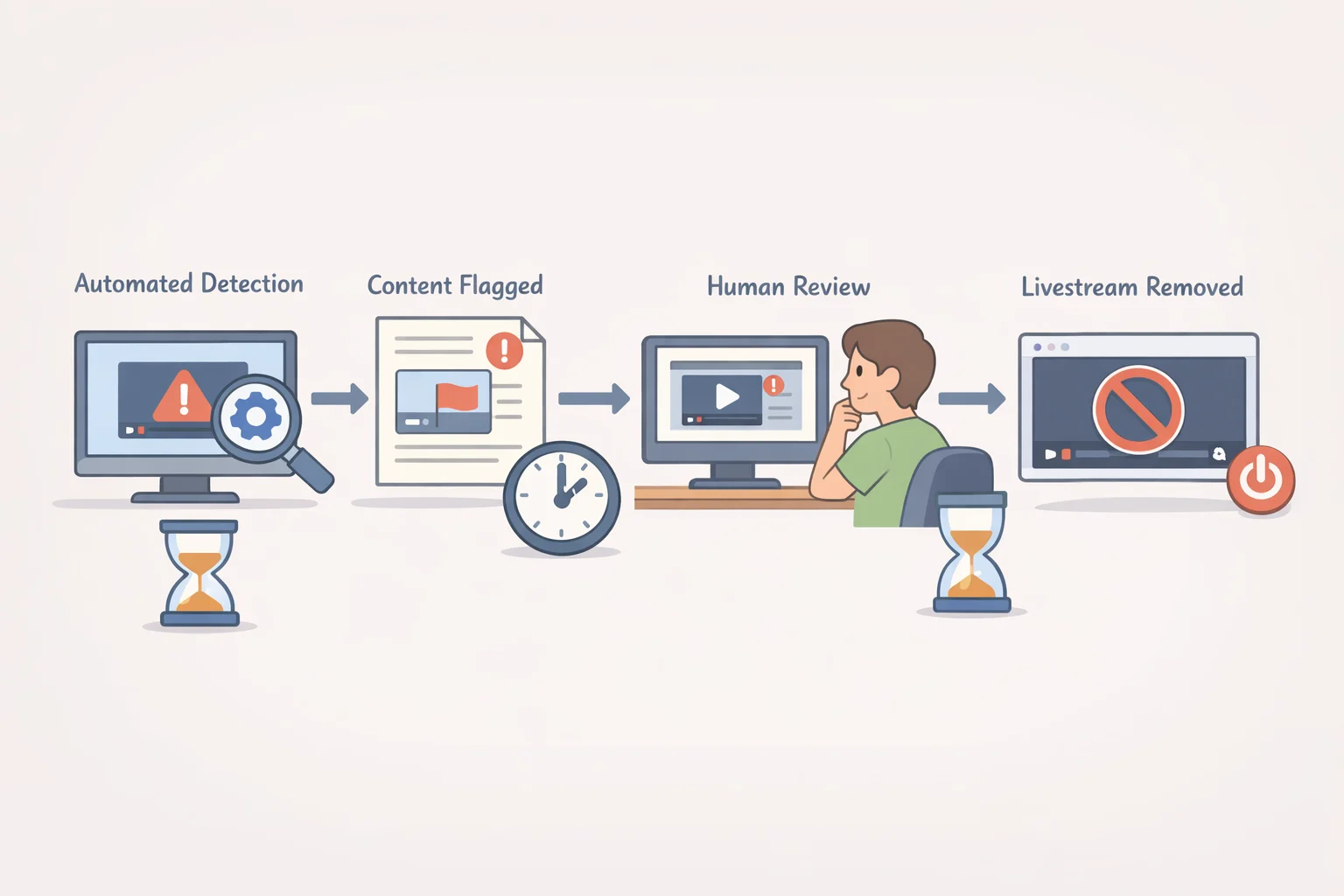
Favazza told The Verge that automated systems flagged the video "within minutes" and routed it to TikTok's U.S. moderation team, where a moderator error held up the takedown (The Verge). The company disputes claims circulating online that the stream ran for 30 minutes, telling reporters it was live for about half that, roughly 15 minutes (TheWrap). None of TikTok's statements to reporters included timestamps showing when the flag, the human review, or the actual removal took place.
TikTok says it moved much faster once Hilton's account was already under scrutiny. Several livestreams he started afterward were removed within 90 seconds (FOX Business; TheWrap). TikTok cited the later removals as evidence that it responded more quickly afterward. Based on the company's own figures, that's roughly ten times faster than the original stream came down, though there's no independent verification of either number.
TikTok's rules leave little room for interpretation here. Its Community Guidelines state: "We want TikTok to be a place where you can discuss emotionally complex topics in a supportive way without increasing the risk of harm. We don't allow showing, promoting or sharing plans for suicide or self-harm" (TheWrap). The company's automated system flagged the video correctly and fast. What TikTok hasn't clarified is where enforcement stalled somewhere after automated detection and routing, before a human decision actually got made.
Every fact in this timeline, the minutes-to-flag, the 15-minute duration, the 90-second follow-ups, comes from TikTok's own statements to reporters. That doesn't make the account false. It means the sequence is the company's telling of its own failure, not a chronology independently verified from server logs or third-party review.
Video of the Day
What TikTok's transparency data can, and can't, establish

TikTok has published aggregate figures suggesting its moderation systems generally work well at scale, though "well" needs unpacking. Its most recent transparency report under the EU's Digital Services Act says automated systems "actioned" 93.8% of all violating content without human review between July and December 2025, out of roughly 112 million pieces of content removed across the bloc during that period (TikTok Newsroom).
"Actioned without human review" is a narrower claim than it sounds. It describes how much removal work automation handled on its own, not whether automation caught every violation that existed, and not how quickly any of it happened. The report also says 97.6% of automated enforcement decisions were later confirmed correct, which is a quality check on outcomes, not a measurement of how fast a flagged item reaches a human reviewer.
None of that data speaks to the specific sequence at issue in Hilton's case: automated detection, routing to a regional team, human review, removal, account suspension, and notifying law enforcement. TikTok's transparency report covers Europe, not the United States, and content moderation broadly, not livestreams or self-harm cases in particular. High accuracy in aggregate says nothing about how long the human-review step took when it mattered here.
TikTok has been publishing these reports voluntarily since 2019, and the company has talked about improvement before. A statement from four years ago said TikTok had made "significant strides" in the "efficacy, speed, and consistency" of enforcement, while acknowledging that safety work has "no finish line" (TikTok Newsroom). The 2026 report does update the company's aggregate accuracy figures for Europe. What it doesn't offer, then or now, is anything specific about U.S. livestream review speed, which is exactly the gap this week's incident exposed.
Layoffs add context, not an explanation

The Verge, citing a New York Times report, said TikTok US is laying off 250 employees and closing its Nashville office, where part of TikTok's content-moderation team was based (The Verge). The news broke the same day TikTok addressed the delay publicly. TikTok has separately confirmed that Hilton's livestream was routed to its U.S. moderation team for review (The Verge; TheWrap).
Nashville housed part of that broader U.S. moderation operation, not necessarily the specific reviewers or queue that handled Hilton's stream. Nothing in the available reporting establishes that the two are the same team, and the supplied reports do not connect the layoffs to this incident. TikTok hasn't suggested staffing played any role in the delay.
The timing is notable on its own terms, even without a proven link. A company trimming its U.S. content-moderation footprint is the one now being asked to explain why a flagged self-harm livestream took roughly 15 minutes to come down.
What's still missing

TikTok's account establishes a sequence: flagged fast, live too long, later streams cut quickly. It doesn't establish a mechanism. The company hasn't said whether the delay came from a misrouted queue, a reviewer who misjudged the video, a staffing gap, or something else entirely, and each of those remains a hypothetical example of what's unexplained rather than a likely cause (The Verge).
Its transparency reporting shows heavy, mostly accurate reliance on automation across Europe. That's a different claim from showing how quickly a flagged, live, self-harm video reaches a human decision-maker in the United States, which is the piece of the process TikTok says broke down this week.
Settling whether TikTok's response was adequate would require details the company hasn't released: timestamps for detection, queuing, human review, removal, account suspension, and law-enforcement notification. Until TikTok publishes that level of detail, or explains why it can't, "moderator error" describes an outcome. It doesn't yet describe a cause.