Signs you are using the wrong motor oil: 4 label checks
Most drivers expect a bad oil choice to announce itself with a knock, a warning light, or some other unmistakable signal. It rarely works that way. The clearest signs you are using the wrong motor oil show up before the engine ever turns over: on the bottle and in the owner's manual. Matching two details, the viscosity grade and the performance standard, settles most of the guesswork before you even open a quart.
The American Petroleum Institute (API) puts it plainly: match both the SAE viscosity grade and the specific API or ILSAC performance standard a manufacturer requires, not a number that simply looks familiar from the last fill-up (API Motor Oil Guide). That guidance matters more than it sounds, because the underlying engineering isn't as simple as "thicker is safer." Lower-viscosity oil reaches bearings, lifters, and cam surfaces faster, cutting the friction and drag that come with a heavier oil, but it can also lose film strength under high heat and load; heavier oil resists flow more, trading some of that efficiency for a thicker cushion between moving parts (Rick's Free Auto Repair Advice). Which side of that trade-off wins depends on the specific engine's clearances and oiling system, not on whichever number sounds sturdier.
That same myth, that a heavier oil offers more protection almost by default, doesn't hold up well under controlled testing either. A mechanic's dyno comparison published earlier this year found real tradeoffs running thin and thick oil in the same engine, with neither grade winning across every measure (Rick's Free Auto Repair Advice). That's one test on one engine, worth noting rather than treating as gospel. This piece walks through four checkable label mismatches for gasoline passenger vehicles, plus one operating clue that only suggests a problem rather than proving one, with brief notes for diesel owners where the rules diverge.
What "wrong motor oil" actually means
Video of the Day
Viscosity measures how easily oil flows at a given temperature. Thinner oil moves faster when cold; thicker oil resists flow more as things heat up (Rick's Free Auto Repair Advice). There's no universally "correct" thickness. The right viscosity is whichever one delivers oil at the right pressure to the right components at the right time, a function of that specific engine's clearances and design (Rick's Free Auto Repair Advice).
Viscosity is only half the requirement. Under API's licensing system, oil marketers may be authorized to display up to three marks: the API Service Symbol, known informally as the Donut, and where applicable, one of two certification marks, the Starburst or the Shield (API 1509). The two certification marks aren't interchangeable. Starburst confirms an oil meets the current ILSAC engine-protection and fuel-economy standard, but it can't be applied to 0W-16 oils; Shield applies only to 0W-16 grades and confirms a separate ILSAC standard (API Motor Oil Guide). So a bottle missing one of the two marks isn't necessarily noncompliant; it may simply carry the mark that fits its viscosity grade. The manual, not the label alone, is the controlling reference.
Think of viscosity as shoe size and the performance category as the shoe's purpose. A perfectly fitted dress shoe is still the wrong choice for a hiking trail.
Video of the Day
Signs you are using the wrong motor oil: four label checks
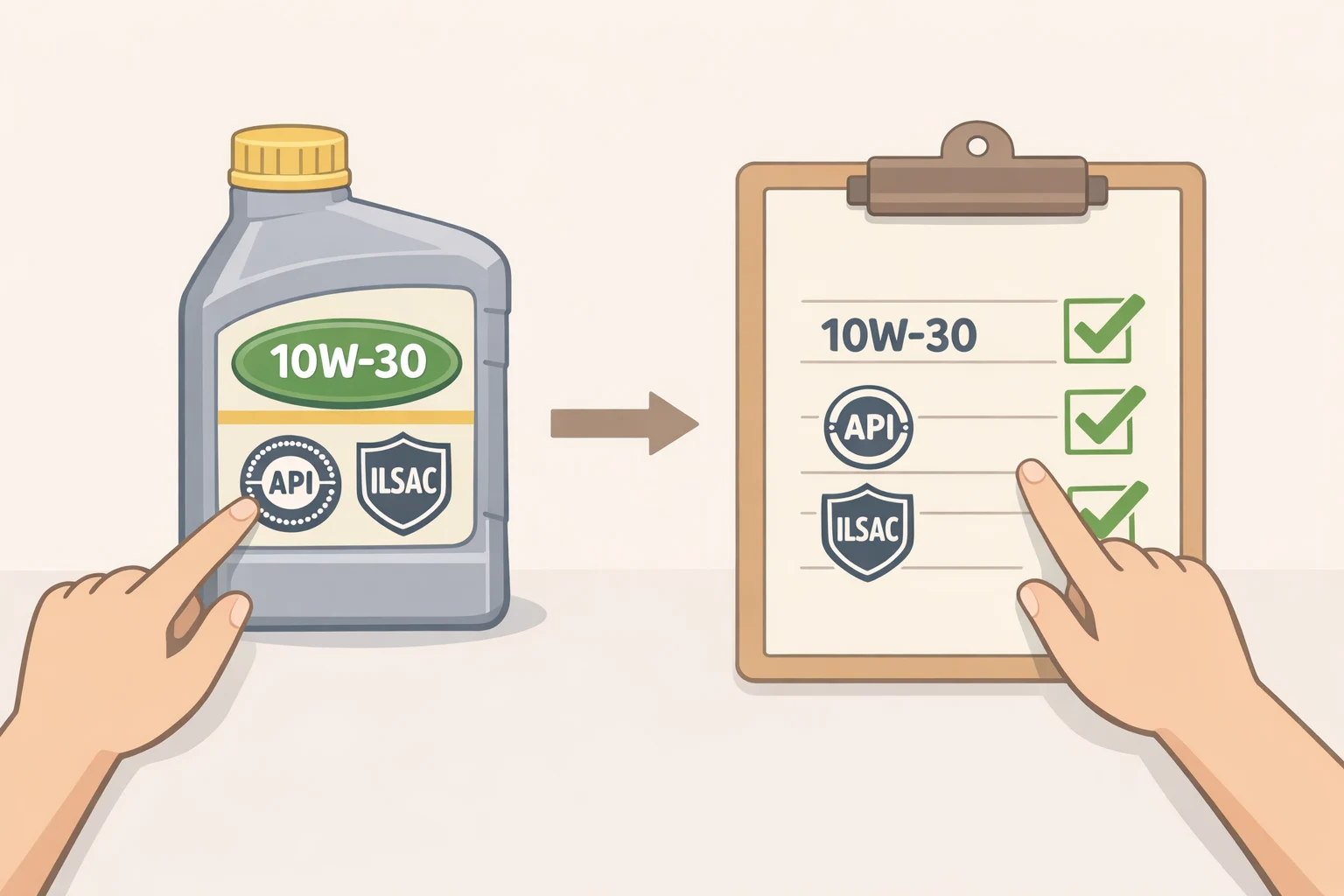
API's own guide includes a section literally titled "5 Signs You're Using The Wrong Motor Oil For Your Car," and four of those checks apply directly to gasoline vehicles (API Motor Oil Guide). Here's how to tell if motor oil is the wrong viscosity or category before it ever goes into the engine.
Sign 1: the SAE grade on the bottle isn't one the manual lists. Requirements vary by vehicle, so the fix is checking the specific recommendation rather than assuming a familiar number still applies (API Motor Oil Guide).
Sign 2: the performance category falls short of what the manual specifies. This one requires some nuance. In some cases a newer API category is defined to include everything an older one required, rather than replacing it outright. API SP, for instance, includes all SN PLUS requirements, and CK-4 and CJ-4 include all CI-4 PLUS requirements (API Motor Oil Guide). So an oil carrying a newer category isn't automatically wrong just because the wording on the label doesn't match the manual word for word. What matters is whether the bottle meets the minimum category and any OEM specification the manual names. Obsolescence still matters in some cases: API SH is already marked obsolete and may not adequately protect against sludge, oxidation, or wear in most gasoline engines built after 1996 (API Motor Oil Guide).
Sign 3: the bottle lists a diesel category but not the gasoline specification your engine needs. "C"-category oils are formulated primarily for diesel engines and may not meet the performance requirements manufacturers set for gasoline engines (API Motor Oil Guide). The problem isn't a diesel category by itself; plenty of bottles carry both a diesel "C" rating and a gasoline "S" rating. The issue is a bottle that lacks the required "S" specification altogether. Diesel owners have their own version of this trap: FA-4 oils aren't interchangeable or backward compatible with CK-4, CJ-4, CI-4 with CI-4 PLUS, CI-4, or CH-4, so checking the engine manufacturer's own guidance is the deciding step there too (API Motor Oil Guide).
Sign 4: the manual names extra wording the bottle doesn't meet. Some manuals go beyond viscosity and category. "Resource Conserving," for example, is a designation API defines specifically for gasoline cars, vans, and light trucks, and widespread use of it may support fuel savings across the vehicle fleet (API Motor Oil Guide). Read the manual's full oil section, not just the viscosity line, and treat any additional wording as a fourth item to match.
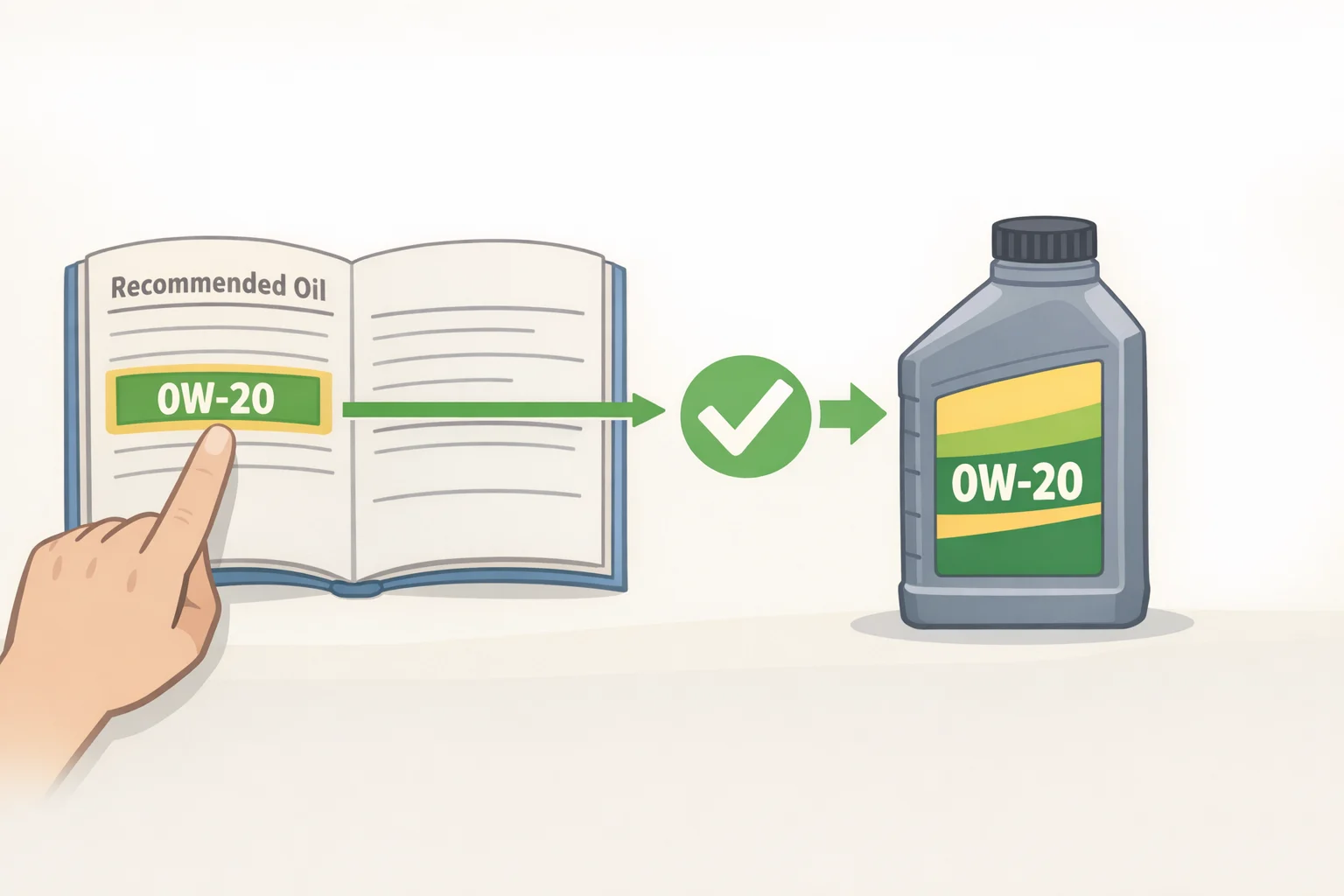
A quick example makes the stakes concrete. Say a manual calls for 0W-20 oil. A bottle labeled SAE 5W-30 fails the viscosity check outright, regardless of what performance category it carries, because that grade isn't among those the manufacturer approved. If the manual also specifically requires a category like API SP, look for a bottle that lists that category or a manufacturer-approved equivalent explicitly. Don't assume an older category is close enough just because the viscosity happens to match.
The fifth sign: an operating clue, not proof

Wrong-viscosity oil can still leave traces in how a car behaves, even before a label check turns up a mismatch. Oil thicker than specified can delay lubrication at cold start and add drag from windage losses at high RPM; oil thinner than specified can lose film strength and shear off loaded surfaces, particularly under high heat and load (Rick's Free Auto Repair Advice). Those mechanics explain what happens if you use oil that's too thick or too thin. But the same symptoms of using the wrong oil in your car, cold-start ticking, a dip in fuel economy, unusual engine heat, also show up with an overdue oil change, a low fill level, or contamination. A symptom alone doesn't tell you which cause is responsible.
The dyno comparison referenced earlier, a mechanic's independent test rather than peer-reviewed research, illustrates why generalizing is risky. Thinner oil produced more horsepower and less drag, but oil analysis showed higher wear-metal readings, more iron and lead, especially during repeated cold starts and high-load running. Thicker oil showed the opposite pattern: lower wear, but a bigger early power penalty that shrank once the oil warmed (Rick's Free Auto Repair Advice). The test explains the mechanism; it cannot identify the cause of a symptom in a particular car, since one engine and one test don't establish what happens in a different vehicle.
That's the deeper point behind the dyno numbers: which viscosity wins depends entirely on that engine's design and operating conditions, not on a fixed rule about thick versus thin (Rick's Free Auto Repair Advice). One test on one engine can't tell a driver what a different viscosity would do in a different vehicle. That's the reason not to chase a viscosity change based on a forum post or a hunch. If a car's behavior changes with no clear explanation, the right move is comparing the label against the manual, or asking a technician to look, not guessing at the cause.
Use the manufacturer recommended motor oil, and check before you pour

Pull three details from the owner's manual before buying oil: the required SAE grade or grades, the API or ILSAC category, and any extra wording the manual specifies, such as "Resource Conserving" (API Motor Oil Guide). Because the manual contains the manufacturer's full specification, check it before relying on the cap alone.
Compare those three items, the grade, the category, and any manual-specified wording, against the bottle's Donut and any Starburst or Shield mark before adding anything to the crankcase. If a top-off means mixing brands, use the same viscosity grade and API service category to keep performance consistent, which is API's own recommendation for blending oils (API Motor Oil Guide). If a full oil change turns out to have used the wrong grade, the wrong category, or missed a manual-specified designation, the sensible next step is asking the manufacturer or a qualified technician whether an early oil change is warranted, rather than assuming either that it's fine or that it needs to come out immediately.
The oil viscosity a manufacturer specifies already accounts for that engine's design, materials, and expected operating conditions. Deviating from it should be a deliberate, documented choice, not a default reaction to a car's age, its mileage, or a noise heard once (Rick's Free Auto Repair Advice).
The practical rule
The wrong oil is defined by a mismatch against what the manufacturer specified, not by how the engine sounds or feels. A viscosity, a category, or a manual-required designation that doesn't match are checkable facts; an operating symptom is a reason to go check, not evidence on its own.
Specifications aren't static, either. API's guide lists some categories as scheduled for obsolescence on October 1, 2026, while SH is already marked obsolete and unsuitable for most gasoline engines built after 1996 (API Motor Oil Guide). Check the current manual rather than assuming an older label remains acceptable.
Photograph the manual's oil-specification page before the next service. Then compare the viscosity, the API or ILSAC category, and any OEM wording against what's printed on the bottle. If one of them doesn't match, pause before adding more oil and confirm the right choice with the manufacturer or a qualified technician, rather than letting a familiar number or a noise from the engine bay make the call.