Firefox Supports uBlock Origin as Chrome Drops Key API
Chrome users are already losing access to uBlock Origin, one of the most popular ad blockers, because it depends on a Manifest V2 feature called blockingWebRequest that Chrome's newer extension rules do not carry forward, according to Mozilla. Firefox supports uBlock Origin because Mozilla built its own version of Manifest V3 to keep blockingWebRequest running alongside the newer declarativeNetRequest API, rather than retiring the older one, the company says (Mozilla).
The difference is not the filter list. It is the browser API available to the extension, and that single choice is why the same tool behaves so differently depending on where it's installed.
What Chrome's Manifest V3 removes
Video of the Day

Chrome's implementation of Manifest V3 does not carry forward blockingWebRequest, the API uBlock Origin depends on to block network requests before they load. Mozilla states this plainly: Chrome users are already losing access to uBlock Origin because of it, not as some future risk (Mozilla).
Mozilla has pointed to cross-browser compatibility as part of its own reasoning for adopting Manifest V3, according to a 2021 report from the Electronic Frontier Foundation. That's worth noting because it means both companies adopted the same underlying standard and still ended up in opposite places on this one extension.
Video of the Day
Why Firefox supports uBlock Origin

Firefox's version of Manifest V3 supports both blockingWebRequest and declarativeNetRequest at the same time. Mozilla says that combination gives extension developers more flexibility while keeping powerful privacy tools available to users (Mozilla).
That approach was signaled well before Chrome's changes reached most users. In 2023, Mozilla wrote that its implementation of Manifest V3 would ensure people could keep access to "the most effective privacy tools available like uBlock Origin and other content-blocking and privacy-preserving extensions," (Mozilla) rather than deciding the matter after the fact.
The security tradeoff behind all of this got addressed directly, too. In 2021, Mozilla told the EFF that malicious add-ons had posed a "manageable" risk on Firefox, since bad actors could already pull data through the non-blocking version of webRequest even without the more powerful blocking variant (EFF). That's a historical position from years before the current rollout, not a current audit of Firefox's extension security, but it lays out the calculation Mozilla was working from.
What's documented and what isn't
The confirmed part of this story is narrow: Chrome users are losing full access to uBlock Origin because the extension relies on blockingWebRequest, and Firefox has kept that API running while Chrome hasn't (Mozilla).
What isn't established, at least in the sourcing available here, is a detailed comparison of what replaces full uBlock Origin on Chrome, how any lighter alternative handles filter capacity, or how much blocking accuracy changes in practice. Readers should treat "Chrome's version is more limited" as a structural fact tied to the missing API, not a precisely measured one. Anyone weighing that tradeoff for their own setup would need current documentation directly from Google or the uBlock Origin project to get specifics beyond what Mozilla has said.
The wider fight over extension control
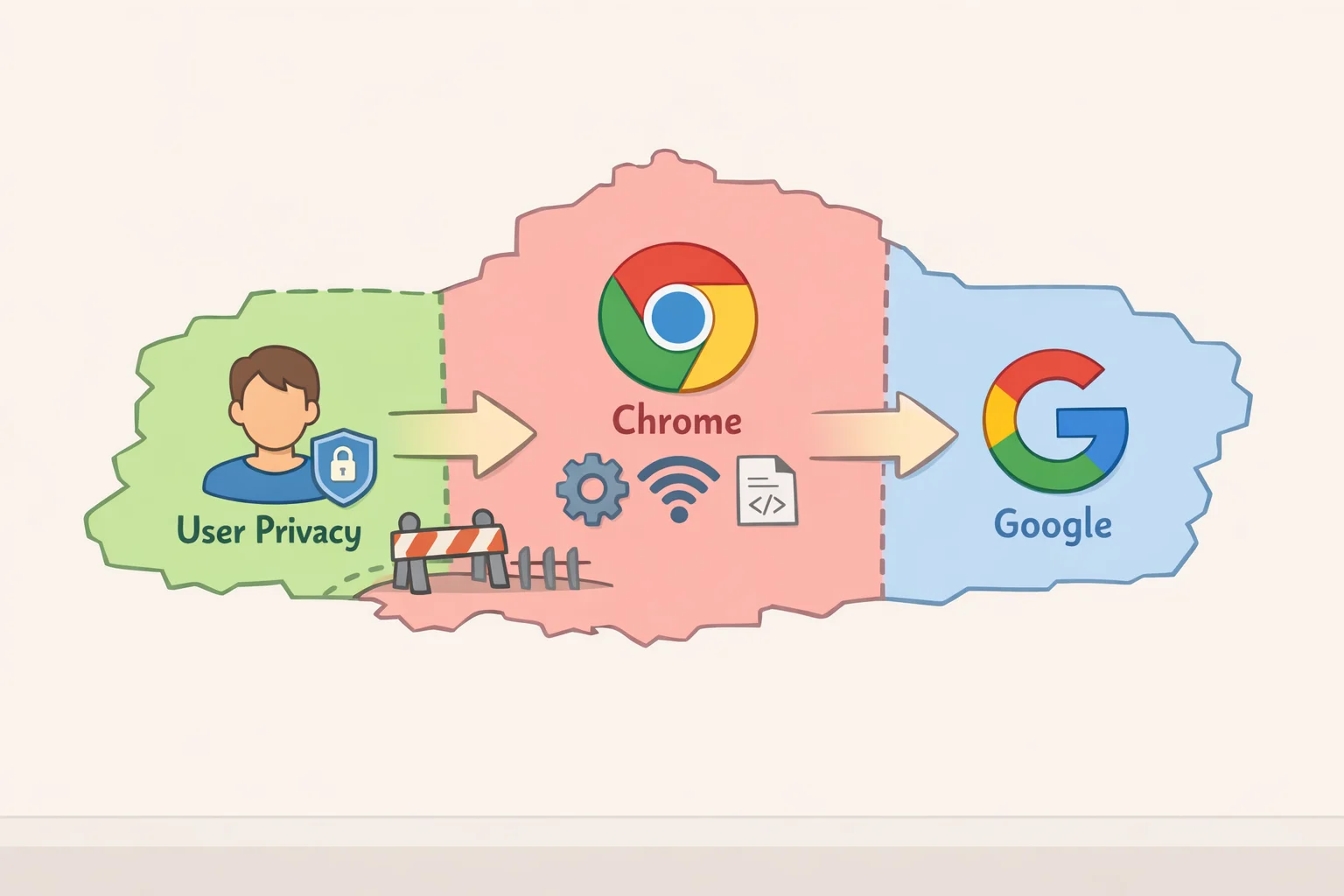
The argument over Manifest V3 was never just about ad blockers. In 2021, Giorgio Maone, who had by then spent 16 years building the script-blocking extension NoScript, called Manifest V3 "the worst offender by a long shot" among the API changes he'd worked through, arguing it shrinks both what extensions can do and how much control users have over their browsing (EFF).
Princeton researcher Jonathan Mayer went further that same year, tying Chrome's restrictions to Google's advertising business and its position atop the browser market. "A web browser is supposed to act on behalf of the user and respect the user's interests," Mayer said. "Unfortunately, Chrome now has a track record as a Google agent, not a user agent. It is the only major web browser that lacks meaningful privacy protections by default, shoves users toward linking activity with a Google Account, and implements invasive new advertising capabilities. Google's latest changes will break Chrome privacy extensions, despite academic research demonstrating that no change is necessary. These user-hostile decisions are all directly attributable to Google's surveillance business model and enabled by its dominance of the desktop browser market," (EFF).
Those comments came in 2021, before Chrome's Manifest V3 changes had reached most users, and they describe stakes critics anticipated rather than a full record of what happened to every affected extension since. Firefox's relevance to that debate isn't abstract, either: the EFF noted in that same 2021 report that Firefox held the largest extension market outside the Chrome-based browser family, meaning Mozilla's API decisions carry weight for a developer base that has nothing to do with Chrome (EFF).
Where this leaves things
What's settled is specific: Chrome's Manifest V3 doesn't carry forward blockingWebRequest, Mozilla's does, and that gap is why uBlock Origin still runs on Firefox the way its developer built it while Chrome users lose access to that version (Mozilla).
What's not settled is how long that arrangement holds. Mozilla's 2023 statement described its intended approach, and its most recent public post on the subject dates to early last year, but neither document lays out a roadmap for how long blockingWebRequest stays part of Firefox going forward. Whether Google revisits its own implementation, or whether Firefox's hybrid model remains the exception rather than a shared industry approach, isn't something the current record answers. For now, the practical fact stands on its own: Firefox runs the version of uBlock Origin that Chrome no longer fully supports.