What Does Panel-Ready Refrigerator Mean? Full Guide
Ask a kitchen designer what does panel-ready refrigerator mean, and the answer usually comes back short: "it means the fridge disappears into the cabinets." That's the goal, but it undersells what's actually happening. Panel-ready isn't a finish you pick off a swatch card. It's an engineering spec, one that determines how a refrigerator physically bolts to cabinetry someone else has to build, at a cost that starts before delivery and can resurface fifteen or twenty-five years later.
Here's the plain-language version: a panel-ready refrigerator ships with a flat front, reinforced hinges, and a mounting bracket system engineered to carry the weight of a decorative cover panel. A cabinetmaker builds that panel separately to match the surrounding kitchen. Instead of the finished stainless or black exterior you'd get on a standard model, the appliance arrives with an unfinished front by design, per Shop Appliances.
A few things worth knowing before anything else. You cannot bolt cabinet panels onto a standard refrigerator after the fact. Forcing panels onto an appliance that wasn't built for them can damage the unit and void the warranty, so the refrigerator has to leave the factory ready for this from day one, according to South Florida Kitchen & Bath. In Sub-Zero's Built-In lineup specifically, "panel-ready" lines up with what the company calls the Overlay, or /O, trim designation, distinct from its Framed (/F) models, per a ManualsLib summary of Sub-Zero's documentation. And the premium isn't hypothetical: panel-ready units typically run $2,000 to $5,000 more than a comparable standard model, before a single panel, hinge, or hour of installation labor gets added, South Florida Kitchen & Bath reports.
What follows is the rest of the picture: how panel-ready differs from terms it gets confused with, what to nail down before you order one, and the long-term dependency that rarely comes up until the original refrigerator dies.
What panel-ready actually means, and doesn't
Video of the Day
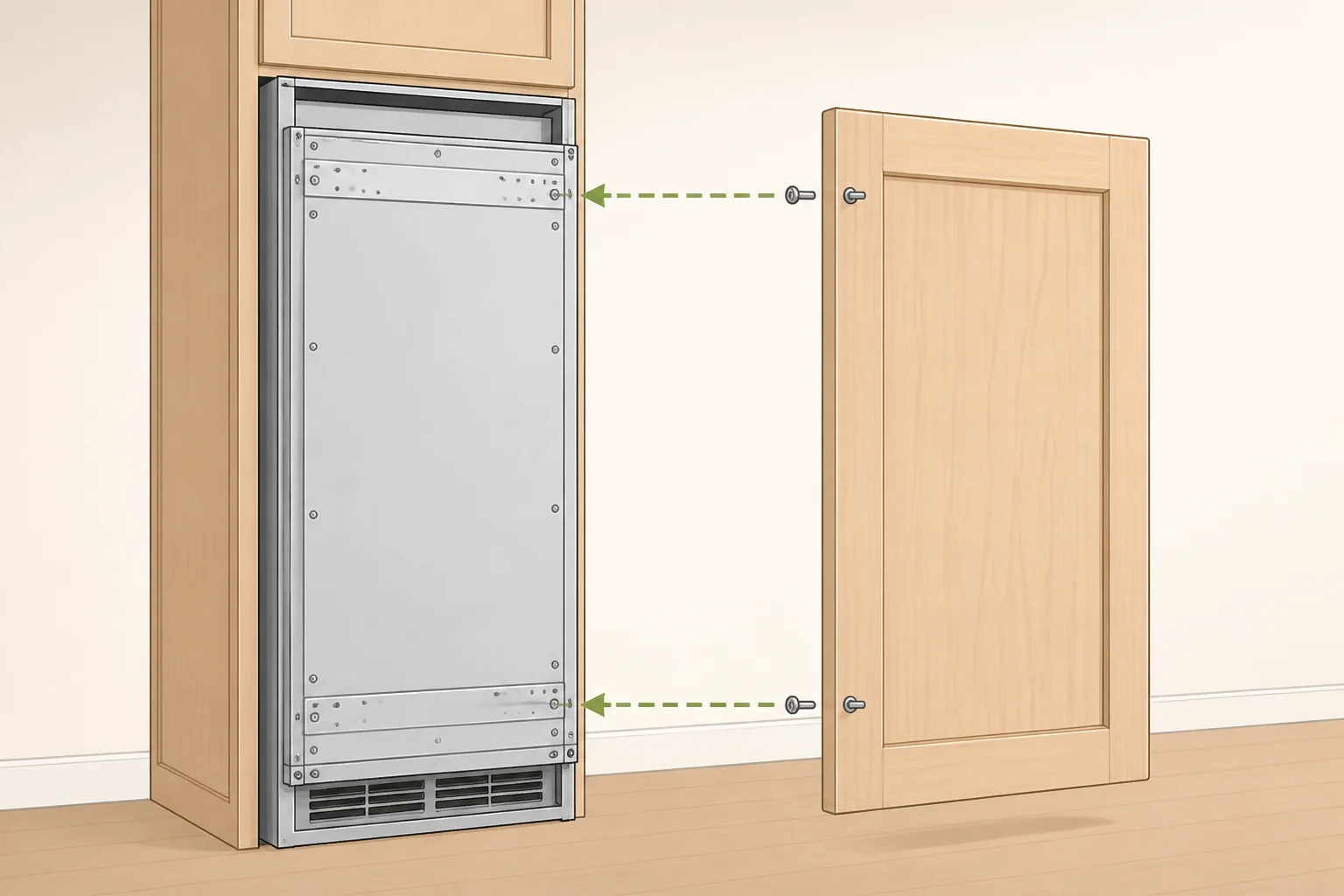
Strip away the marketing and a panel-ready refrigerator is a base appliance with three specific features: an unfinished front, hinges rated to carry extra weight, and a bracket system designed to hold a cover flush against the door. The wood or laminate face itself gets fabricated separately, typically by a cabinetmaker, to match everything around it.
On Sub-Zero's Overlay models, that unfinished-front approach goes further than most buyers expect. The units ship without a handle at all. The pull gets sourced separately so it matches the kitchen's other hardware, per the ManualsLib summary. On some of these models, the custom panel doesn't stop at the door. It extends up to cover the grille above the unit too, so the whole face reads as one continuous run of cabinetry instead of appliance-plus-trim.
None of this happens with a standard cabinet hinge. The custom panel attaches through what Shop Appliances describes as a sophisticated mounting bracket system, a setup an ordinary refrigerator hinge was never built to carry. Weight and thickness limits are set per model. Sub-Zero, for instance, specifies exact panel weight and thickness requirements for each BI Series unit to keep strain off the hinges and the door sealing properly, per ManualsLib. That's the number a cabinetmaker should be cutting wood against, not a rule of thumb.
Think of the refrigerator as the mechanical chassis. It handles cooling, sealing, the compressor, the hinges rated for the extra load. The visible door is a separate job, built by someone else, sized to that chassis's exact dimensions. The manufacturer supplies the machine. Your cabinetmaker supplies what you actually see.
That's the correction that matters most here: panel-ready is a compatibility spec, not a promise about how the refrigerator will look on delivery day, or automatically look once it's installed.
Video of the Day
Panel-ready vs. built-in refrigerator: what's the difference?
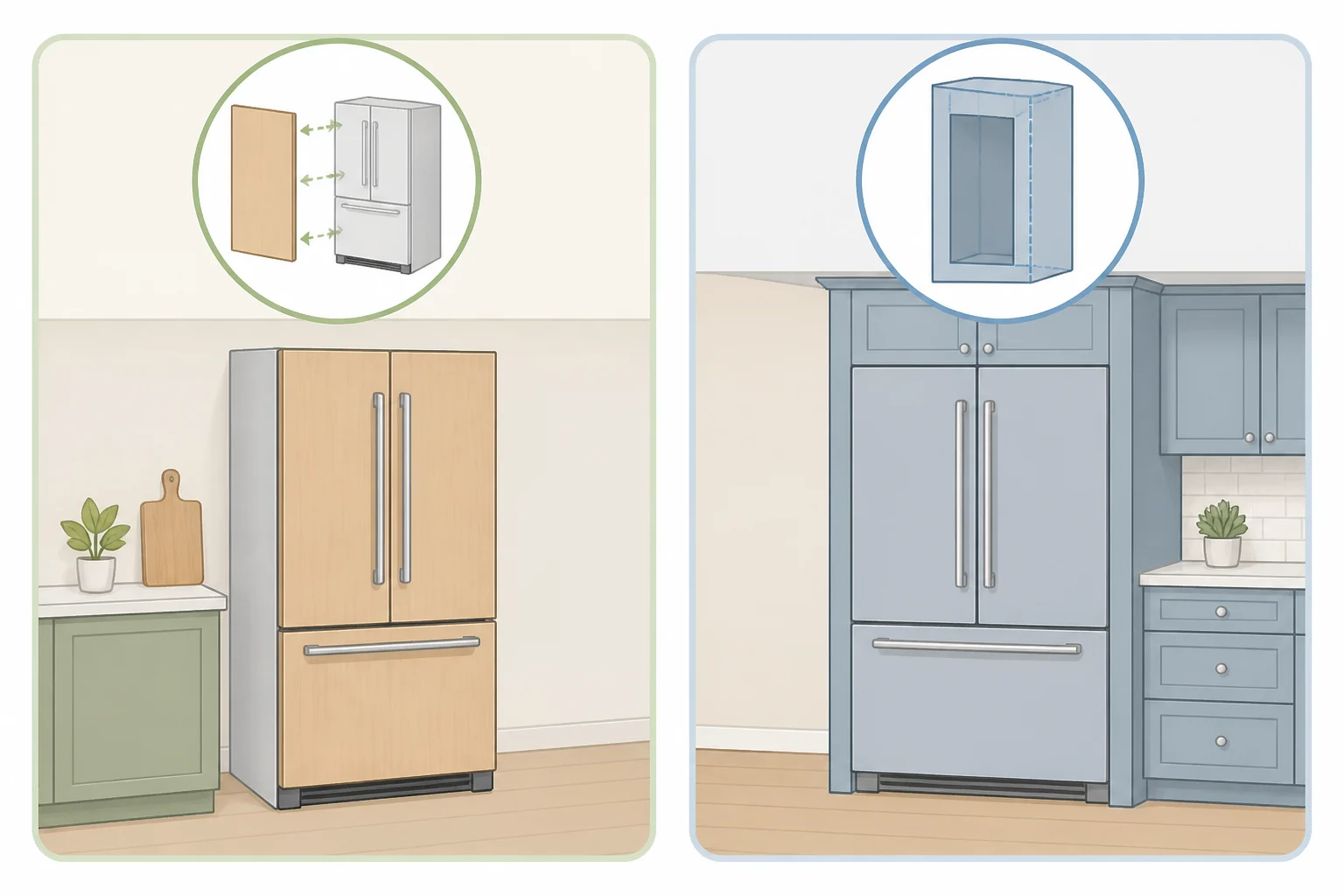
Panel-ready and built-in aren't synonyms, and mixing them up is where most of the confusion starts. A panel-ready refrigerator is simply a unit capable of accepting a cover panel. Built-in describes something else: how the appliance sits in the room, fitted into a fixed cabinet opening rather than standing free with room to pull it out.
| Term | What it actually describes |
|---|---|
| Panel-ready | The appliance is built to accept a custom cover panel |
| Built-in | An installation category. Fits a fixed cabinet opening rather than standing freely |
| Counter-depth | A depth dimension, shallower than a standard freestanding unit |
| Flush inset (Sub-Zero) | A recessed installation outcome where the panel sits level with adjacent cabinet doors |
That flush inset row deserves unpacking, because it's easy to assume every panel-ready unit gets there automatically. A ManualsLib summary of Sub-Zero's documentation separates two outcomes: a standard installation, where custom panels sit slightly proud of the surrounding cabinetry, and a flush inset application, where the unit is recessed further so panels end up perfectly level with the doors next to them (ManualsLib). One is the default. The other takes a more deliberate installation choice.
The numbers behind that outcome are model-specific, not category-wide. Shop Appliances notes that a dimensional error of as little as one to two inches can throw off door alignment, interfere with hinge operation, or leave a visible gap that breaks the seamless look entirely. Cabinet depth, door-swing clearance, and panel thickness all have to be planned against the exact model's specs, not a general assumption about the category.
Counter-depth adds another wrinkle. Panel-ready and built-in units tend to run shallower than standard freestanding refrigerators to support that flush look, and Shop Appliances points out that standard-depth stainless models typically offer more interior volume, which matters more to households with heavy grocery needs. It's worth checking a specific model's cubic footage rather than assuming the trade-off is small.
Buyers who treat "panel-ready" as a guarantee of a seamless, flush result are working from an incomplete picture. The term guarantees compatibility. The finished look depends on the specific model, the panel system, and which installation method the cabinetmaker actually pulls off.
Planning a panel-ready refrigerator installation before you order
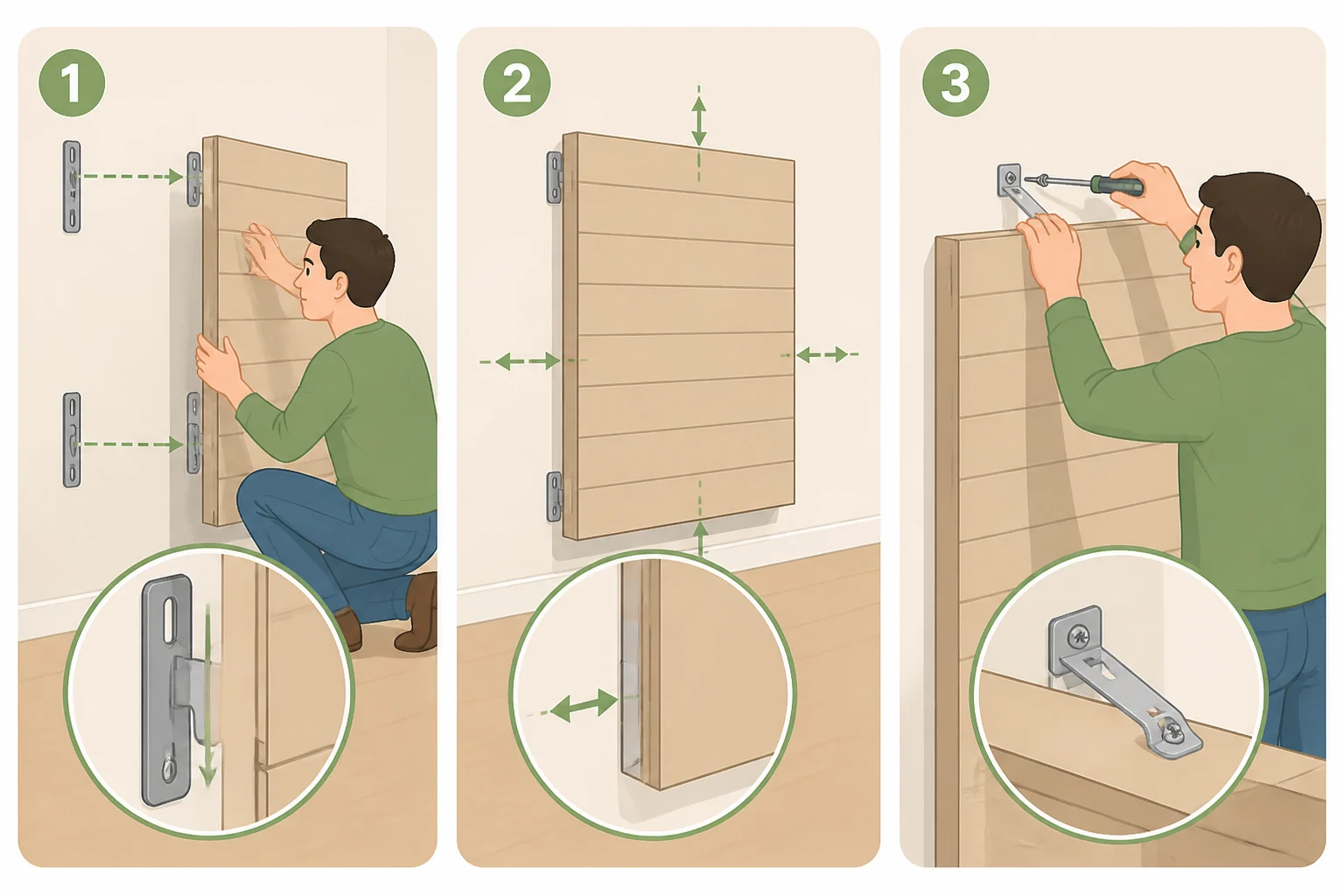
This is less a purchase decision than a construction-coordination task, and the tolerances are tighter than most people expect. Shop Appliances puts it plainly: because panel-ready units have to sit flush against adjacent cabinets, even a one-to-two-inch dimensional error can ruin the installation. A few things worth confirming before the cabinetmaker cuts anything:
- Weight limits. Cabinet doors generally need to stay within 15 to 25 pounds, per one estimate from South Florida Kitchen & Bath, and manufacturers set their own weight and thickness ceilings model by model to keep hinges from straining, per ManualsLib. Confirm both figures before any wood gets cut.
- Clearance. Most manufacturers require roughly an eighth of an inch of clearance on all sides, South Florida Kitchen & Bath notes. That's a tight enough margin that assuming a category-wide standard is a mistake.
- Utilities. Electrical outlets and water lines need to land in recessed locations so they don't interfere with the appliance sitting flush against the wall, a coordination point Shop Appliances flags as work that has to happen before construction closes up.
- Hardware. Many panel-ready units, Sub-Zero's Overlay line among them, ship without a handle at all. The cabinetmaker sources one separately to match the kitchen's other pulls, per ManualsLib.
Coordinating all of that, the appliance dealer, the cabinetmaker, the installer, has to fall on somebody. Shop Appliances is blunt about the sequencing: specs need to be confirmed before cabinetry gets finalized, not adjusted after the fact. None of it comes cheap once cabinets are already built around the wrong assumptions.
The dollar figures deserve their own layer, kept separate rather than collapsed into one number. The appliance premium alone typically runs $2,000 to $5,000 above a comparable standard model, South Florida Kitchen & Bath reports; the firm's own project breakdown lists custom cabinet panels at $800 to $2,500, hardware integration at $200 to $800, professional installation at $500 to $1,500, and rough-in work at $300 to $1,200, with a total paneled-refrigerator project landing anywhere from $6,300 to $21,000 depending on scope. A Boston-area estimate from Yale Appliance puts the combined cost of panels, hardware, and installation closer to $4,000, a reminder that these are regional retailer and installer figures, not a national average. Treat them as a planning range, not a quote.
This route makes the most sense for a renovation from the studs, not a straight swap of an existing fridge, and for someone willing to lock in appliance specs before the cabinets get built. It's a poor fit for anyone who wants the simplest, cheapest, or fastest refrigerator replacement.
The long-term cost nobody quotes upfront
The dollar figures above only cover the purchase. The sharper issue shows up years later, when the cabinetry is still standing and the refrigerator isn't.
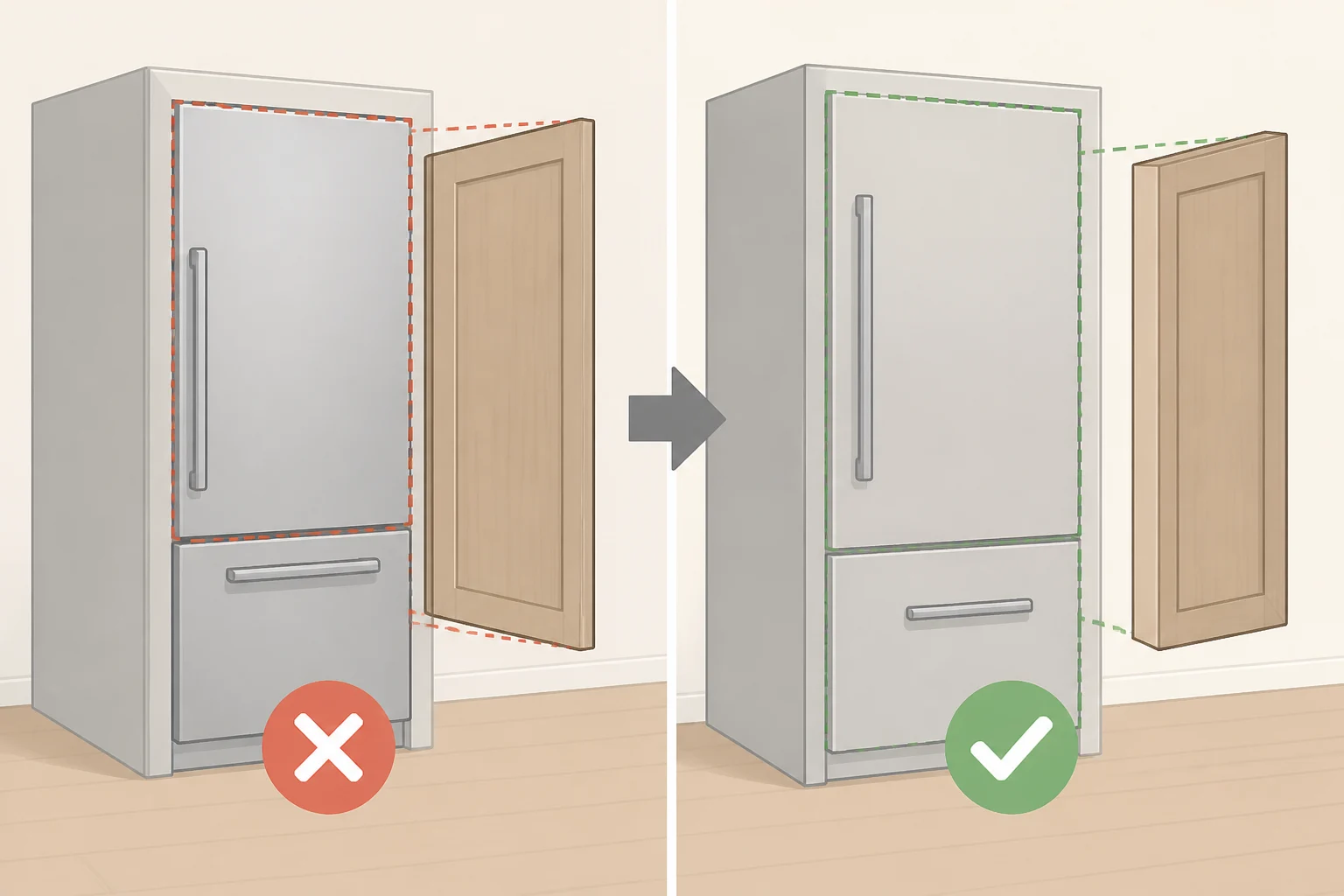
Refrigerator dimensions shift across product cycles, and manufacturers don't hold them steady for the sake of anyone's custom panels. In one documented case from Yale Appliance, a Sub-Zero unit installed in 2001 stood 80 inches tall; the model that replaces it today stands 84 inches. Four inches sounds trivial until you realize the original panels simply don't fit the new frame.
New panels rarely match cabinets that have aged 15 to 25 years, either. If a cabinetmaker has to run a special batch just to approximate wood they cut a quarter-century earlier, the price is largely whatever they decide it is, per Yale Appliance. The risk scales with the size of the appliance. A dishwasher's 24-inch opening barely changes generation to generation, and a slight mismatch on a small, low panel tends to go unnoticed. Refrigerators are the largest paneled appliance in most kitchens and the most visible, so they carry the biggest replacement risk by a wide margin.
That's also why Yale Appliance argues that repair, not replacement, is often the smarter first move for an aging unit in a paneled kitchen. In one of their own examples, Sub-Zero still supplied parts for a refrigerator installed in 2001, by then 24 years old. Repair kept the panels, the finish, and the kitchen's look intact in a way that swapping the appliance never could have.
The practical takeaway is simple enough to act on immediately: at the time of installation, save the model's panel template, the installation guide, exact cabinet drawings, the wood and finish specifications, and the cabinetmaker's contact information. If a repair or replacement ever comes up, that folder is the difference between a routine parts order and a costly custom-fabrication project.
Panel-ready isn't a purchase decision with a fixed price tag attached. It's an ongoing dependency between an appliance and the cabinetry built around it, and that dependency has a shelf life measured in decades, not years.
Where this leaves a buyer
Panel-ready describes what a refrigerator can accept, not what it looks like the day it arrives. The finished appearance depends on a panel someone else fabricates, hardware chosen to match, and an installation method that varies by model and brand. The appeal is almost entirely visual continuity, and that look carries a real, multi-part cost: appliance premium, panels, hardware, installation, all worth budgeting as a stack rather than a single figure.
The cost that rarely gets quoted at the counter is the one that shows up 15 to 25 years down the road, when a discontinued or resized model leaves the original panels, and the kitchen's visual consistency, in question. Anyone weighing this route should talk to a cabinetmaker and appliance dealer before cabinets get ordered, confirm the exact model's clearance and weight specs against its manufacturer installation guide, and keep that documentation somewhere it won't get lost. The refrigerator is replaceable. Getting it wrong the first time is the expensive part.