Will drones replace helicopters? What Army data shows
A mission-by-mission look at where drones are taking on helicopter functions, and where they aren't
The clearest test case for whether drones will replace helicopters isn't a lab demo or a trade show pitch. It's the U.S. Army, which relies on helicopters while expanding its use of unmanned aircraft, and is now rewriting doctrine, procurement plans, and airspace rules to figure out how the two fit together. Its recent decisions offer a close, if institutional, look at where this transition stands, not a neutral verdict from outside the building.
Start with the decision most often cited as proof drones are winning. In February 2024, the Army ended development of its Future Attack Reconnaissance Aircraft (FARA), a planned $5.3 billion crewed reconnaissance and attack helicopter, after budget officials cited concerns about the long-term affordability of developing FARA and FLRAA at the same time (GAO). GAO describes the decision as ending FARA's development; the supplied record does not describe a retirement of any operating helicopter fleet. The summary attributes the decision to affordability, not to any demonstrated case that drones could do FARA's job.
The rest of the record complicates the "drones are winning" story further. The 3rd Combat Aviation Brigade puts it bluntly: it is not discarding helicopters, and the Apache, Black Hawk, and Chinook remain indispensable to how it fights (U.S. Army). The same GAO review that documents FARA's end also confirms the Army kept funding, and later proposed accelerating, the Future Long Range Assault Aircraft, a new crewed aircraft meant to improve on today's Black Hawks in speed, range, agility, endurance, and sustainability (GAO). And the Army's broader 2030 vision calls for divisions and brigades fielding hundreds of unmanned systems integrated into multi-domain operations (U.S. Army), language that reads more like addition than subtraction.
So the useful question isn't "drones or helicopters." It's narrower: can drones replace helicopters for specific jobs within a helicopter's mission set, or only extend what the helicopter already does? This piece works through that question using Army program records, GAO procurement oversight, and combat lessons from Ukraine and the 2025 Iran-Israel war. The sourcing skews institutional, a limitation worth naming upfront, but it's the most concrete evidence available on where things stand this fall.
The FARA cancellation, and why the Army's drone investment keeps shifting
Video of the Day
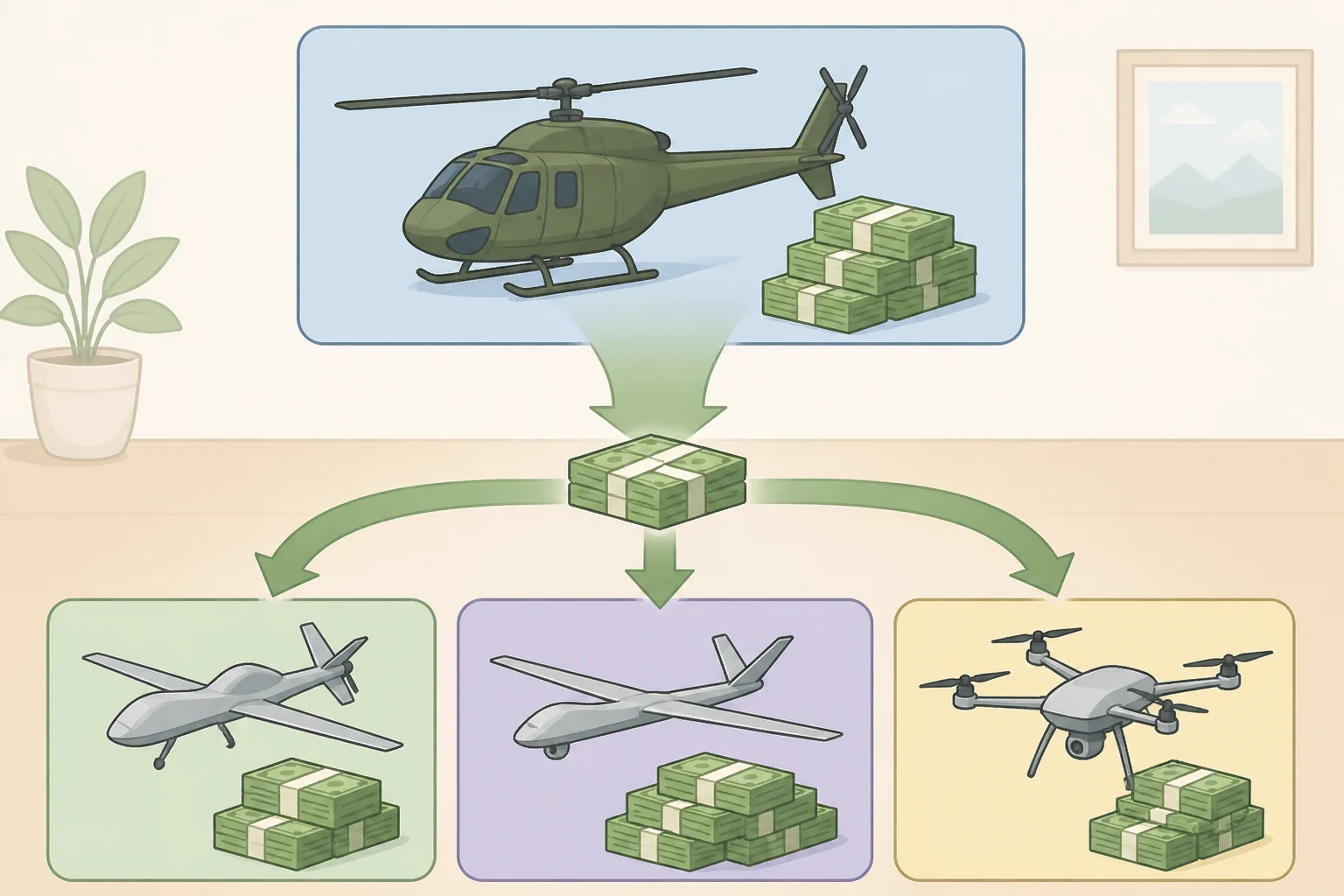
The Army's 2019 Future Vertical Lift strategy paired two crewed aircraft, FARA and FLRAA, with one drone program, the Future Tactical Unmanned Aircraft System (FTUAS) (GAO). When FARA was cut in February 2024, the restructuring shifted roughly $7.3 billion in planned spending elsewhere, including increased investment in FTUAS and other vertical-lift programs, plus barracks improvements that had nothing to do with aviation at all, per the same GAO review. The Army's stated plan going forward: future uncrewed systems would handle some reconnaissance and attack missions, while existing helicopters would continue flying attack missions.
That wasn't the end of the rewrite. Following the Secretary of Defense's April 2025 Army Transformation Initiative, the Army proposed a second restructuring: accelerating FLRAA, accelerating the fielding of launched uncrewed aircraft, and ending the very FTUAS program it had expanded about a year earlier (GAO). None of it is locked in. Army officials told GAO these proposals depend on the fiscal year 2026 budget.
Read together, those two moves say something specific: the Army first expanded FTUAS, then proposed ending it, reversing course on an individual program within about a year of committing to it. The most-cited evidence for drones replacing helicopters is a budget decision about one unbuilt aircraft, made in one direction and then proposed to be undone. That's a story about affordability and shifting institutional priorities, not evidence that drones make FARA's mission obsolete.
Video of the Day
Helicopter-drone teaming: why military drones and helicopters are being built to work together
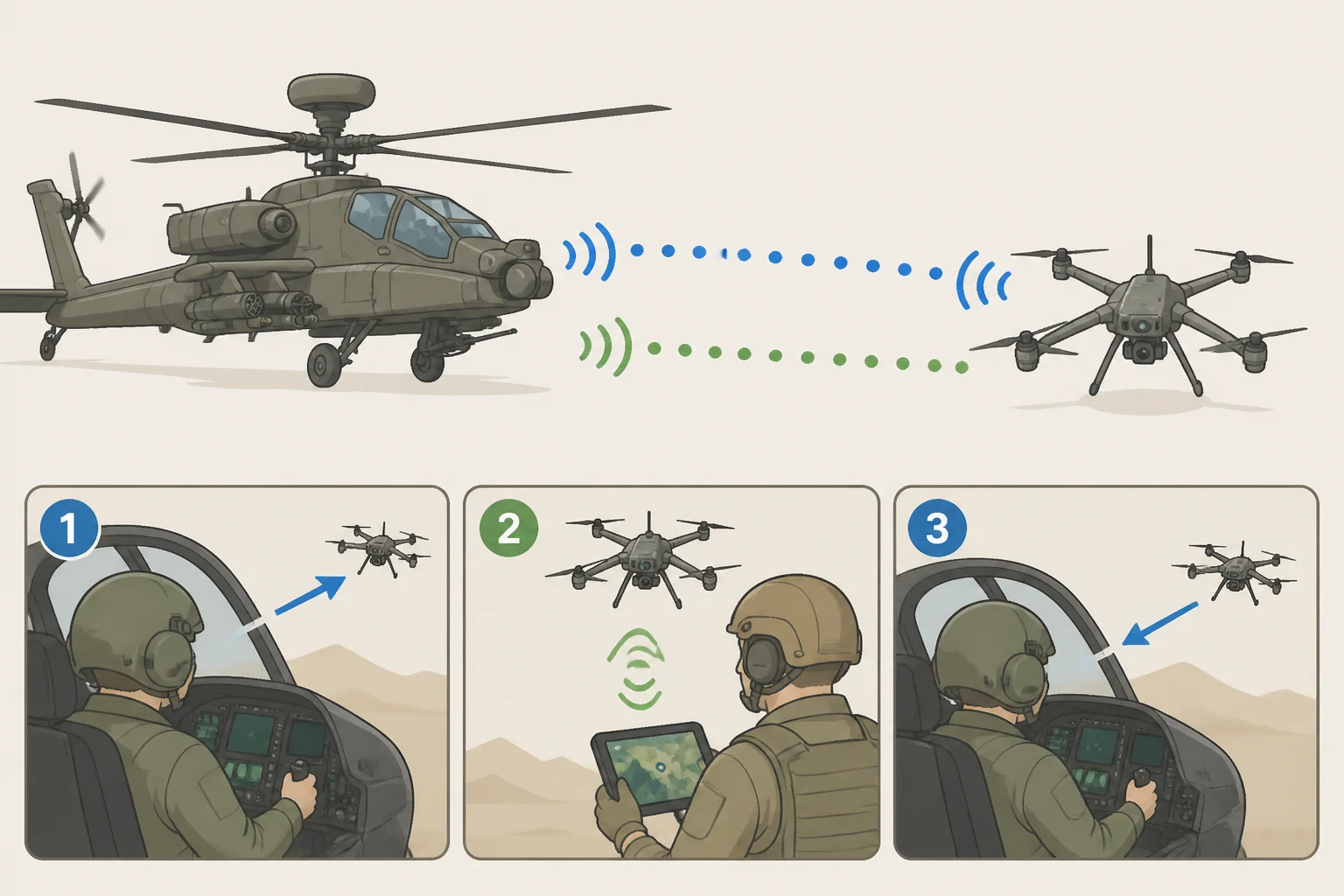
The Army's clearest attempt to build that cooperation is LEDGR, the Launched Effects Dispenser for Ground and Rotorcraft. In 2025, the Army's Combat Capabilities Development Command conducted live-fire launches of the system from a test stand at Redstone Arsenal, separately demonstrated it on an AH-64 Apache, and is now integrating it onto the UH-60 Black Hawk (U.S. Army). Design, installation, and further demonstrations on both platforms are aligned toward fielding a meaningful "Transformation in Contact" capability later this year, per the Army.
Launched effects themselves are small, autonomous or semi-autonomous aircraft that can carry reconnaissance, electronic-warfare, or kinetic-strike payloads (U.S. Army). The Army describes their main advantage as increasing a helicopter's standoff distance from threats: the crewed aircraft holds back while the smaller drone works forward. The Army is also designing a common launcher that can send those effects from rotorcraft or ground vehicles, so the system isn't tied to any single platform.
Making that work means sharing airspace, and airspace is getting crowded. The rapid growth of small drones at every level of the Army has forced units to deconflict thousands of Group 1 and Group 2 systems with rotary-wing traffic during large exercises (U.S. Army). The fix is a color-coded system drawn from a September 2025 handbook: green allows unrestricted drone flight below 500 feet when no helicopters are scheduled, amber requires lateral deconfliction near planned air corridors, and red grounds small drones, but only for emergencies or dynamic retasking, not as a routine default. The Army scheduled the plan for testing during an April 2026 exercise involving opposing forces, degraded communications, and mixed manned-unmanned operations; the cited reporting predates the exercise, so it cannot show whether the system worked under those conditions.
Tactically, the 3rd Combat Aviation Brigade has already adjusted around this crowding, using smaller command nodes, tighter emissions control, decoys, and adjunct drones that mask or move pathways ahead of the rotary-wing force (U.S. Army).
That still leaves the harder question unanswered: what would it actually take for a drone to replace a helicopter function, rather than just assist one? A reasonable bar is that the drone performs the task independently, delivers comparable operational usefulness, holds up under contested conditions, and does so without needing a helicopter as its launch, control, or recovery platform. Measured against that bar, some functions look close. Others don't come close at all.
Mission by mission: which helicopter functions are shifting to drones?
Reconnaissance, electronic warfare, and kinetic strikes are the functions the Army built launched effects to perform, according to its own description of their standoff advantage (U.S. Army). On the hardware side, one Army training effort showed how fast units can move: soldiers printed more than 90 unique drone components in hours and flew Group 1 first-person-view drones weighing under 20 pounds (U.S. Army). Against the four-part test, these functions score well on independence and usefulness; whether they hold up under sustained jamming and contested conditions is less settled.
Strike missions are more contested, and Ukraine's war supplies the clearest illustration. According to figures the Army itself cites, Ukraine has flown at least 58 long-range drone strikes into Russian territory since August 2025, some traveling as far as 2,000 kilometers, disrupting an estimated 17 percent of Russian refining capacity (U.S. Army). The research provided here does not independently verify those figures. The numbers show something narrower than a wholesale substitution: drones performing long-range strike missions in Ukraine's war, not drones taking over a mission the U.S. Army currently assigns to a helicopter.
Some missions the Army still assigns primarily to helicopters. Its own account states that the Apache retains deep-strike firepower, the Black Hawk still handles MEDEVAC and air assault, and the Chinook still delivers heavy lift and rapid repositioning (U.S. Army). That's the Army's current operational judgment about where helicopters remain necessary, not a claim that drones are structurally incapable of those jobs. Against the four-part test, these functions fail on independence: nothing in the sources reviewed here shows a drone performing casualty evacuation, passenger transport, or heavy lift without a helicopter involved. The sources reviewed for this piece also provide no side-by-side comparison of drones and helicopters on casualty evacuation, passenger capacity, or lift tonnage, a gap in the public evidence, not a settled conclusion either way.
A narrower outside data point adds some texture. A CSIS review of the 2025 Iran-Israel war and the ongoing Russia-Ukraine conflict found that Israel's rapid air superiority rested on more than 50 years of integrated training, intelligence work, and suppression of enemy air defenses, not any single aircraft type (CSIS). It doesn't weigh drones against helicopters directly, but it reinforces the same lesson the Army keeps drawing from its own program decisions: mission success tracks with integrated systems and years of preparation, not a single platform swap.
Risk cuts in both directions, too. In February 2025, Russia launched an overnight strike of 267 attack drones against Ukraine, the largest single drone assault of the war to that point (U.S. Army). Read alongside the Army's own point that drones and helicopters both leave acoustic and thermal signatures, the evidence suggests mass drone proliferation is a threat both sides have to manage, not a clean advantage for whichever military fields more of them.
The open questions the Army hasn't answered
The Army's doctrine reads more like an institution adapting to a persistent threat than one declaring the substitution question closed. Its March 2025 update to Field Manual 3-0 added imperatives like "protect against constant observation" and "make contact with sensors, unmanned systems, or the smallest element possible," language aimed at reducing exposure rather than announcing that any mission has been eliminated (U.S. Army).
The Army is also updating doctrine faster than its usual multi-year cycle. Officials describe a "learn-by-doing" approach: fielding drone capabilities to soldiers first, then letting real-world experience shape the tactics, techniques, and procedures that follow (U.S. Army). That pace suggests the Army doesn't yet consider the drone-helicopter relationship settled enough to write down permanently.
Several gaps limit how far any outside observer can push a verdict. The evidence reviewed here includes no public dataset comparing payload, lifecycle cost, or survivability between drones and helicopters directly. No independent account confirms whether launched effects have controlled combat operations from an Apache or Black Hawk under actual fire, as opposed to a test stand or training exercise. And none of the sourcing here comes from helicopter manufacturers, allied militaries, or independent aviation researchers, any of whom could sharpen or challenge the Army's own framing. These are gaps in the evidence base this article draws on, not proof of anything in either direction.
What the evidence shows, and what's still unproven

Put together, the record supports a narrower and more useful claim than "drones will replace helicopters." Specific functions, reconnaissance, electronic warfare, decoying, and some strike roles, are being assigned to or tested with drones. Whole missions like MEDEVAC, troop insertion, and heavy lift remain in the "Army says helicopters are still needed" category, an institutional assessment rather than an independently tested fact.
GAO said the Army's proposed restructuring, ending FTUAS, accelerating FLRAA and launched effects, depended on the fiscal year 2026 budget (GAO). Which of those proposals actually got funded doesn't appear in the sources reviewed here. But the more consequential test was never going to be a budget line. It's whether drone-helicopter teaming holds up when the enemy is jamming radios, aircraft are going down, and nobody can talk to headquarters, rather than in a scheduled training rotation. That's the test the Army has set for itself. Whether it passes isn't part of the record yet.