How Marine Air Defense Integrated System MADIS works
On Dec. 12, 2025, the Marine Corps delivered two Marine Air Defense Integrated System units, known as MADIS, to 1st Low Altitude Air Defense (LAAD) Battalion in the Indo-Pacific (1st Marine Aircraft Wing). That date matters more than a routine hardware handoff suggests. It marks the clearest confirmed fielding of a full-rate production MADIS to an operating unit, not another round of testing on a range.
MADIS, in plain terms, is a pair of networked vehicles built to spot drones and low-flying aircraft and stop them before they reach Marines on the ground. The Marine Corps treats that mission as urgent rather than optional: cheap, commercially available drones have become a persistent battlefield threat, and the service says countering them "cannot be overstated" (Marine Corps Systems Command).
What follows is the full picture: a system now reaching Indo-Pacific units, resting on a kill chain that was validated in a 2023 live-fire test under an earlier configuration. Where the proof ends and the promise begins is the thread worth pulling.
What MADIS is: a JLTV air defense system now in the fleet
Video of the Day
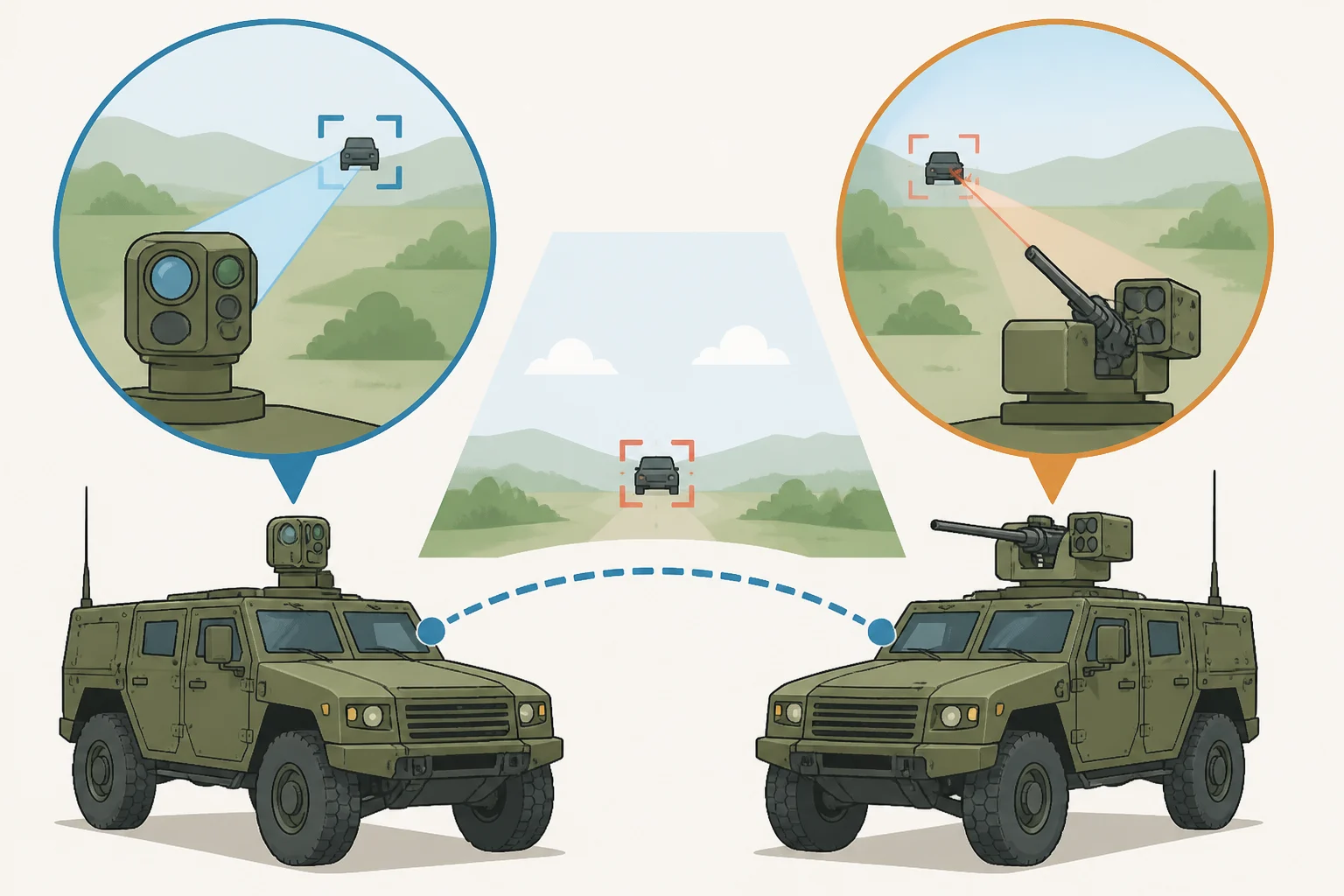
MADIS is a short-range, mobile, surface-to-air system built around two Joint Light Tactical Vehicles, or JLTVs, working as a pair. One vehicle focuses on detection, the other on offensive action (1st Marine Aircraft Wing). Splitting the job across two trucks means the system can keep scanning the sky while it engages a target instead of asking one vehicle to do both at once.
Together, the pair forms a maneuverable air-defense unit designed to defeat unmanned aircraft as well as manned fixed-wing and rotary-wing threats, whether moving or stopped (1st Marine Aircraft Wing). "Short-range" and "low-altitude" describe the kind of threat MADIS is built for: drones and aircraft flying close to the ground near friendly forces, the altitude band where bigger, longer-range air-defense systems don't make sense.
The fielding record is worth being precise about, since it has shifted. A 2024 Marine Corps Systems Command report named 3rd Littoral Anti-Air Battalion as the planned first recipient of MADIS (Marine Corps Systems Command). The confirmed milestone since then is the delivery of two full-rate production systems to 1st LAAD Battalion, part of Marine Air Control Group 18 under 1st Marine Aircraft Wing (1st Marine Aircraft Wing).
That delivery caps a longer buildup. 1st LAAD Battalion reactivated in 2023, then stood up Firing Battery Alpha in 2024 and Firing Battery Mike last year, steps the Marine Corps calls a pivotal expansion of expeditionary air-defense capability in the Indo-Pacific (1st Marine Aircraft Wing). Master Gunnery Sgt. Mario Guadarrama, the battalion's operations chief, put the shift in simple terms: "Owning these systems gives us direct control capability," he said, adding that it narrows the gap between training and how the unit would actually operate alongside partners across the region (1st Marine Aircraft Wing).
Video of the Day
How MADIS finds and tracks a target: the sensor-to-shooter chain

A counter-drone system only matters if it spots a threat in time to act on it. Marine officials describe the MADIS sequence as detect, track, identify, assign a weapon, then engage, a process Col. Andrew Konicki, program manager for Ground Based Air Defense, called completing "the entire kill chain" (Marine Corps Systems Command).
The clearest public evidence for that chain comes from a live-fire test at Yuma Proving Ground in 2023, where the Marine Corps reported that the low-rate initial production model of MADIS detected, tracked, identified, and defeated launched drone targets (Marine Corps Systems Command). The Corps framed it as a real battlefield scenario, though it was still a proving-ground exercise against launched targets, not a combat engagement. Konicki's comment applied to that earlier production configuration, not the full-rate system now at 1st LAAD.
Targeting data moves between the two vehicles through the Common Aviation Command and Control System, letting the pair engage one threat while continuing to track others nearby. The Corps describes this as 360-degree detection that lets the system engage and neutralize threats with kinetic and non-kinetic force alike (Marine Corps Systems Command; 1st Marine Aircraft Wing). Kinetic means physically destroying a target with a cannon round or a missile. Non-kinetic means disabling it without a direct hit, through jamming or other electronic means. What the public record actually documents is sustained tracking during one active engagement. It says nothing about how the system handles several drones arriving at the same time, a scenario the available material simply doesn't cover.
The full-rate system adds a layer of automation on top of that chain. Lt. Col. Mike Billings, product manager for Future Weapons Systems, said it provides "automatic target recognition and weapon assignment to decrease engagement times and reduce the cognitive load on the Marine operator" (1st Marine Aircraft Wing). Where human authorization sits inside that faster loop isn't specified, which matters for a system explicitly built to speed up the decision to fire.
Why MADIS carries multiple weapons, and what's still unconfirmed
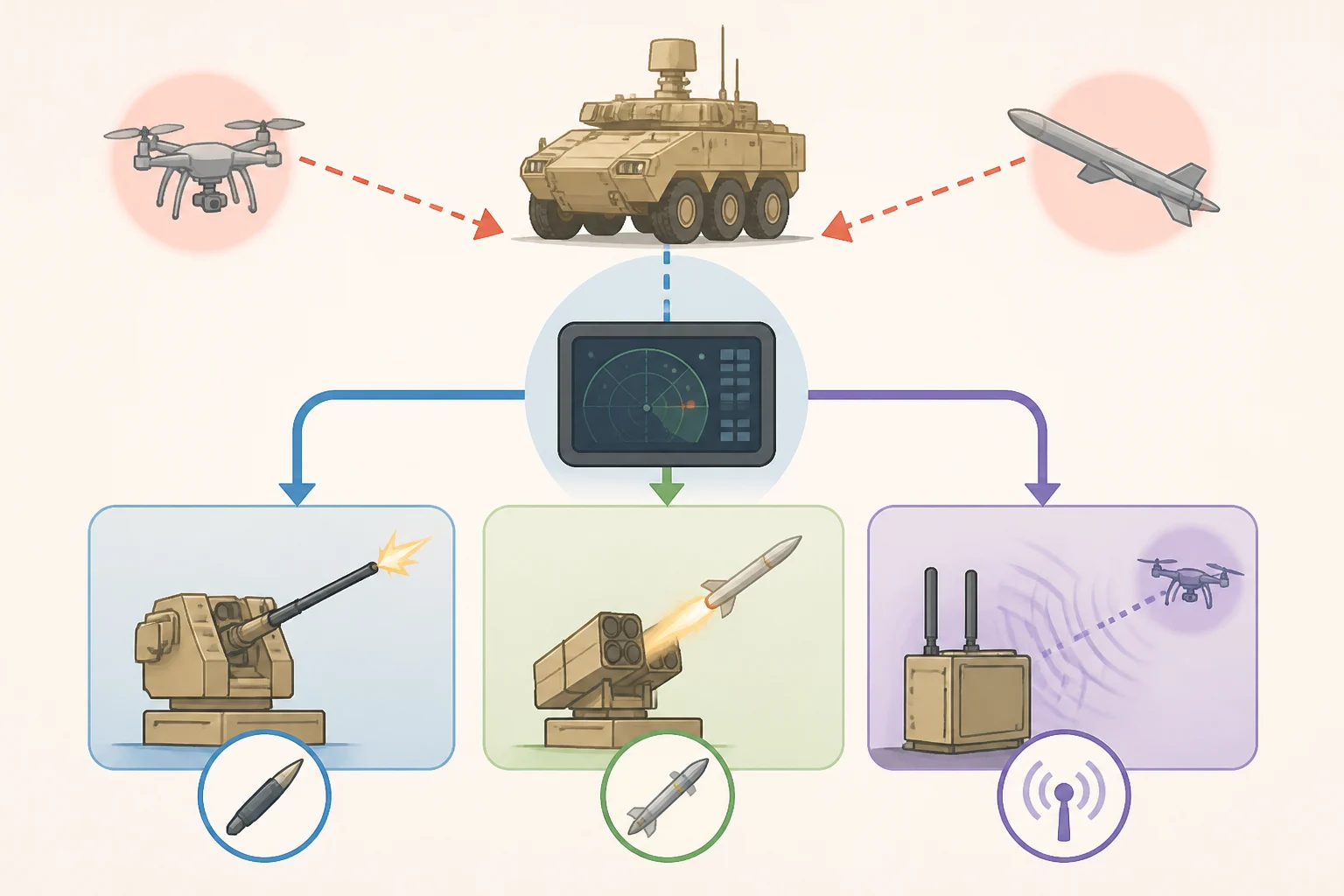
The full-rate production configuration gives MADIS three categories of capability: 30 mm cannons, Stinger missiles, and multifunctional electronic-warfare equipment (1st Marine Aircraft Wing). The Corps describes kinetic and non-kinetic effects working together, though it doesn't spell out exactly what the electronic-warfare system does or where its limits lie.
The strongest public evidence for the kinetic side still traces back to the 2023 Yuma test, where both the Stinger missiles and the 30 mm cannon hit multiple launched drones during the same engagement (Marine Corps Systems Command). That result suggests the system doesn't depend on a single weapon type to score a hit, though it's an inference from one test event rather than a settled performance figure. It also reflects the low-rate model's cannon and missile performance specifically. The electronic-warfare equipment riding on the full-rate configuration wasn't part of that test, and nothing in the Marine Corps material cited here details how it performs.
A similar gap runs through basic performance figures. Detection range, engagement range, ammunition capacity, and how the system holds up against a coordinated, multi-drone attack go unmentioned in the releases cited here. For a system the Corps plans to field broadly, those aren't minor omissions. They're the numbers that would actually show how MADIS performs against a real attack rather than a scripted range event.
The strategic problem MADIS is meant to solve
MADIS exists because cheap drones have rewritten the math of who can threaten a Marine unit and for how little money. Konicki put it bluntly: "We see it all over the news. MADIS is the key" (Marine Corps Systems Command).
The Marine Corps' own offensive drone program shows that cost math from the other side of the ledger. On April 24, 2025, the Corps conducted its first kinetic live-fire strike using a first-person-view, or FPV, drone at Quantico, a strike that cost less than $5,000 compared with more than $80,000 for a traditional infantry-battalion organic missile (Combat Development & Integration). Those same drones can reach ranges up to 20 kilometers, well beyond the 1 to 2 kilometer range of systems currently available to rifle squads and platoons (Combat Development & Integration).
If cheap FPV drones make sense as a weapon for Marine units to use, the same logic cuts the other way. That's an inference rather than a sourced claim, but it's hard to look at the two programs side by side and not see mirror images: one building the cheap offensive tool, the other fielding the defense meant to stop someone else's version of it.
Both efforts sit inside the Corps' wider Force Design modernization push, which the service says was shaped partly by lessons from Russia's invasion of Ukraine (Combat Development & Integration). Commandant Gen. Eric Smith has framed that push around giving Marines "lethal capability that is affordable, that is light, that is getting more autonomous" (Combat Development & Integration). MADIS fits that frame as the defensive half of a program built on the assumption that cheap drones aren't going away.
What's proven, what's still a promise
Strip away the acronyms and MADIS is two networked JLTVs, one watching, one acting, built to detect and destroy drones and aircraft with cannons, missiles, and electronic-warfare equipment. It's now reaching an operational Indo-Pacific unit rather than sitting on a test range.
The strongest evidence behind that picture still comes from the 2023 Yuma test, run on an earlier production configuration. The electronic-warfare performance, multi-drone handling, and combat durability of the full-rate system now confirmed at 1st LAAD remain undemonstrated in the material the Marine Corps has made public (Marine Corps Systems Command). A successful live-fire test and a combat-proven weapon are two different things, and nothing in the public record has closed that distance yet.
The Marine Corps says the next step is delivering full-rate MADIS to every low-altitude and littoral anti-air battalion in the service, at what officials call a rapid pace (1st Marine Aircraft Wing). The markers worth watching from here aren't more fielding announcements. They're training throughput, how many systems actually reach units, and whether the Corps eventually releases test data on the full-rate configuration's electronic-warfare effects and its performance against multiple simultaneous targets. That's the evidence that would show whether MADIS works the way the Corps says it does once it meets a drone-saturated battlefield instead of a scripted range.