Home Solar Myths in 2026: 12 Costly Misconceptions Debunked
Most home solar myths circulating right now aren't fringe misinformation they're the default assumptions embedded in installer sales pitches, online calculators, and neighborhood word-of-mouth. The problem is that most of them were accurate under policy structures that are now being dismantled.
U.S. energy costs rose at triple the rate of overall inflation in the past year, making rooftop solar look more attractive than ever and more consequential to get wrong, according to MIT Sloan/CEEPR research published earlier this year. Whether it pays off depends less on panel count and sunlight than on three variables most buyers never check: how their utility compensates exported power, how reliable the hardware actually is, and whether the system is designed for self-consumption rather than grid export.
Two sourcing notes upfront: a claim circulating in solar industry content that the 30% Residential Clean Energy Credit (Section 25D) has been eliminated lacks corroboration from the IRS, DOE, or Congress as of this writing and is flagged in context. Home-value premium figures cited in some installer materials come from a commercial source and should be read as directional data, not verified research.
The myths below follow the sequence a buying decision actually unfolds: bill savings first, then storage economics, then hardware quality and long-term performance.
Common home solar myths about bill savings (myths 1–4)
Video of the Day
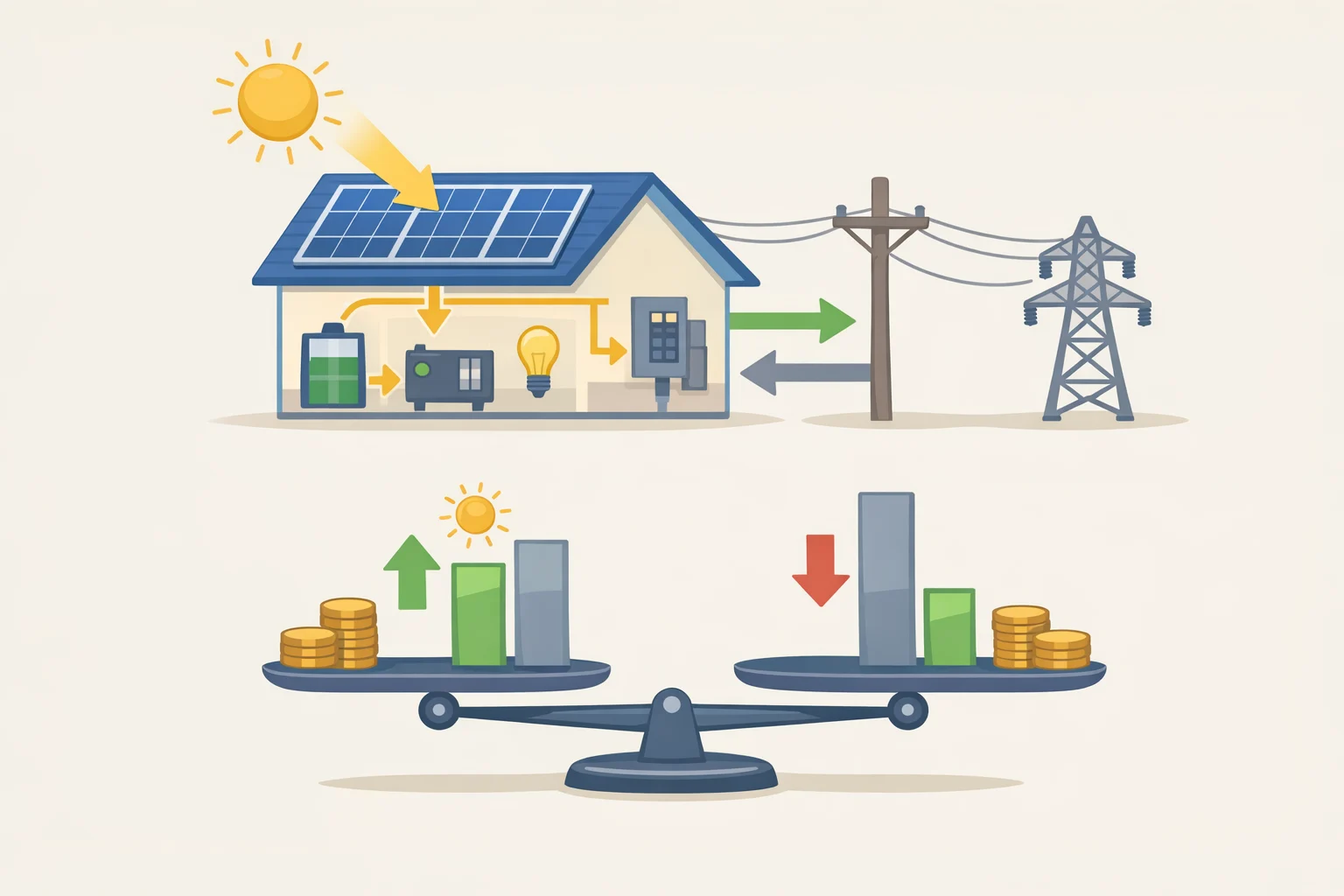
Myth 1: Solar will definitely lower my electricity bill.
Rooftop solar is statistically correlated with higher electricity prices for households without panels. Not because solar generates bad power, but because U.S. distribution networks were built as a one-way street power flows from a central plant to the home. Reverse current from thousands of rooftop generators forces the grid to operate in ways it wasn't designed for, raising operations and maintenance costs that spread across all ratepayers. MIT researchers analyzing 25 years of U.S. electricity data found this correlation is significant (MIT Sloan/CEEPR, earlier this year).
Worth holding onto: utility-scale wind and solar are reliably linked to lower residential prices in the same dataset. The cost-shifting problem is specific to distributed rooftop generation and aging infrastructure, not renewable energy in general. For the homeowner going solar, savings can still be strong under the right tariff and load profile, but those system-level pressures are exactly why utilities are cutting export compensation and redesigning rate structures. Bill savings increasingly depend on self-consumption, not on how many panels are on the roof.
If an installer's payback projection is driven primarily by energy exported to the grid, ask what happens to those numbers if export rates are cut by half in year three. No clear answer means the model is fragile.
Myth 2: Renewable energy mandates are driving up my electricity bill.
MIT's 25-year dataset found that state renewable portfolio standard mandates have virtually zero measurable impact on retail electricity prices. What actually drives higher bills is outdated cost-recovery structure specifically, how utilities charge for poles, wires, and infrastructure maintenance (MIT Sloan/CEEPR, earlier this year).
This clarifies the actual risk for solar buyers. The problem isn't green energy; it's grid policy that hasn't modernized. That same policy gap is why export compensation is shrinking rooftop solar owners in usage-based billing states can pay near-zero infrastructure charges while still relying on the poles and wires. Before accepting any installer's bill-savings projection, look up your state's current net metering rules at the public utilities commission, not the installer's summary of them.
Myth 3: Net metering will make my excess solar power highly valuable.
Traditional net metering where exported solar earns close to the full retail rate is being restructured or replaced across the country. California regulators cut compensation for exported solar energy by roughly 75%, leaving homeowners in major utility territories earning as little as 5–8 cents per kilowatt-hour for midday exports while paying 30–40 cents for evening grid power (NEDES, earlier this year; NEDES is a commercial solar installer the California NEM 3.0 direction is consistent with regulatory filings, but current rates should be verified with the specific utility). Illinois customers under ComEd, Ameren, and MidAmerican who installed solar after January 2025 now receive only supply credits for exported power, not delivery credits a structural change that substantially reduces returns on standalone systems (NEDES, earlier this year).
A system sized to cover daytime load with minimal export outperforms an oversized system in most restructured-rate markets. Before signing, request the specific export compensation rate your utility currently offers in writing, and ask whether it could be revised mid-contract.
Myth 4: Solar pays for itself the same way everywhere.
Local utility rate design, time-of-use pricing, export compensation levels, and fixed infrastructure charges mean that two physically identical rooftop systems same panels, same installer, same annual sun hours can produce dramatically different payback periods depending on which utility serves each home.
A peer-reviewed life-cycle analysis found payback periods under eight years are achievable under favorable conditions, but also found that operating and maintenance costs over a 25-year project life are the dominant cost category, not installation (Science and Technology for Energy Transition, 2025; based on a small system in India, so specific cost ratios don't transfer directly to U.S. installations, but the directional finding aligns with broader industry experience). Ask the installer what share of projected savings comes from self-consumed power versus grid export if the answer leans heavily on exports, treat the model as policy-sensitive and stress-test it accordingly.
Video of the Day
Solar panel myths about batteries and storage economics (myths 5–7)
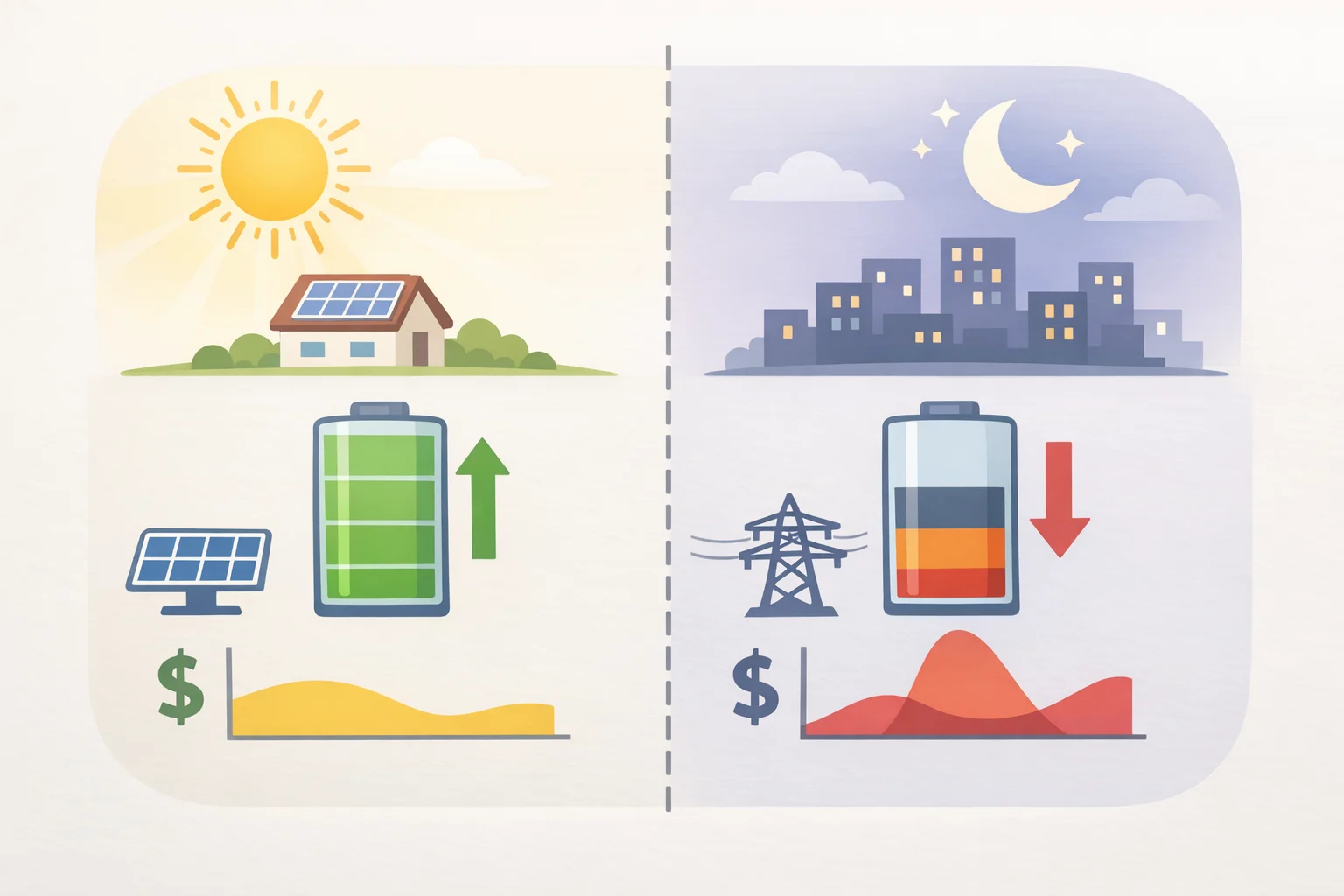
Myth 5: A battery doesn't change the solar math.
Under older net metering rules, exporting excess solar at retail rates made batteries largely redundant. That logic has inverted in states with steep time-of-use pricing. When midday solar export earns 5–8 cents per kilowatt-hour and evening grid power costs 30–40 cents, a battery capturing midday surplus and discharging at peak hours earns a spread of roughly 25–35 cents on every kilowatt-hour it cycles with no change to the panels or the roof (NEDES, earlier this year; the underlying time-of-use arithmetic is independently verifiable from utility rate schedules).
The DOE projects that deploying 80–160 gigawatts of virtual power plants networks of coordinated home batteries, solar systems, and smart appliances by 2030 could serve 10–20% of U.S. peak load while reducing overall grid costs (DOE VPP Liftoff). Homeowners with solar-plus-storage can participate through utility demand-response agreements, earning bill credits or direct payments for allowing controlled discharge during peak events. In active markets like California, Texas, and the Northeast, this adds a second revenue stream that changes the battery's payback calculation independent of its backup value.
Myth 6: Storage is only worth it for homes that lose power regularly.
Resilience is a legitimate reason to add a battery, but it's the weakest financial justification in 2026. The stronger case in most markets is time-of-use arbitrage and self-consumption maximization capturing cheap midday solar and deploying it during expensive evening hours. VPPs already draw on home solar-plus-storage to supply homes during constrained peak hours and charge batteries when electricity is abundant, generating compensable grid services for enrolled households (DOE VPP Liftoff). If an installer is selling storage primarily on the outage angle, ask what the return looks like under your utility's current time-of-use schedule before deciding.
Myth 7: Buying a battery now locks in poor economics if technology improves.
This myth actively delays decisions in households where storage would already be financially justified under current rates. The more accurate risk is buying the wrong battery size, not buying too early. Rate structures driving storage value time-of-use pricing, reduced export compensation are moving in the direction of making storage more financially necessary, not less. Model the battery return using your utility's current export and time-of-use rates. If storage pays under today's rates, future cost declines are upside, not a reason to wait.
What independent testing and lifecycle costs actually show (myths 8–10)
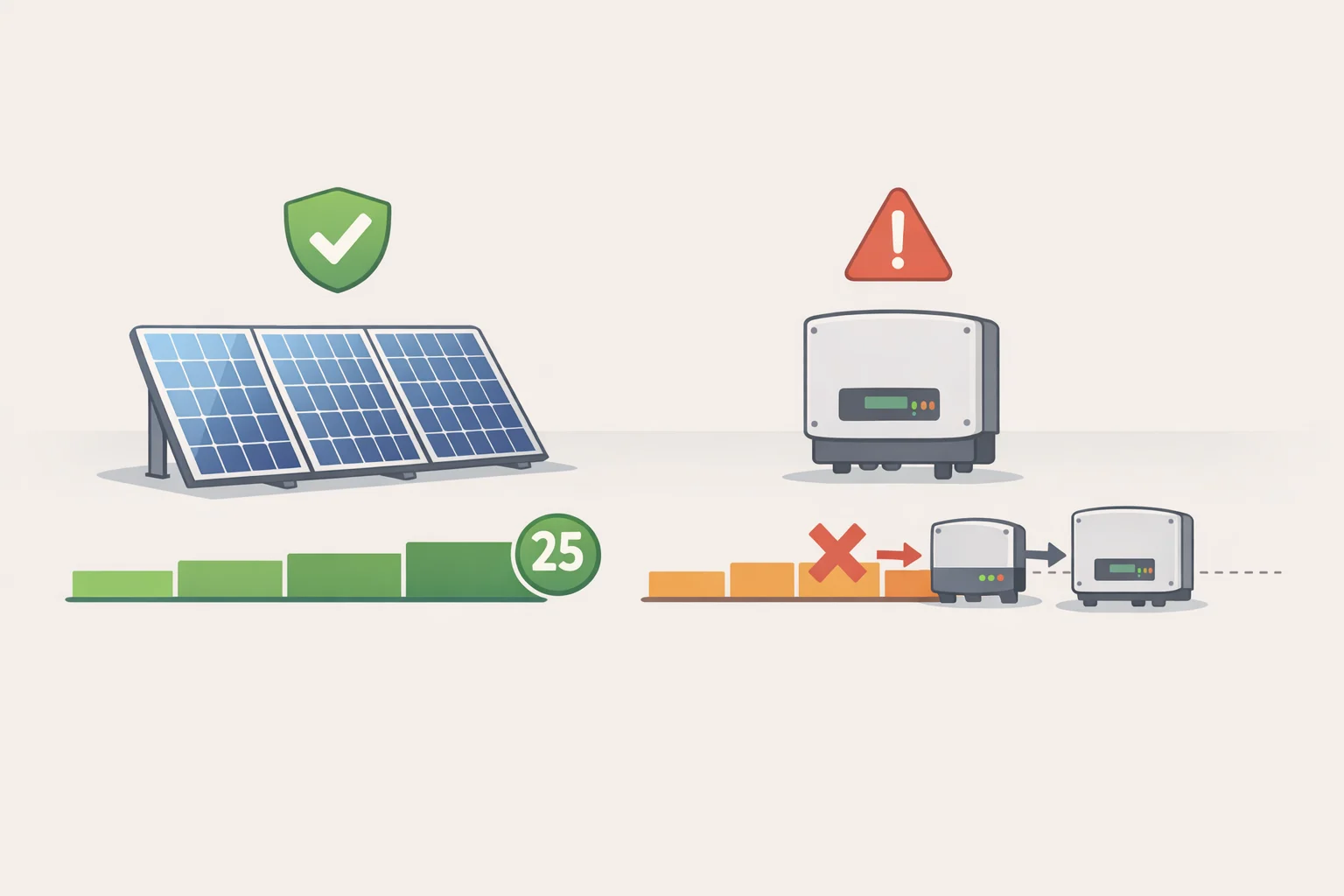
Myth 8: All solar panels are basically the same quality.
Independent testing lab Kiwa PVEL released its 2026 Solar Module Reliability Scorecard with a result unprecedented in the lab's 12-year history: not a single module from any manufacturer earned "top performer" status across all test categories, and 87% of manufacturers experienced at least one failure during testing (pv magazine/Kiwa PVEL, two weeks ago). Tests simulate real field conditions: repeated temperature cycling, moisture exposure, mechanical load from snow and wind, hail impact.
Breakage and delamination rates hit new highs: 26% of bill-of-materials combinations experienced breakage during load testing, and 45% of manufacturers had at least one major delamination failure among submitted modules (pv magazine/Kiwa PVEL, two weeks ago). The same scorecard found performance improvements in energy yield for some products so this isn't a story of universal decline. The spread between stronger and weaker products is widening as manufacturers compress costs. Ask whether the specific module model being quoted has independent Kiwa PVEL test results available, and request the summary. A manufacturer that doesn't submit products for independent testing is itself a signal worth taking seriously.
Myth 9: A 25-year warranty means I don't need to think about reliability.
A warranty covers replacement cost under defined failure conditions. It doesn't cover lost energy production during downtime, labor for a mid-roof repair, or components carrying shorter warranty terms than the panels themselves.
Microinverter warranties in systems analyzed by a peer-reviewed life-cycle study ran to 10 years meaning at least one inverter replacement within a 25-year system life is close to certain, not contingent (Science and Technology for Energy Transition, 2025; India-based case study, but the warranty structure is consistent with manufacturer specifications in major global markets). Inverters and balance-of-system elements were identified as the primary non-panel cost drivers. Request a full component-by-component warranty schedule before signing panels, inverters, racking, monitoring system with explicit replacement cost estimates at each expected end-of-life date. Inverter replacement is not a contingency over 25 years; it's a near-certainty within 10–12.
Myth 10: Solar is maintenance-free once installed.
A peer-reviewed life-cycle analysis found that operations and maintenance expenses panel cleaning, inspections, component checks, inverter servicing accounted for roughly 74% of total lifetime system cost over 25 years (Science and Technology for Energy Transition, 2025; India-based case study; the specific percentage doesn't transfer directly to U.S. cost structures, but the structural finding that ongoing costs dominate installation costs over a full lifecycle is consistent with the field broadly). A 25-year projection that excludes realistic maintenance isn't a payback analysis; it's a best case. Ask for a written maintenance schedule with estimated annual cost. Any answer that amounts to "the monitoring app handles it" is not a plan.
Why production estimates may not hold for 25 years (myths 11–12)
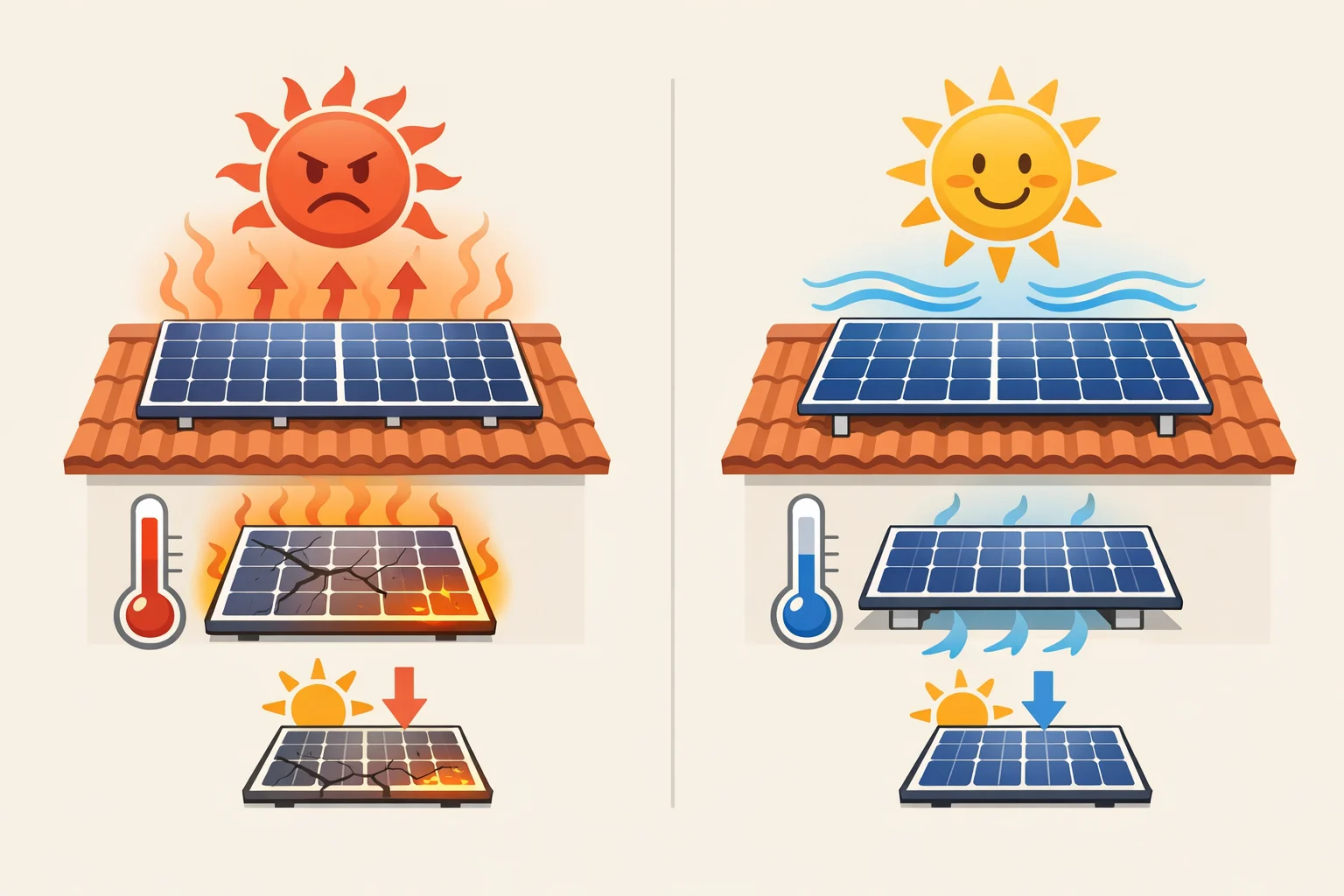
Myth 11: Heat doesn't meaningfully affect how long my panels last.
Rooftop panels face a heat problem that ground-mounted systems largely avoid: narrow mounting gaps trap heat, keeping operating temperatures significantly higher than open-air installations. A global study published in Joule drawing on research from Peking University, Zhejiang University, the University of Michigan, and Purdue found that climate-change-driven temperature increases could raise the levelized cost of electricity from rooftop solar by up to 20% in some regions, roughly three times larger than cost effects from efficiency or irradiance changes that prior research concentrated on (pv magazine/Joule, earlier this year). The study modeled outcomes across warming scenarios using a baseline degradation rate of 0.66% per year.
At 4°C of warming, global rooftop solar capacity exposed to high-temperature risk could nearly double compared to historical levels. For buyers in hot U.S. markets, this is a current-decade production variable, not a distant scenario. Ask installers what operating temperature the 25-year production estimate assumes and whether the mounting design includes any thermal management provision.
Myth 12: The certifications on my panels accurately reflect how they'll perform in my actual climate.
The international standard most commonly referenced for solar high-temperature risk (IEC-63126) is calibrated to historical weather data from roughly 1998–2020. At 2°C of warming, that standard captures only 74% of global rooftop capacity projected to face actual high-temperature risk; at 4°C, the figure drops to 48% (pv magazine/Joule, earlier this year). The benchmarks certifying a panel as suitable for a given climate were designed for a climate that no longer describes much of the world's rooftop solar installations.
Researchers working with IEC Technical Committee 82 the body responsible for PV energy system standards have flagged this gap explicitly, warning that investors and installers using current standards risk underestimating degradation and facing unexpected replacement costs. Standards revisions are in progress but not yet finalized. For dark-colored roofs with tight-fit mounting in warm climates, ask whether the modules being quoted are rated for elevated temperature exposure beyond standard certification.
Before you sign: five filters in sequence
1. Utility rate check. Confirm your utility's current export compensation rate in writing and whether it's grandfathered for new installations. If the installer's payback projection leans heavily on export revenue and that rate can be revised mid-contract, the projection needs a stress test. The right source: your state public utility commission's net metering tariff schedule, not the installer's summary of it.
2. Self-consumption sizing. Ask what percentage of projected production the system is designed to self-consume versus export. Systems prioritizing self-consumption are better protected against export rate changes. If the installer can't answer clearly, the system may be oversized for your actual consumption pattern.
3. Equipment vetting. Confirm the specific module model has independent Kiwa PVEL or equivalent test results available, and request the inverter's warranty term with a replacement cost estimate at end of that term. Budget inverter replacement as a line item, not a contingency.
4. Maintenance plan. Request a written maintenance schedule with estimated annual cost. Follow up "the monitoring app alerts you" with: who performs the service, at what cost, and on what timeline? A system without a service plan isn't maintenance-free it's unmaintained.
5. Climate-adjusted production (hot climates). In any market where summer roof temperatures routinely exceed standard test conditions, ask what degradation rate the 25-year production estimate uses and whether it accounts for mounting design and local climate trajectory. The Joule study used a 0.66% annual baseline if an installer's estimate uses a lower figure without explanation, that's worth pressing on.
What home solar in 2026 actually requires
The case for home solar hasn't collapsed, but it has matured. As MIT's researchers put it: "High electricity bills aren't an inevitable side effect of going green; they are the result of outdated policy choices" (MIT Sloan/CEEPR, earlier this year). The same logic applies to the individual buyer the outcome of a rooftop installation isn't determined by the technology. It's determined by how well the design matches the local policy and physical environment.
Buyers most likely to see strong returns designed for self-consumption rather than grid export, verified hardware quality through independent testing records rather than manufacturer warranties alone, and budgeted for inverter replacement and ongoing maintenance as known costs. Where those conditions exist, payback under eight years is achievable; where they don't, the same physical system can underperform significantly (Science and Technology for Energy Transition, 2025).
The trajectory points toward more self-consumption, more storage, and deeper integration with grid programs that aggregate home solar-plus-storage into virtual power plants capable of serving 10–20% of peak U.S. load under DOE projections (DOE VPP Liftoff). Buyers who size and design for that grid rather than the one most sales materials were written for are positioned for a system that gains value as policy evolves.
Where to go deeper: Your state's public utility commission publishes current net metering and export compensation rules that's the most important document before any installer conversation. Kiwa PVEL's annual scorecard is publicly summarized at pv magazine and worth reviewing before committing to a module brand. The DOE's VPP Liftoff page explains how solar-plus-storage connects to broader grid programs context that directly affects whether a battery makes financial sense in your market.