Robot Mower vs Riding Mower: 5 Key Capability Differences
A riding mower is a vehicle. It needs someone in the seat every time it runs 30 to 45 minutes of active operator time for a quarter-acre lawn, every single week, for the entire growing season. That constraint isn't incidental to how riding mowers work. It defines almost every meaningful capability gap in the robot mower vs riding mower comparison.
A robot mower works more like a household appliance than a piece of outdoor equipment. Once configured, it mows on its own schedule, returns to its charging dock, and starts again without any human input. Two of the five capability differences covered here are absolute: no riding mower mows without an operator, and none navigates from a virtual digital map. The other three quiet operation, continuous micro-trimming, and reduced soil compaction are structural advantages that riding mowers can't replicate without someone at the controls every time. All five are real. None of them apply to every yard.
One clarification before diving in: not all robot mowers are the same tier of machine. The virtual boundary mapping and app-based zone control discussed in sections two through five are specific to wire-free RTK and vision-based models, the newer mid-to-premium category. Older wired perimeter robots are cheaper, widely available, and capable of autonomous operation but they don't offer the digital zone logic described here. Where a capability is model-dependent, the text says so.
1. Mow without anyone present
Video of the Day
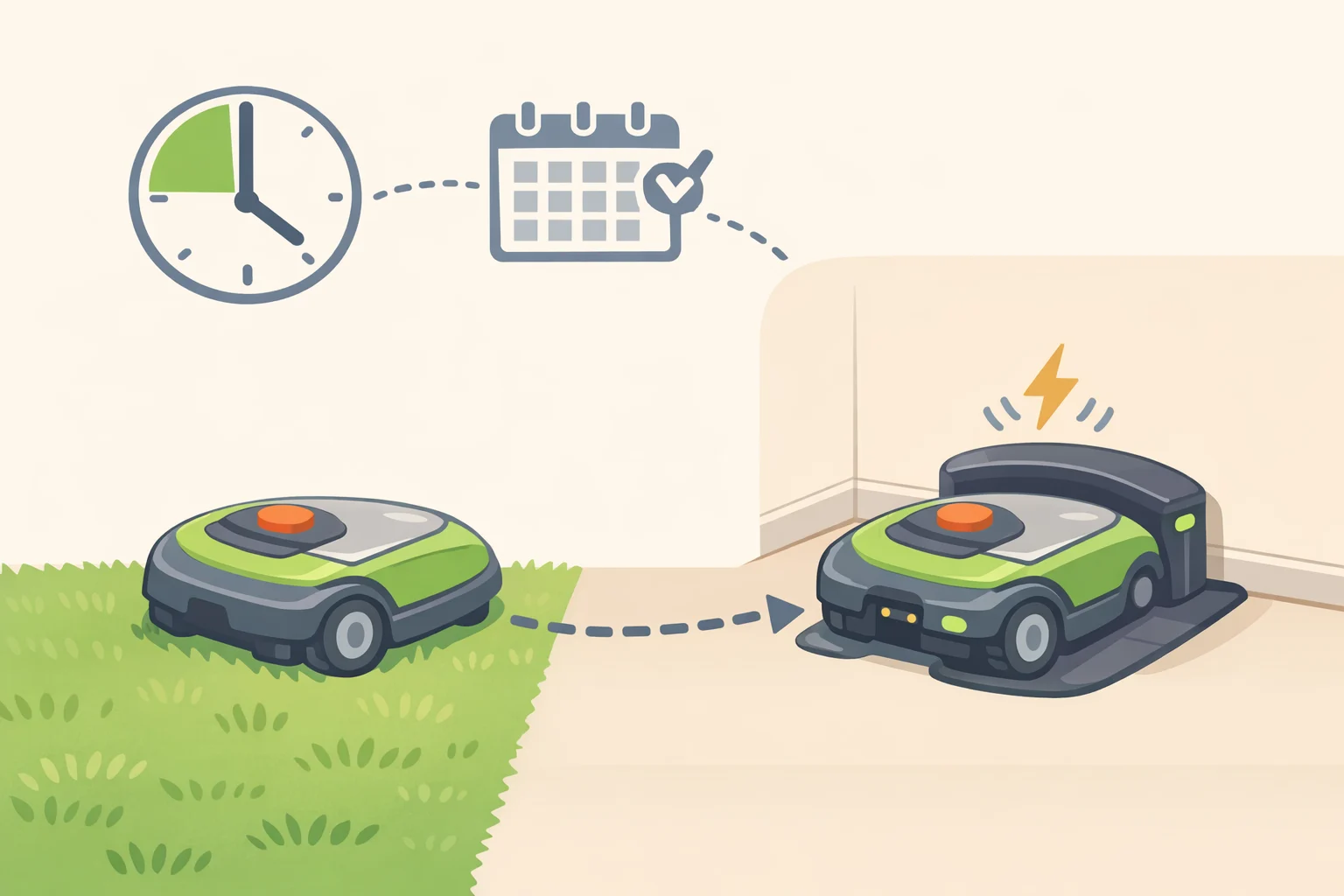
This is the root difference. A riding mower needs a person at the controls every time it runs no workaround, no exception. A robot mower, once its boundary is set, mows on its own schedule, docks to recharge when needed, and resumes without any human prompt. That's not a feature. It's a different category of machine.
For a quarter-acre lawn mowed weekly, a conventional mower requires roughly 30 to 45 minutes of active operator time per session; a robot mower logs more total runtime but demands zero hands-on minutes per cycle, according to Lawn Care Center. University of Florida IFAS research confirms that autonomous mowers reduce labor requirements and operator fatigue benefits that compound across a full growing season of weekly runs. The UF IFAS extension guide notes that once installed, the mower works within its set boundary and returns to its charging station as needed.
Think of the difference between a dishwasher and washing dishes by hand. Both get dishes clean. One requires you to be there the whole time.
That said, "unattended" comes with conditions. Robot mowers can navigate obstacles up to about two inches tall, but gardening tools left outside, pet toys, and fallen branches are genuine operational hazards. The autonomy works best in a tidy yard. Beyond clutter, Lawn Care Center is direct: yards with sustained slopes above 30 degrees, frequent wet-grass conditions, or unfenced drop-offs are better suited to a riding mower regardless of other preferences. The remaining four advantages all extend from this one they exist because robot mowers are lightweight, electric, self-navigating systems rather than operator-driven vehicles.
Video of the Day
2. Follow a digital map including no-go zones, separate lawn areas, and app-adjusted boundaries

A riding mower goes where it's steered. A wire-free robot mower follows a digital map stored in software one that defines mowing zones, flags areas to avoid, and routes the mower between separated sections of lawn. Users can redraw that map from a phone without touching the machine. This capability is specific to wire-free RTK and vision-based models.
Wire-free robot mowers define all operating boundaries digitally, through RTK (Real-Time Kinematic) GPS positioning, camera-based vision, or a combination of both, with no physical wire buried in the yard. Through companion apps, users can configure distinct mowing zones, draw no-go areas around garden beds or play equipment, and map paths between separate lawn sections, Trivando's hands-on testing found. RTK delivers centimeter-level accuracy using a reference station to correct GPS signal data in real time. Many modern systems pair RTK with onboard cameras for obstacle detection and edge recognition a combination Trivando notes is often the most effective in practice, particularly in yards with irregular layouts or frequent obstacles.
In everyday terms: a homeowner can mark a garden bed as off-limits, designate a corridor between the front and back yard, or tell the mower to skip the area near the playset then change any of it next week from their phone. A riding mower can't do any of that without the operator making every judgment call in real time.
Older wired perimeter models use a buried low-voltage cable to establish the mowing boundary, a one-time installation lasting several hours. They're cheaper and widely available, but they don't support app-based zone logic or virtual no-go areas. That digital flexibility is a wire-free, RTK/vision-tier capability only, Lawn Care Center confirms.
Wire-free doesn't mean setup-free, though. Trivando's testing found that skipping the boundary wire shifts the effort to the digital side: positioning the RTK reference station correctly, completing an initial mapping run, and fine-tuning zone edges in the app. A poorly configured virtual map not hardware failure is the most common source of early operational frustration. Think of it as different setup, not less setup.
3. Run quietly enough to mow on its own schedule
A gas riding mower generates 90 to 100 decibels, roughly equivalent to a motorcycle at close range. A robot mower runs at 55 to 65 decibels, around the level of a normal conversation. That gap isn't a comfort preference it determines when mowing can actually happen without disturbing neighbors, household members, or local noise ordinances, according to Lawn Care Center. Electric conventional mowers land in the middle at 70 to 80 dB, quieter than gas but still disruptive enough to matter.
UF IFAS identifies reduced noise as a documented, peer-reviewed advantage of autonomous mowers over gasoline-powered equipment, alongside lower fuel use and reduced emissions. The practical implication is straightforward: a gas riding mower operating at 6 a.m. on a Tuesday in a suburban neighborhood is far more likely to create noise issues than the same mow done quietly and automatically. A robot mower can run during a backyard gathering, before the neighborhood wakes up, or while the household is at work without becoming anyone's problem.
Combined with full autonomy, quiet operation is what makes flexible scheduling genuinely autonomous. There's no tradeoff between the mower running at a convenient time and someone having to operate it at that time. The mower handles both.
4. Trim continuously rather than in weekly passes and what that does to turf
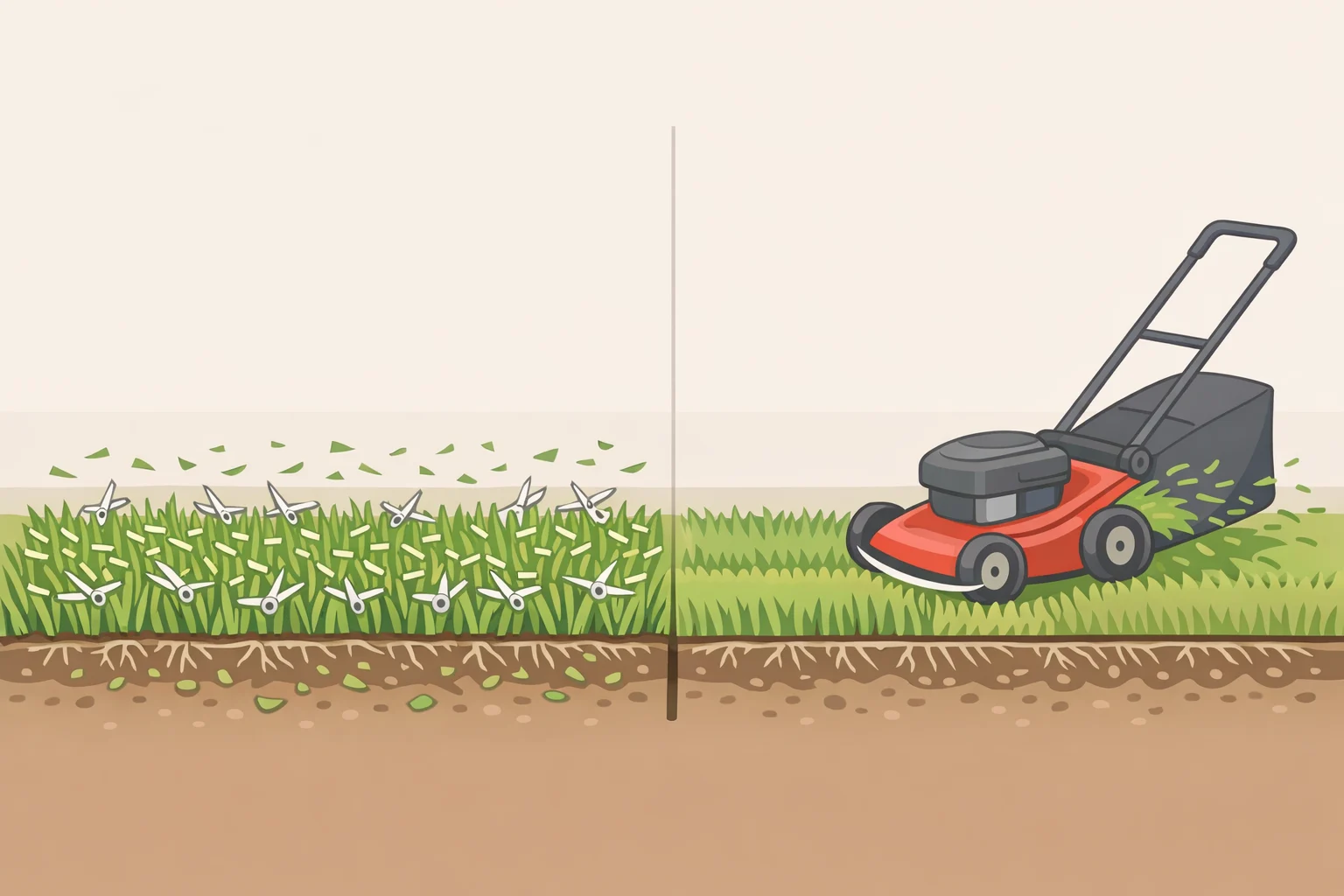
Riding mowers mow once a week and stop. Robot mowers make frequent, shallow passes treating lawn maintenance as a continuous process rather than a periodic event. That difference produces measurable turf outcomes, though the benefits are grass-type-dependent and not universal.
Frequent micro-cuts produce small clippings that act as continuous mulch, reducing the growth-stress spikes that occur when a lawn is cut back significantly in a single session, Lawn Care Center notes. The blades on robot mowers measure under 1.5 inches compared to roughly 20 inches on a conventional rotary deck producing a cleaner, more precise cut that UF IFAS research found reduces leaf fraying, yellowing, and overall turf stress. In controlled UF studies, St. Augustinegrass maintained by a robot mower showed more uniform green cover than the same grass cut traditionally, particularly during spring and fall; zoysiagrass showed higher turf quality and greater shoot density under autonomous mowing.
These benefits are conditional. Most robot mowers were originally designed for cool-season grasses mowed below 2.5 inches. Warm-season varieties like St. Augustinegrass require cutting heights of 2.5 to 4 inches that some models can't reach, and UF IFAS notes that research on bahiagrass, centipedegrass, and bermudagrass remains limited. The micro-trim advantage is well-supported for compatible grass types, but it's not a blanket promise for every lawn.
A riding mower cannot make unattended passes several times a week. The continuous micro-trim approach is structurally enabled by autonomy it's not a setting a riding mower can replicate without an operator at every run.
5. Stay light enough to avoid soil compaction
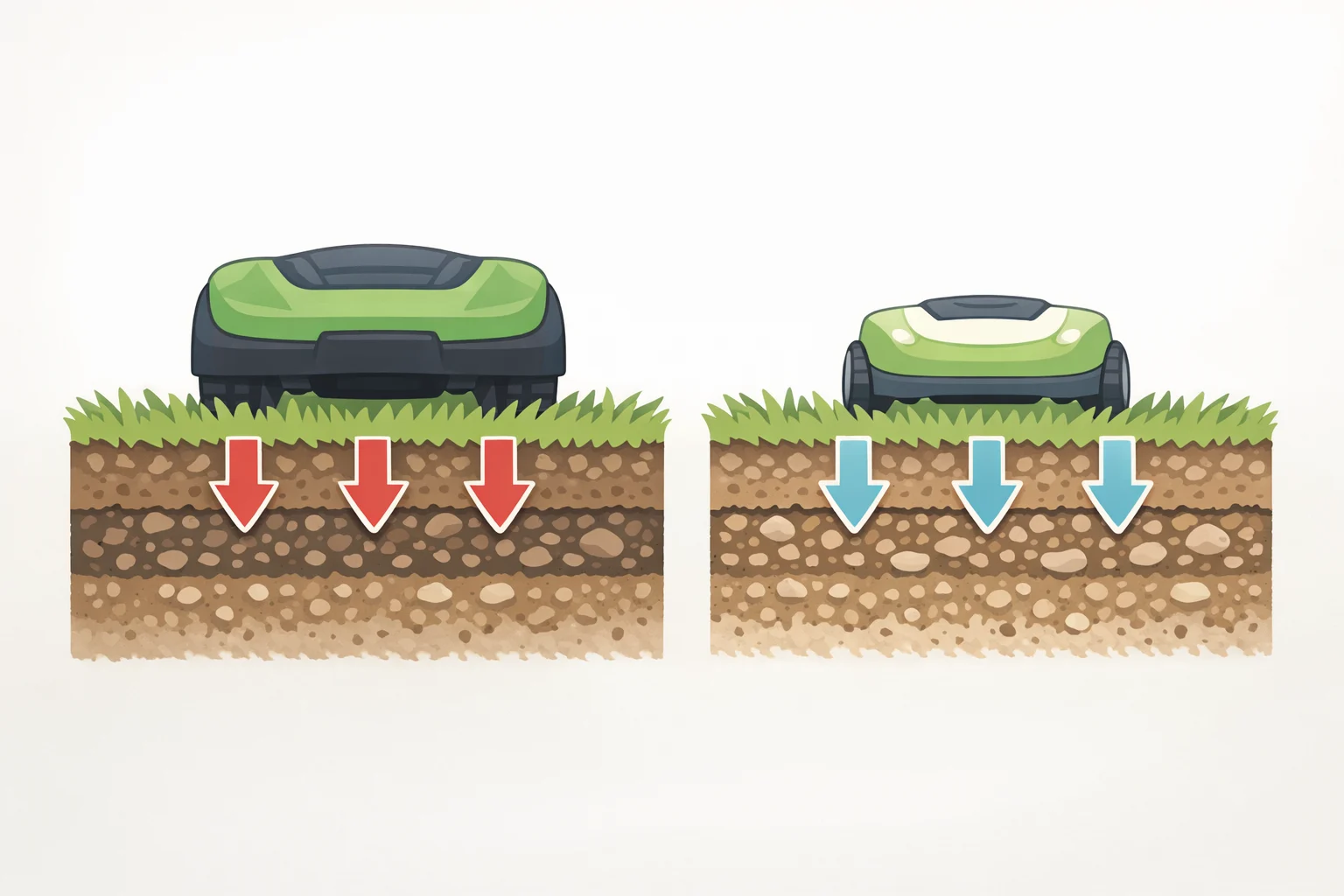
Repeated mowing passes by heavy equipment compact the soil beneath the turf, restricting aeration and limiting root growth over time. Robot mowers sidestep this problem entirely because of their weight. UF IFAS lists reduced soil compaction as a documented advantage of robot mowers, a direct result of their lightweight build relative to conventional mowing equipment. The same research found that autonomous mowers can improve turf density and overall lawn quality over time, partly because of reduced physical pressure on the soil from lighter ground contact.
This is a consequence of physics, not a configurable feature. A riding mower's weight is structural it's what gives the machine its brute-force capability on difficult terrain.
When riding mowers still have the clearer case
The same weight that causes compaction is exactly what makes riding mowers effective in demanding conditions. They handle tall or wet grass, bag clippings, manage large and complex properties, and navigate sustained slopes more reliably than any current consumer robot mower. Lawn Care Center is direct: if a yard has sustained slopes above 30 degrees, frequent wet-grass conditions, or unfenced drop-offs, a riding mower is the safer and more practical default regardless of other preferences.
Bagging is another hard gap. Robot mowers mulch only they don't collect clippings. For lawns that regularly accumulate debris, or owners who need clippings removed, that's a non-starter.
Upfront cost and lifespan also tilt toward traditional equipment. Riding mowers carry a significantly longer mechanical lifespan 15 or more years is common with regular service, compared to 7 to 10 years for most robot mowers, where the lithium battery pack is typically the limiting component, Lawn Care Center reports. For someone who already owns and services a riding mower, the math on switching rarely pencils out quickly.
Robot mower vs riding mower: which yards benefit most?
Five real capabilities are only worth paying for if the yard actually makes use of them.
Robot mowers are a strong fit when:
- The lawn falls between roughly 0.05 and 1.73 acres, depending on the model; wire-free RTK units currently top out near that upper range (Lawn Care Center)
- The layout is relatively open, with few complex obstacles, narrow passages, or frequent debris
- The grass type is compatible with the mower's cutting height range worth confirming before purchasing, especially for warm-season varieties (UF IFAS)
- The owner's primary goal is reclaimed time and quieter operation, not raw mowing power or bagging capability
Riding mowers remain the practical default when:
- The property has sustained slopes exceeding 30 degrees, frequent wet-grass conditions, or unfenced drop-offs (Lawn Care Center)
- Regular bagging is required, or the lawn frequently accumulates debris that would stop an autonomous mower
- The yard is large or complex enough to push past robot mower coverage limits
On cost: robot mowers typically recover their price premium somewhere between years four and seven a reasonable long-term proposition for owners who value the time savings, but not an automatic win for someone who already runs a well-maintained riding mower, Lawn Care Center notes.
The bottom line for buyers
Robot mowers aren't a better version of a riding mower. They're a different category of machine built on a different premise. The two hard capability gaps no operator required, navigation from a virtual digital map aren't features that riding mowers could eventually add. They're structural. The three advantages that follow (quiet operation, continuous micro-trimming, lower soil compaction) exist because robot mowers are lightweight, electric, self-navigating systems. Riding mowers are none of those things, by design.
If the yard falls under roughly an acre, has a manageable layout, uses a compatible grass type, and the weekly operator time is what the owner most wants back, robot mowers already deliver on all five capabilities. For large properties, steep terrain, wet conditions, or bagging needs, the riding mower still has a clear case, as both UF IFAS and Lawn Care Center confirm.
RTK navigation, vision-based obstacle detection, and app zone logic are improving at a meaningful pace, and Trivando's 2026 hands-on comparison found wire-free systems increasingly reliable in real-world yard conditions. For the right yard, the technology is ready now.
Readers evaluating specific models should consult CNET's hands-on testing of nine robot mowers; those in warm-climate states should review the UF IFAS extension guide for grass-type-specific guidance before purchasing.