Can You Bring a Power Bank on a Plane? Carry-On Rules Explained
Yes, you can bring a power bank on a plane but only in your carry-on baggage, and only if it meets capacity and quantity rules that tightened in March 2026. Pack one in checked luggage and you may be required to remove it at the gate, surrender it, or miss your bag cutoff, depending on the airline and checkpoint. This guide walks through exactly how to check your power bank's capacity, how to pack it correctly, and what changed about in-flight use under the ICAO addendum that took effect earlier this year.
The short answer, before the details:
- Carry-on only, always. No exceptions.
- Under 100 Wh: generally allowed under both FAA and IATA rules.
- 100–160 Wh: may be permitted with airline approval under current FAA rules and through end of 2026 under IATA's transitional guidance. Not carried into 2027 international standards for power banks specifically.
- Over 160 Wh: not permitted on passenger aircraft, per IATA.
- Two-bank limit: in force now under the ICAO/IATA March 2026 addendum; binding internationally from January 2027.
- Never leave a power bank in a gate-checked bag.
- Check your airline. Their policy may be stricter than any of the above.
The rest of this guide explains why those rules exist, how to verify you're compliant, and where most travelers go wrong.
Why power banks are classified as spare batteries and why that determines everything
Video of the Day
In airline rules, a power bank is a spare battery. IATA's passenger guidance states it plainly: any device whose primary purpose is to supply power to another device is treated as a spare battery, not a consumer electronics item. A laptop battery is installed in the laptop and serves the laptop. A power bank exists to power something else. That single distinction is why a laptop can go in checked luggage and a power bank cannot.
The carry-on requirement is a fire-response strategy. Lithium-ion batteries can enter thermal runaway, a self-sustaining chain reaction that generates intense heat and can ignite, when damaged, short-circuited, or overcharged. IATA explains the logic directly: if a battery ignites in the cargo hold, crew cannot reach it. In the cabin, they can act immediately. The rule exists because the cabin is the only place where a response is possible.
The March 2026 ICAO addendum goes further. IATA's guidance on the addendum formally separates power banks into their own regulatory category, with requirements that exceed the spare battery rules they previously fell under. The stated driver: concerns about manufacturer oversight and the volume of uncertified, unlabeled devices on the market.
Understanding which rules apply to you
Three distinct layers govern what any individual traveler is allowed to carry, and they don't always agree:
- FAA/TSA baseline: carry-on only; under 100 Wh generally allowed; 101–160 Wh may be permitted with airline approval; no general quantity cap for personal-use spare batteries. The TSA adds that the checkpoint officer holds final discretion a bank that meets the FAA baseline may still be questioned if its label is unreadable or if the airline's own policy is tighter.
- IATA/ICAO March 2026 addendum: power banks split into their own category; maximum two per person; no recharging the bank in flight; the recommendation not to use it to charge other devices in flight; 100–160 Wh with operator approval only through end of 2026, not carried into 2027 international rules.
- Airline policy: may be stricter than either. Both domestic and international carriers can impose lower capacity or quantity limits, per FAA PackSafe guidance. Check before you fly.
The IATA/ICAO addendum applies on international routes and on any airline that has already adopted the standard domestically. The FAA baseline governs US domestic travel at minimum, but airlines flying those routes may voluntarily apply the tighter IATA standard. When the sections below reference what IATA/ICAO now require, that distinction is worth keeping in mind.
Video of the Day
Power bank carry-on rules: what you need to check before you pack
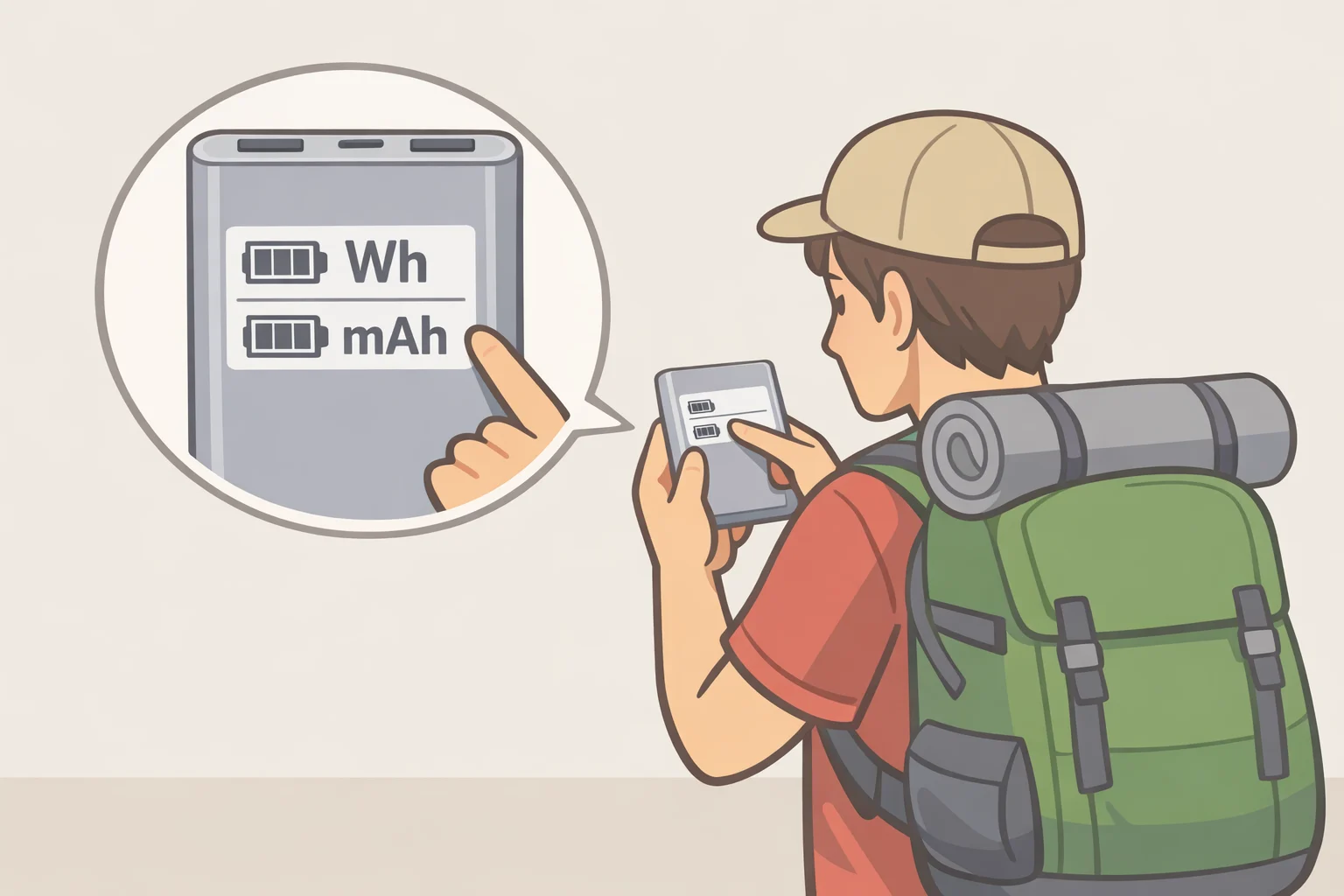
Locate the label on your device before anything else. You need either a watt-hour (Wh) rating printed on the device, or a milliamp-hour (mAh) rating combined with a voltage. If neither is legible, that's a compliance problem addressed below.
The 100 Wh limit
The standard ceiling for lithium-ion spare batteries is 100 Wh per unit, per FAA PackSafe guidance updated this past April. Most consumer power banks fall well under this threshold; a 20,000 mAh bank at 3.7V works out to roughly 74 Wh. Verify rather than assume, though the label is the only number that counts at the checkpoint.
The FAA's rules currently allow some 101–160 Wh lithium-ion spares to travel with airline approval. For power banks specifically, that window is closing. IATA's addendum does permit 100–160 Wh power banks with operator approval through the end of 2026, but that provision will not carry into the 68th edition DGR, citing concerns about oversight of power bank manufacturers. A bank above 100 Wh is in a grey zone for the remainder of this year and prohibited under formal international standards from January 2027. Anything over 160 Wh is not permitted on passenger aircraft at all, per IATA.
Calculating Wh when your label shows only mAh
Multiply the mAh rating by the voltage (typically 3.6V or 3.7V), then divide by 1,000.
- 20,000 mAh at 3.7V = 74 Wh. Well under the limit.
- 27,000 mAh at 3.7V = roughly 100 Wh. Right at the ceiling.
- 30,000 mAh at 3.7V = approximately 111 Wh. Over the limit under both current and forthcoming IATA rules for power banks.
If there is no readable rating
The compliance failure belongs to the manufacturer; the problem lands with the traveler at the checkpoint. An unlabeled or illegibly labeled bank may be stopped at screening or rejected by the airline. Replace it before the trip, or travel with something you can verify. IATA recommends checking the label before every trip.
The two-bank limit
The FAA sets no hard quantity ceiling for standard spare batteries carried for personal use. The IATA/ICAO addendum introduces a firm limit of two power banks per person, a restriction specific to power banks that becomes formally binding under the 2027 DGR. On international routes and airlines that have adopted the IATA standard, two is the ceiling now.
Three small banks, each under 100 Wh, does not clear the limit. The count is what matters, not just the capacity.
Pre-pack checklist
- Is it a power bank? Carry-on only, no exceptions.
- Is the Wh rating readable on the device? If not, don't bring it.
- Is it under 100 Wh? Allowed. Between 100–160 Wh? Permitted with operator approval through 2026 only; prohibited under 2027 IATA rules for power banks. Over 160 Wh? Not permitted on passenger aircraft.
- Bringing more than two? Under the IATA/ICAO 2026 standard, reduce to two.
- Is it swollen, cracked, or running unusually hot? Leave it home.
Step 2: Pack it correctly and know the gate-check trap
Condition first
A swollen, punctured, or visibly damaged power bank cannot legally travel on any aircraft. The FAA explicitly prohibits carrying damaged or recalled batteries aboard unless the battery has been removed or rendered safe. IATA is equally direct: don't travel with compromised batteries. Inspect before packing, not at security.
Protect the terminals
Exposed metal terminals that contact a coin, key, or another battery can cause a short circuit. The FAA's acceptable methods: original retail packaging, tape over the terminals, a dedicated battery sleeve, or a separate plastic pouch. IATA's 2026 addendum makes individual protection a formal requirement; each bank protected separately, not loosely together in the same bag pocket. Tossing two banks and a set of keys into the same compartment is non-compliant.
The gate-check trap
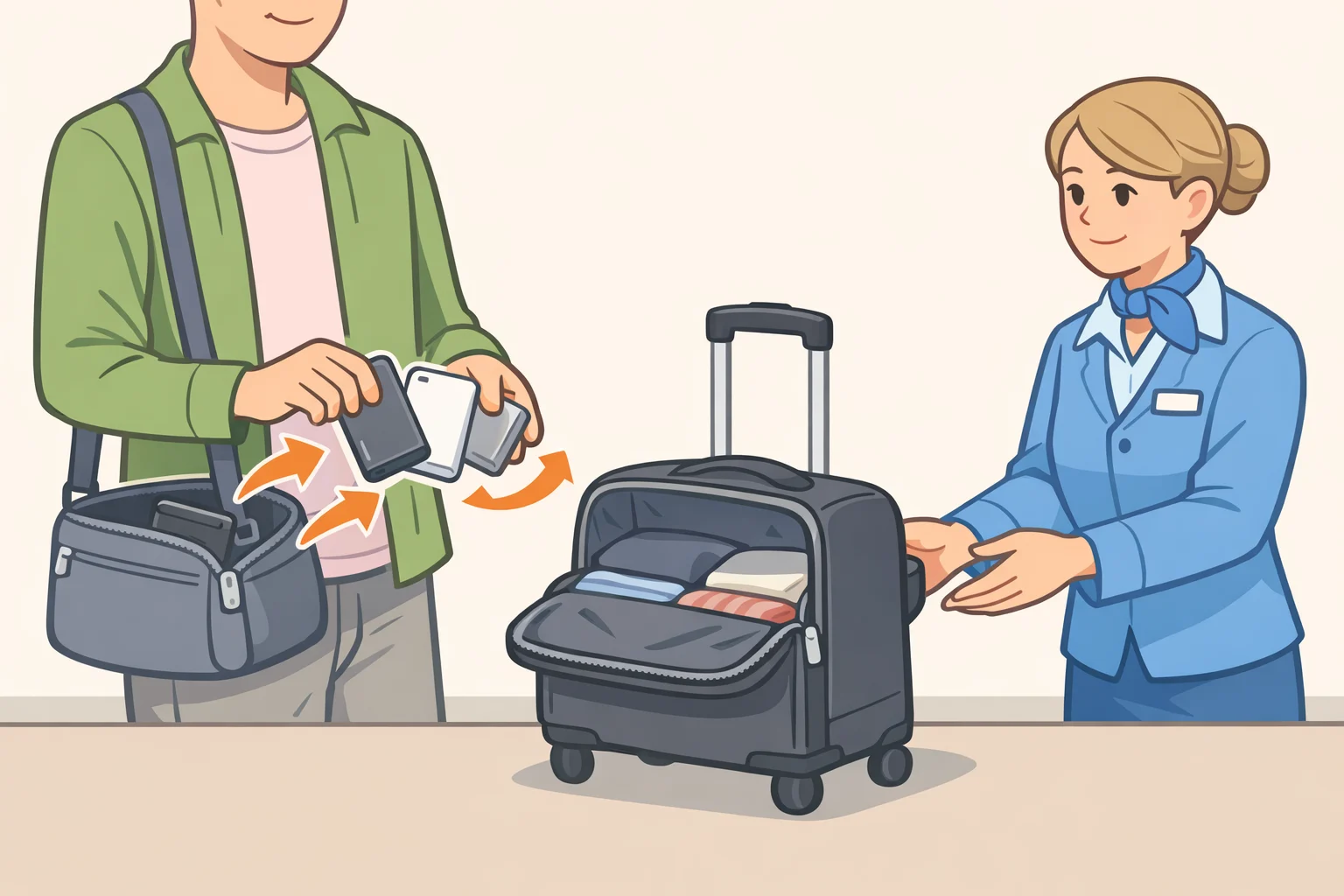
When overhead bins fill up and an airline gate-checks a carry-on, that bag goes into the cargo hold. Any power bank left inside it is now in exactly the position regulators prohibit. Both the FAA and IATA require passengers to remove all spare batteries and power banks from a bag before it is gate-checked, and carry them onto the plane in a personal item or by hand.
This is where most unintentional violations happen. About two in five passengers admit to putting lithium-powered products in checked luggage, and 30% of passengers in gate-check situations report they were never asked about lithium batteries, per ULSE data from last year. Not being asked is not clearance. The responsibility to act sits entirely with the traveler.
Step 3: What you can and cannot do with a power bank in flight
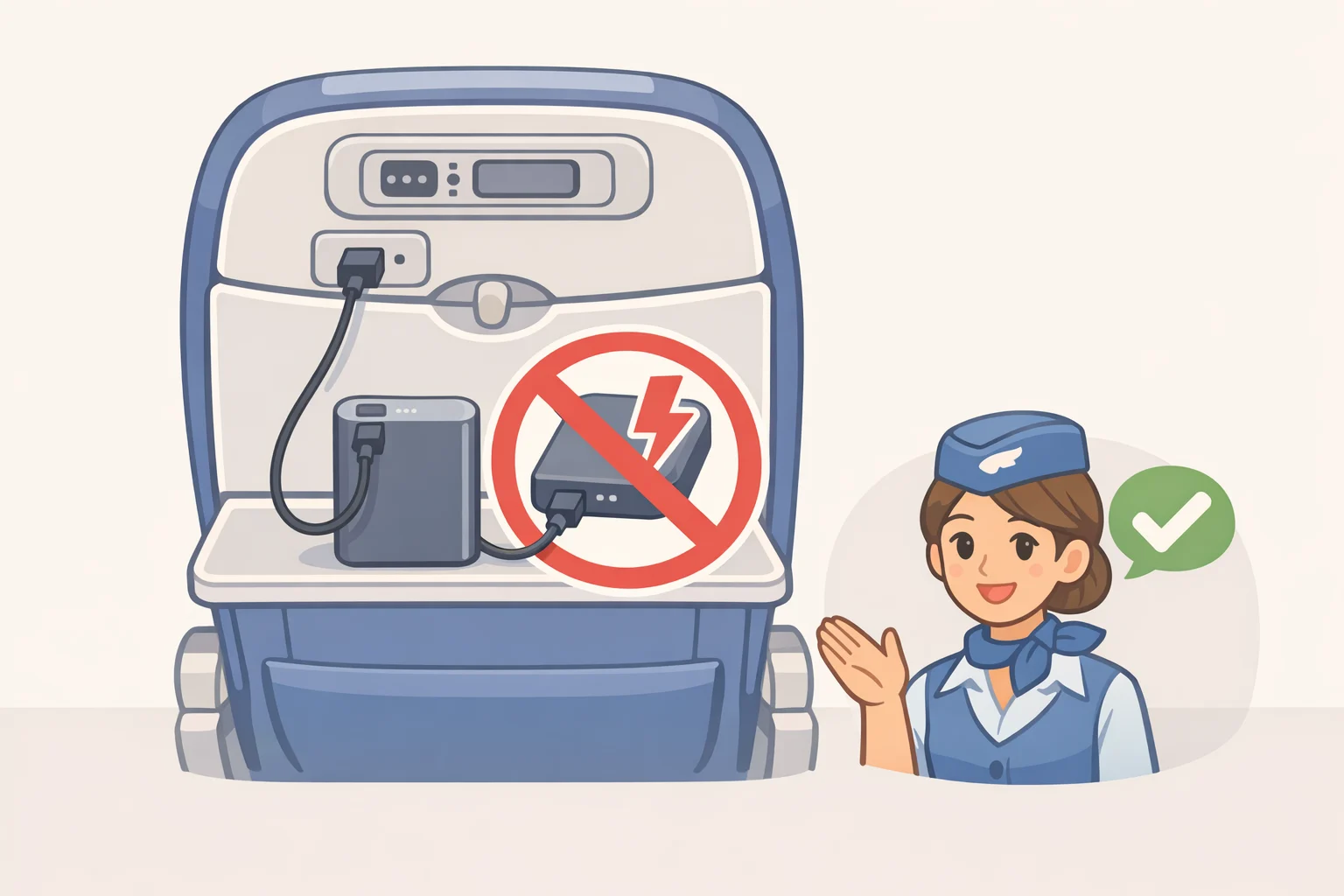
Power bank carry-on rules aren't new. What changed, under the ICAO addendum effective 27 March 2026, is what you're permitted to do once you're seated.
Two distinct restrictions now apply. Recharging the power bank itself during a flight, plugging it into an aircraft USB port to top it up, is prohibited outright. Using the power bank to charge another device during the flight is officially discouraged under the same addendum, stated as a recommendation rather than a hard prohibition.
These are not the same thing. The hard rule covers one direction of charging; the recommendation covers the other. Travelers who do both habitually should treat the recommendation as the direction of travel for 2027.
The rule layers, precisely stated:
- Required under ICAO/IATA: carry-on only; no in-flight recharging of the power bank itself; no more than two per person; terminals individually protected; 100 Wh or under.
- Recommended under the same addendum: don't use the power bank to charge other devices during flight.
- Check with your airline: exact quantity limits, whether a specific bank above 100 Wh carries operator approval for 2026, and what the checkpoint officer decides at screening.
If something goes wrong in flight a device overheats, smokes, or falls into a seat mechanism IATA's guidance is clear: notify the crew immediately, don't attempt to cool or move the device yourself, and follow their instructions. Cabin crew are trained and equipped for lithium battery incidents. The reason power banks must stay in the cabin is precisely so that response is possible.
Five failure points that catch travelers at security and boarding
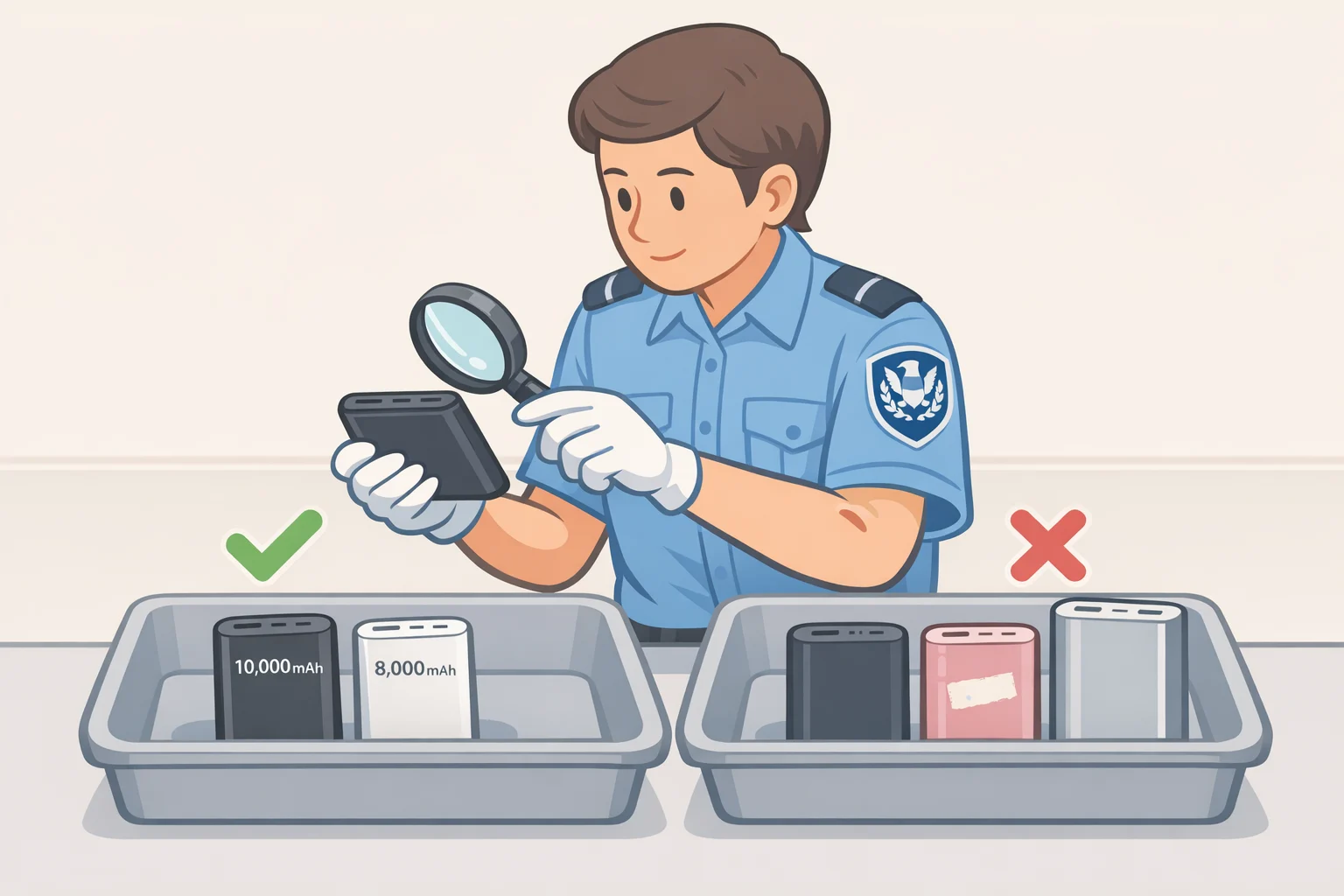
Most people carrying a single standard power bank are already compliant without knowing it. The problems cluster around a handful of specific scenarios:
Unreadable label. No printed Wh or mAh rating means no way to verify the capacity at the checkpoint. The bank may be stopped, and the traveler has no recourse. Buy something labeled or replace it before the trip.
Oversized banks. A 27,000 mAh bank sits right at the 100 Wh ceiling. A 30,000 mAh bank clears it. Neither is obviously oversized, which is why travelers carry them confidently and get surprised at screening.
Three banks, all under 100 Wh. Each one individually compliant; together, over the IATA/ICAO two-bank limit. This catches frequent travelers who accumulated banks over time and never considered the count.
The gate-check bag. The most common accidental violation. The bank is in the carry-on, the carry-on goes to the hold, and the passenger either didn't realize or assumed the airline would flag it. Thirty percent of passengers in that situation say they were never asked, per ULSE. Pull every bank before handing the bag over.
Charging the bank from the seat USB port. Plugging a phone into a power bank during the flight is now discouraged. Plugging the power bank into the aircraft to recharge it is prohibited outright under the March 2026 addendum. The two actions look similar; the rules treat them differently.
The 68th edition of the IATA DGR takes effect 1 January 2027, formally codifying the two-bank limit, the hard 100 Wh ceiling for power banks, and the in-flight recharging prohibition into binding international standards. Most of what it will say is already in force. The document catches up in five months.