What Is a Blue Light Flashlight Used For? Everyday Uses
Some products sold as "blue light flashlights" are actually UV blacklights, and that mix-up is worth sorting out before buying one. Visible blue light and UVA ultraviolet light occupy different slices of the spectrum, and UV is the range that does the work behind most of what people search for: finding pet stains, checking currency security features, or making a scorpion glow neon green in the backyard.
In plain terms, a UV flashlight works by triggering fluorescence. It shines invisible ultraviolet light onto a surface, and certain materials absorb that energy and re-emit it as visible light (Tank007, last year). That's a different trick than simply lighting up a dark room. Consumer blacklight flashlights typically emit UVA light between 320 and 400 nanometers, and 365 nm and 395 nm are the two most common consumer wavelengths (Tank007, last year).
This article covers what a blue light flashlight is used for in practice: the common blacklight flashlight uses that show up again and again, pet stains, fluorescent minerals, scorpions, document checks, resin curing, and leak detection. It also covers how to pick a wavelength for the job, what a glow can and can't prove, and some basic safety guidance worth knowing before pointing one of these at anything for long.
Blue light flashlight vs. UV blacklight: what's the difference?
Video of the Day
The label "blue light flashlight" can be misleading because some products use the term loosely for what's actually a UV light. Consumer blacklights emit UVA light in the 320-400 nm range, which sits just below what the human eye can perceive (Tank007, last year). Visible light begins around that same boundary, and true blue light runs roughly from 450 to 470 nm, the band that professional forensic light sources use for a blue channel aimed at specific chemically treated fingerprints (ForensicSpot, earlier this year).
Alternate light sources used in forensic labs, such as the Foster + Freeman Crime-lite and the Rofin Polilight, offer selectable wavelength bands spanning 365 to 625 nm, including that blue channel around 450-470 nm used for fingerprints treated with the chemical reagent DFO (ForensicSpot, earlier this year). These are professional systems built for controlled evidence examination, not tools designed for casual household inspection.
The household applications discussed here, checking for pet accidents, inspecting minerals, verifying a banknote, all rely on UV wavelengths rather than visible blue (Tank007, last year). Think of "blue light flashlight" as a nickname that stuck: the label is loose, but the physics underneath it is specific, and that specificity determines whether the tool does what a buyer expects.
Video of the Day
What is a blue light flashlight used for in everyday use?
With the terminology settled, the list of what a UV flashlight can actually detect is short and specific: pet stains, fluorescent minerals, scorpions, currency and documents, resin curing, and leak detection cover most of what these lights get bought for. These common blacklight flashlight uses all depend on the same basic effect, fluorescence: certain materials glow under UV light while everything around them stays dark.
Pet stains and household residue
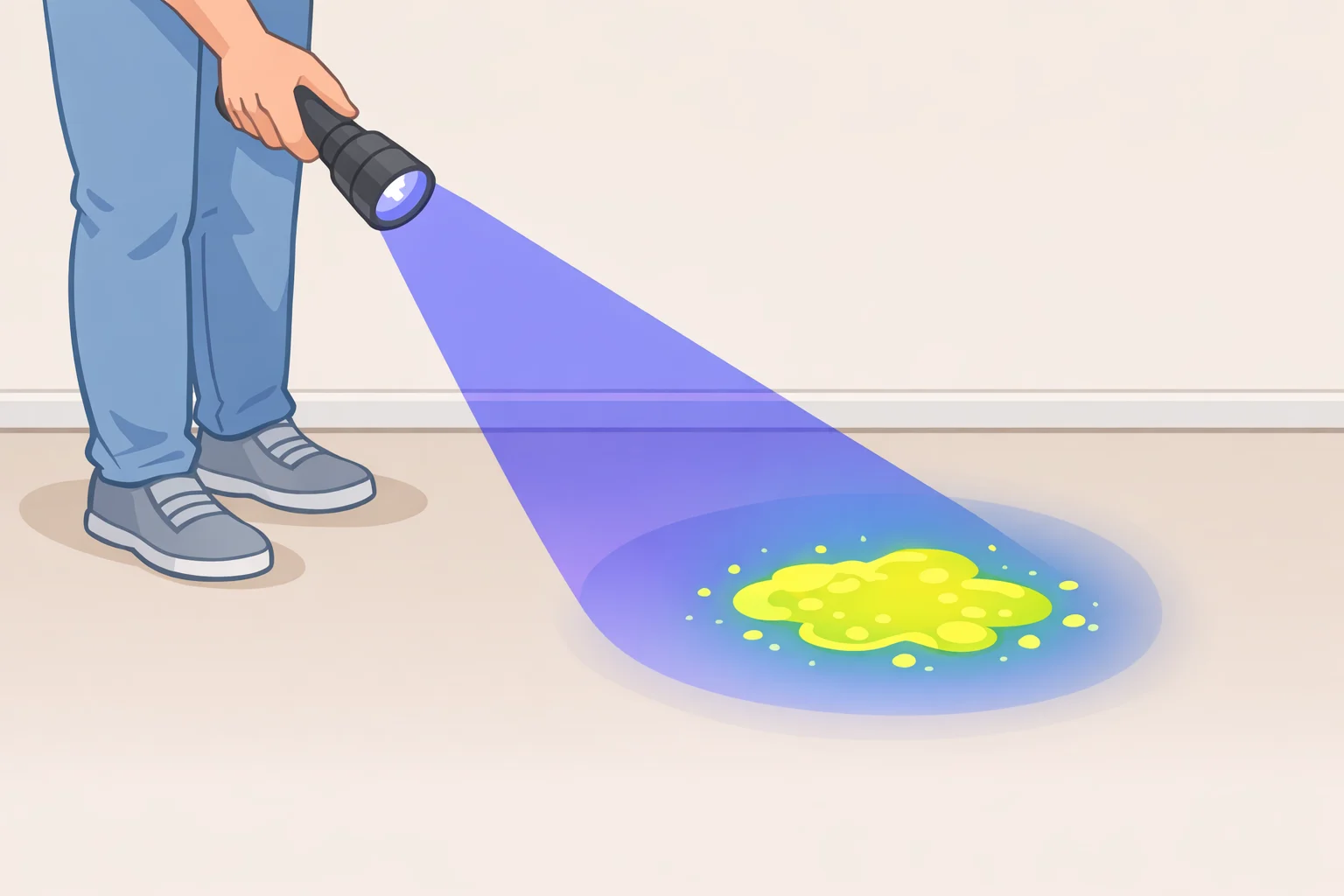
Dried animal-waste salts and proteins fluoresce under UV light, showing up as pale-yellow or greenish patches that may be difficult to spot under normal lighting (Olight, last month). That's the mechanism behind UV flashlight use for pet urine detection: the light doesn't clean anything, it reveals where the residue actually is. Pinpointing the exact spot lets an owner apply enzymatic cleaner precisely, rather than guessing at a general area or masking the odor with a spray (Olight, last month).
A similar logic gets applied to pest inspection. Tank007, a flashlight manufacturer, markets UV light as a way to spot bed bug exoskeletons or stains left on bedding and furniture (Tank007, last year). That claim comes from a company selling the product, so it's worth treating as a plausible use case rather than a guaranteed result.
A glow isn't proof of urine, though. Other residues, and even some fabrics and cleaning products, can fluoresce under the same light, a point covered in more detail later in this article. The reverse is also true: a spot that doesn't glow isn't automatically clean. Old stains, faint residue, or areas that have already been scrubbed may not fluoresce clearly, so a negative result is a weak signal rather than a clean bill of health.
Fluorescent minerals and scorpions
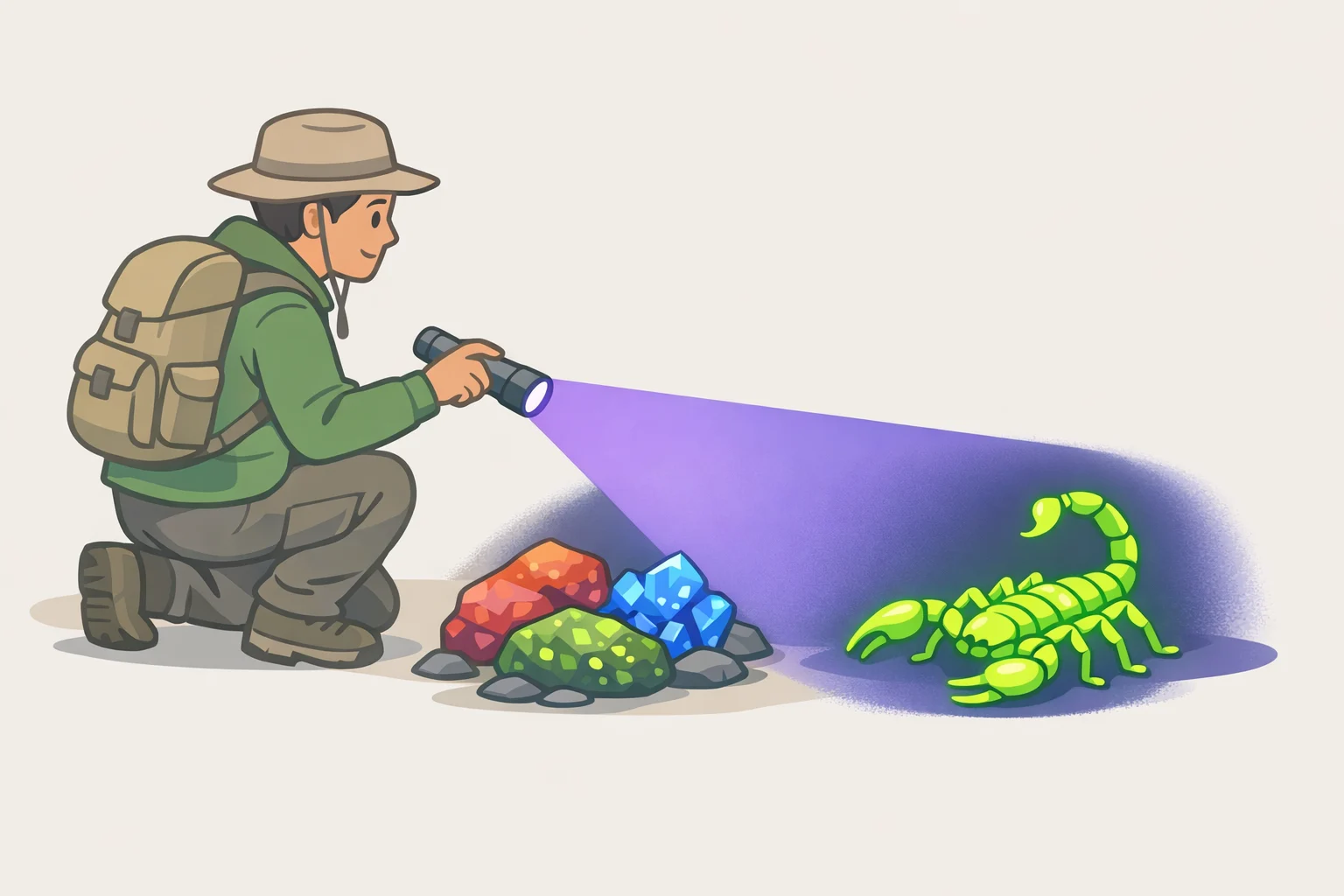
Certain minerals contain trace impurities, manganese, uranium, or chromium, that act as activators, causing the stone to fluoresce in shades of green, red, yellow, or blue that don't show up under regular light (Olight, last month). That's why rockhounds, geologists, and outdoor explorers carry UV flashlights for nighttime hunting: a patch of dull, ordinary-looking rocks can turn out to hide a few fluorescent specimens once the light comes on, though not every rock, and not every night out, turns up something.
Scorpions fluoresce under UV light too, producing a bright neon-green glow (Olight, last month). Campers and homeowners in arid regions use a quick sweep of a UV beam to spot them from several yards away, a common reason people check tents or gear before dark (Olight, last month).
Currency, documents, and resin curing
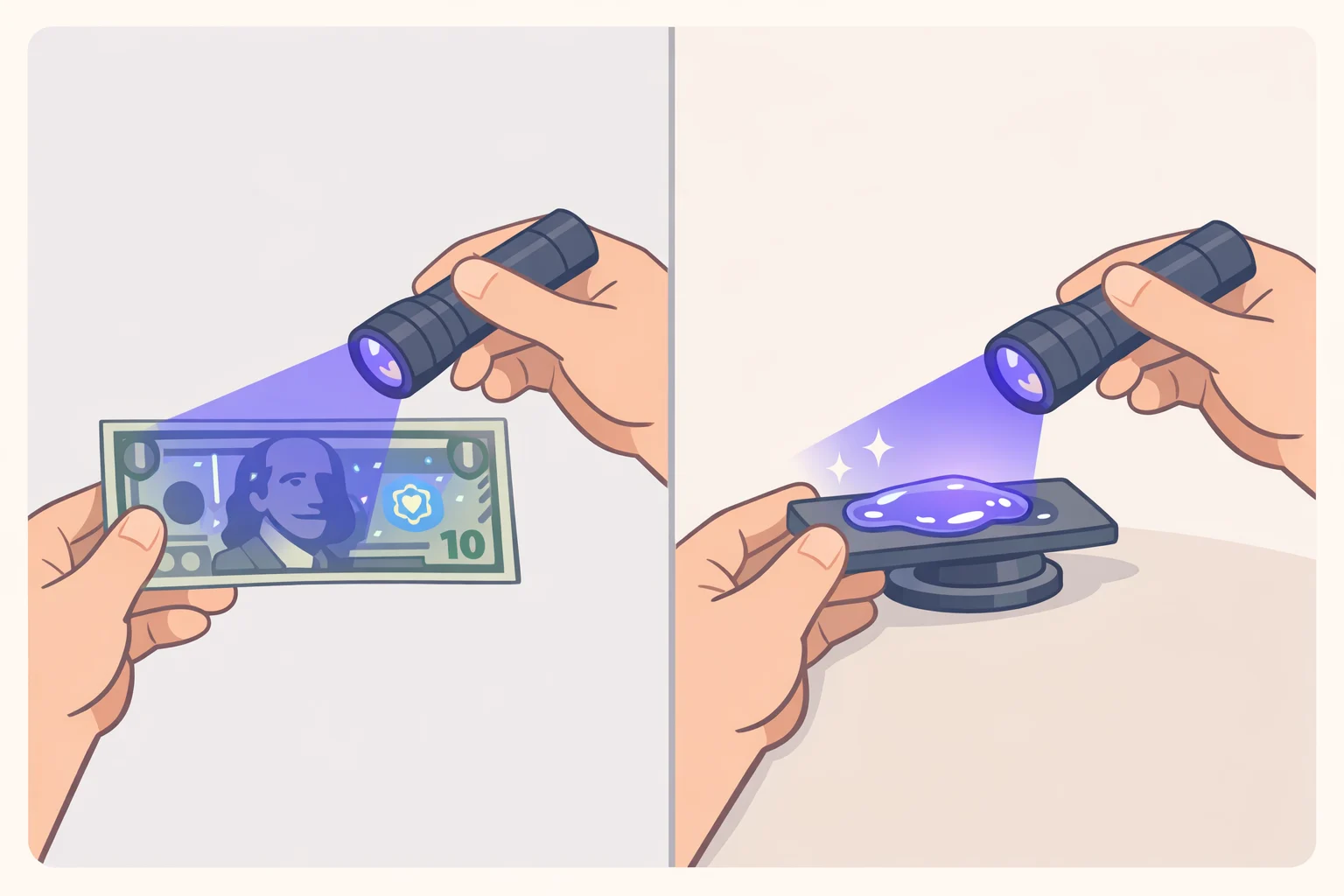
Many banknotes, passports, and identification cards contain UV-reactive threads, inks, or hidden holographic elements built in to help verify authenticity (Olight, last month). The specific features vary by document and issuing authority, so a flashlight check is one signal among several, not a definitive verdict. A missing glow is worth a closer look through official channels, not a snap judgment.
UV-curable resins, glues, and coatings contain photoinitiators, chemical compounds that harden when exposed to the right ultraviolet wavelength. That's why hobbyists, repair technicians, and fly fishermen carry pocket UV lights: a few seconds under the beam can cure an adhesive or seal a crack that would otherwise take hours to dry (Olight, last month). Whether it actually works depends on the resin being formulated for the wavelength the flashlight produces, a detail worth checking on the product label rather than assuming any UV light will do.
Plumbing and HVAC leak detection
UV inspection is also used with fluorescent dyes in plumbing and HVAC systems. The dye provides the visible marker, and the flashlight helps locate where it may be escaping. Tank007 lists leak detection as a commercial application and pairs it with 395 nm lights, the same wavelength it recommends for general home leak and mold checks, though the correct dye, wavelength, and inspection procedure depend on the specific system and product instructions (Tank007, last year; Tank007, last year).
Picking the right wavelength: 365 nm vs. 395 nm
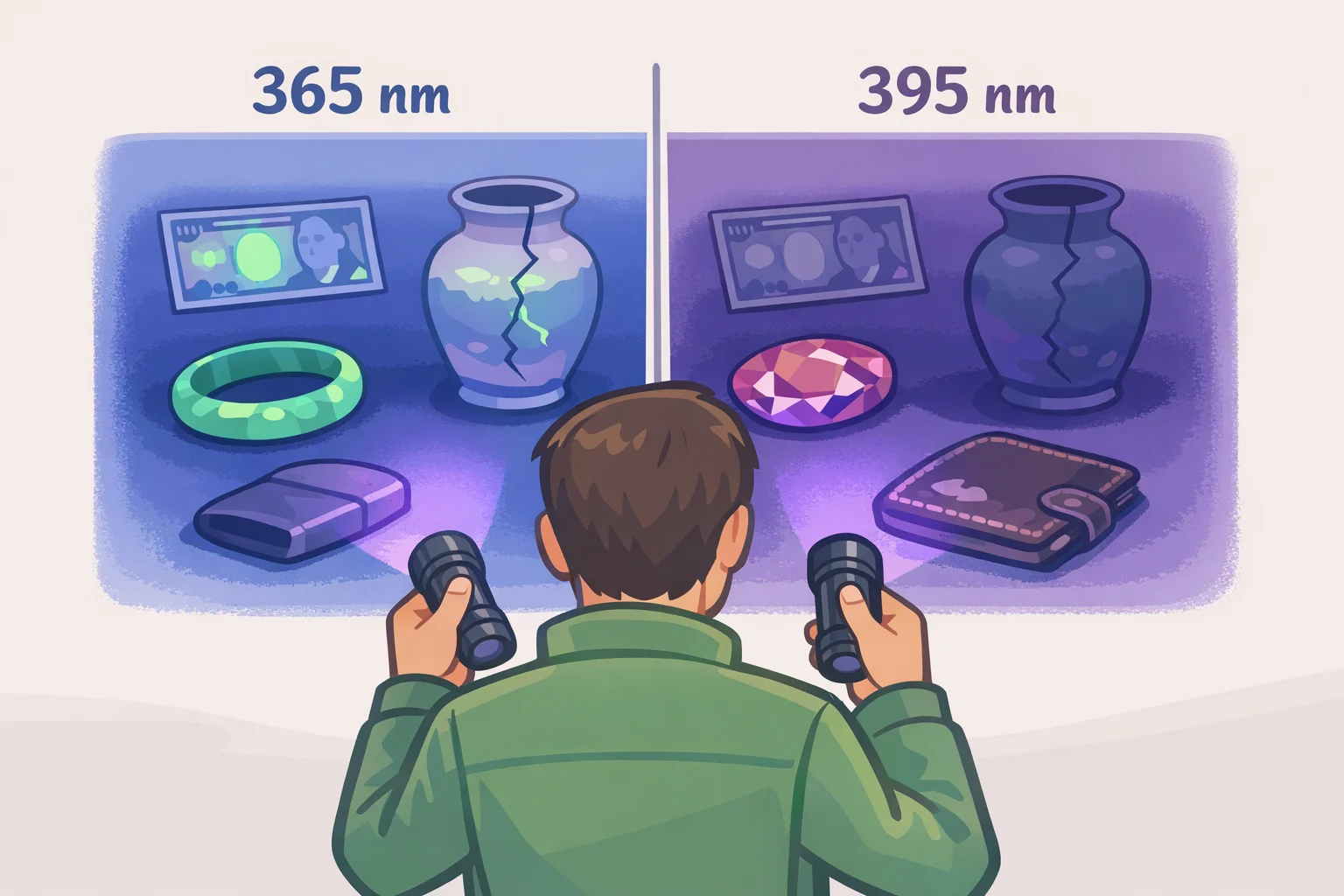
Not every UV flashlight is interchangeable with every other one, even though they're all technically "UV." Tank007 recommends 365 nm for more precise or professional inspection work and 395 nm as the general-purpose choice for casual home use (Tank007, last year). Its guide pairs the two wavelengths with fairly distinct jobs:
- 365 nm: forensic-style inspection, mineralogy, currency and document checks, resin curing
- 395 nm: pet-stain detection, general home maintenance like checking for leaks or mold
That's manufacturer guidance rather than an independent standard, but forensic practice shows how specific wavelength choice can get. Examiners use 254 nm or 365 nm to screen for biological fluids, 450-470 nm for fingerprints treated with certain chemical reagents, and 365-415 nm to pick up optical brighteners in fibers (ForensicSpot, earlier this year). Those are professional ALS pairings, not consumer recommendations, but they illustrate a principle that carries over to any UV light: different materials fluoresce best under different slices of the spectrum. A basic consumer model typically doesn't include the selectable wavelengths and viewing-filter system used in forensic ALS work, but it still helps to match the wavelength to the task rather than assume one light does every job equally well.
Why a stain may not glow clearly
Even with the right wavelength, a UV flashlight doesn't guarantee a clean answer. Fluorescence depends on the specific material and how much of it is present, so a faint or diluted residue may barely register even under the correct light (Olight, last month; ForensicSpot, earlier this year). Ordinary household materials can also fluoresce: optical whitening agents added to fabric and paper are a known source of glow that has nothing to do with stains or security features (ForensicSpot, earlier this year).
Ambient light matters too, as a practical matter rather than a lab finding. Weak fluorescence is far easier to see in a dim room than a bright one, and holding the beam closer to the surface strengthens the effect. Neither tip guarantees that a faint glow turns obvious, but both are worth trying before assuming a flashlight isn't working. A negative result cuts both ways, too: a surface that doesn't glow isn't automatically free of residue, since old, faint, or previously cleaned material may simply fall below what the light can reveal.
What a glow doesn't tell you
A fluorescent reaction is a strong hint, not proof. In forensic practice, a positive glow under UV light is treated as presumptive only: identifying a substance like semen or saliva still requires confirmatory lab testing before anyone can call it conclusive (ForensicSpot, earlier this year). That gap between finding a clue and identifying what it actually is matters just as much for a homeowner scanning a carpet as it does for a crime lab.
The false-positive risk described above has a mechanical cause worth knowing. Professional forensic light sources rely on interference bandpass filters to isolate specific wavelengths, and those filters degrade with UV exposure over time, leaking out-of-band light that can trigger fluorescence in unrelated materials (ForensicSpot, earlier this year). Consumer flashlights don't use the same filter systems, so this exact failure mode doesn't apply directly, but the underlying lesson holds: a glow is a starting point for investigation, not an automatic identification.
Eye and skin safety follow simpler rules for the UVA blacklights most people actually own. Research on the photobiological safety of blue-spectrum LEDs shows that retinal risk depends on radiance, meaning how concentrated the light is, rather than the mere presence of blue wavelengths (ams OSRAM, last year). That research covers visible blue-spectrum LED sources, though, a different hazard category from handheld UVA blacklights, so it doesn't translate into a direct verdict on blacklight safety.
For UVA blacklights specifically, the guidance that applies comes from the manufacturers: prolonged exposure can affect both eyes and skin, so avoid direct exposure, don't stare into the beam, and wear UV-blocking glasses for frequent use (Tank007, last year).
Which UV flashlight should you choose?
- Choose a 395 nm light for general household inspection, the wavelength Tank007 recommends for everyday use (Tank007, last year).
- Consider 365 nm for mineral, document, or more precise inspection tasks, where Tank007 pairs that wavelength with the job (Tank007, last year).
- Verify resin or adhesive compatibility by wavelength before relying on a flashlight to cure it (Olight, last month).
- Treat every glow as evidence that something is fluorescing, not proof of what it is or how it got there.
None of this requires professional-grade equipment. A basic 395 nm flashlight covers most household scanning, a 365 nm unit earns its keep for inspection-heavy tasks, and either one is only as useful as the judgment applied to what it reveals. Treat a glow as a reason to investigate further: clean the marked area, verify a document through official channels, or seek laboratory testing when the stakes are high.