Movies Like Ted Lasso to Watch: Why Hoosiers Fits Best
If you're hunting for movies like Ted Lasso to watch next, start with Hoosiers (1986), provided you can live without the jokes. Many fans were not simply looking for another workplace comedy set on a pitch. They wanted the specific feeling Ted Lasso built its identity on over three seasons: a coach rebuilding a team's belief in itself before the scoreboard catches up. Critics writing last year still called Hoosiers "a testament to teamwork and determination," nearly 40 years after its release (The Loyola Phoenix).
Directed by David Anspaugh, the film follows Norman Dale (Gene Hackman), a coach with a damaged past who takes over a six-player Indiana high school basketball team (The Loyola Phoenix). Dennis Hopper plays Shooter, the team's alcoholic assistant coach, a performance that earned him a Best Supporting Actor Oscar nomination in 1987 (The Loyola Phoenix).
Hackman died last year, and fans revisited Hoosiers to reflect on his work as Dale (The Loyola Phoenix). His death offers a good reason on its own to seek out one of his defining sports-film roles, whatever else draws a viewer to the film.
None of this is a claim that Hoosiers replicates Ted Lasso beat for beat. It's a narrower, more useful promise: the same belief-driven team transformation, minus the comedy and minus the sprawling AFC Richmond ensemble.
What Hoosiers is actually about
Video of the Day
This section sticks to setup, no ending detail, so it's safe even if you haven't seen the film.
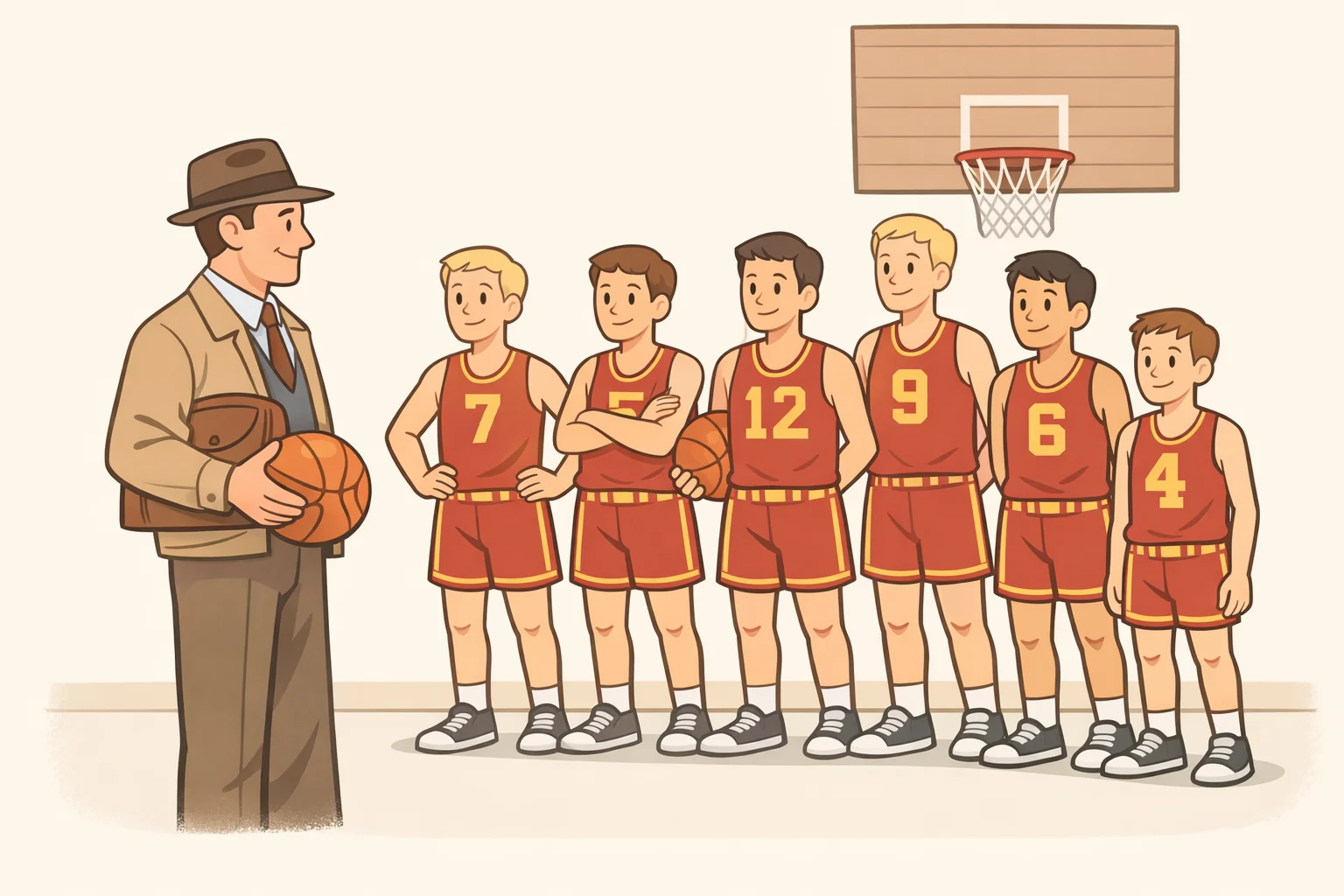
The story unfolds in Hickory, Indiana, a fictional town where daily gossip centers on basketball and a losing season counts as a minor civic wound (The Loyola Phoenix). Dale arrives in 1951 as the high school's new history teacher and coach, inheriting a roster of six players and a team manager named Ollie (The Loyola Phoenix).
He isn't a clean-slate hire. Dale left his previous coaching job after receiving a lifetime NCAA ban for punching one of his own players (The Loyola Phoenix). Jimmy Chitwood, a reserved player who withdrew from the team after the death of the previous coach, isn't even on the roster when Dale arrives (The Loyola Phoenix). Winning him back isn't a talent gap Dale can coach his way around; it's an unresolved wound that hangs over most of the film, one Dale has to work near rather than force.
Any Ted Lasso viewer recognizes this shape: an outsider coach, a team nobody expects much from, a star kept at arm's length until something other than talent draws him back in. Hoosiers runs that arc through one coach and one team, with no comic relief to soften the load, a tighter and harder version of the setup AFC Richmond got.
Video of the Day
Why Ted Lasso fans should watch Hoosiers

Three moments in Hoosiers do the work Ted Lasso spent its whole run doing, compressed and delivered without a single joke. These cover the middle and end of the film, so skip ahead if you'd rather go in cold.
One review frames the Huskers' entire run as proof of a simple idea: teamwork built on hope can close almost any gap, even for a roster this thin (The Loyola Phoenix). The three scenes below are where that idea actually plays out.
When Dale finds himself at risk of being pushed out of the job, what saves him isn't his win record. It's the players who speak up for him, standing by what he's taught them off the court rather than what he's won on it (The Loyola Phoenix). That's the same currency Ted trades in with Richmond: authority built on relationship, not results.
Then there's Shooter. Dale recognizes real basketball knowledge in the town's resident alcoholic and offers him the assistant coaching job on one condition: he stays sober (The Loyola Phoenix). It's a coach investing in someone's life outside the sport, the same instinct that drives much of Ted Lasso's plot, except here the stakes don't reset at the end of an episode.
The clearest single scene arrives at the state finals. Arriving at the unfamiliar Hinkle Fieldhouse, Dale has his players measure the free-throw line and the distance from the rim to the floor, proving the court is identical to the one back home (The Loyola Phoenix). The review reads the exercise as a reminder that the finish line carries the same weight as the starting line (The Loyola Phoenix). Ted makes a version of that same argument to Richmond, minus the tape measure.
That gym still carries the weight of the film. In 2025, Loyola's own basketball team made a National Invitational Tournament run that ended at the very same Hinkle Fieldhouse, 39 years after Hoosiers filmed its final game there (The Loyola Phoenix). Real basketball history and the film's fictional one now share the same address, which is part of why Hoosiers keeps getting cited among uplifting underdog sports films rather than fading into cable-rerun obscurity.
Where Hoosiers pulls back the warmth

Start with structure. Ted Lasso is an ensemble comedy spread across an entire club, with coaches, players, owners, and front office each carrying a subplot. Hoosiers has almost none of that breadth. It's a concentrated coach-and-team drama, one central relationship carrying the whole weight of the story. The comparison holds for the coaching dynamic, not for the size of the cast.
Dale himself isn't a sunnier version of Ted Lasso. He arrives in Hickory carrying real violence in his past, and the film doesn't let viewers forget the ban that followed it (The Loyola Phoenix). His warmth, unlike Ted's, isn't a given from the first scene; it's something the film makes him earn, gradually, over its runtime.
Shooter's drinking gets the same unflinching treatment: an ongoing struggle, not a quirk played for laughs. Hopper's performance was singled out for giving weight to a character "most films would've left in the shadows" (The Loyola Phoenix). Viewers drawn to Ted Lasso for its emotional safety net should know Hoosiers offers no equivalent. It sits with its characters' struggles instead of resolving them for comfort.
Picture Ted Lasso with the biscuits and the one-liners stripped out, and the real cost of rebuilding a reputation left in. That's roughly the tonal distance between the two, and it's why Hoosiers belongs on any list of feel-good sports movies that earn their ending the hard way instead of assuming it.
If you want something different
Two other titles sit near this territory, though neither substitutes for Hoosiers.
If a true story with more comedy sounds appealing, Next Goal Wins (2023) dramatizes a real coach's work turning around a national soccer team after a historic loss. It's closer to Ted Lasso's humor, but reviews were mixed: IndieWire gave it a C grade, and RogerEbert.com called the setup formulaic on paper, though it credited the film's crowd-pleasing finish, noting that a story can't fairly be labeled formulaic when it's based on things that actually happened.
If relationship matters more than the locker room, American Underdog (2021) traces Kurt Warner's path to the NFL through his marriage rather than his teammates. RogerEbert.com praised its unusual off-field focus, but noted it never clearly connects Warner's personal virtue to his on-field success. That's a better fit for viewers who cared more about Ted Lasso's personal storylines than its match footage.
Where to stream Hoosiers

An April 2025 review listed Hoosiers as available to rent or buy on Amazon Prime, YouTube, and Apple's TV app, rather than bundled with any subscription (The Loyola Phoenix). That listing is well over a year old now, and it's unclear whether it meant Apple's rental storefront or the separate Apple TV+ subscription. Digital catalogs shift constantly either way, so check pricing and availability directly on whichever platform you use before committing to a rental.
The verdict
Watch Hoosiers next if what you loved about Ted Lasso was watching a team learn to trust itself through a coach's patience. Dale's work with Shooter, and the players standing up for him when his job is on the line, deliver that transformation with real weight (The Loyola Phoenix).
Skip it, at least for now, if what you loved most was Ted's humor and the show's wide cast of characters. Hoosiers asks viewers to sit with real alcoholism and a coach's violent past rather than resolving them for laughs.
The measuring-the-court scene at Hinkle Fieldhouse is still a decent test either way. If that scene lands for you, the rest of the film will too (The Loyola Phoenix).
Among the best movies for Ted Lasso fans seeking that particular team transformation, Hoosiers is an unusually strong match. Just go in knowing the comedy stays home.