2028 Volvo XC60 PHEV claims 124-mile electric-only range
Volvo says its updated XC60 PHEV will drive 124 miles on electric power alone, a claimed figure that would make it the longest-range plug-in hybrid on sale in the UK once deliveries begin, according to Autocar. That's 19 miles beyond the current record holder, the Omoda 9 SHS, and more than double the outgoing XC60 PHEV's 49-mile rating.
The leap comes from more than doubling the battery, from 19kWh to 41.2kWh, and fitting a stronger electric motor, changes made to Volvo's best-selling model, according to Autocar.
The claim lands as UK PHEV sales surge: up 35% year-on-year in 2025 to a record 11% market share, and up 39.8% year-on-year in August 2026 to 14.5% of the market, according to Autocar. It also arrives as Volvo pulls back from its earlier all-electric ambitions in favor of long-range hybrids, a strategic pivot Autocar ties directly to this new powertrain family.
The headline figure is clear. Its practical significance is not.
Volvo XC60 T6 124-mile EV range: how it stacks up against rivals
Video of the Day
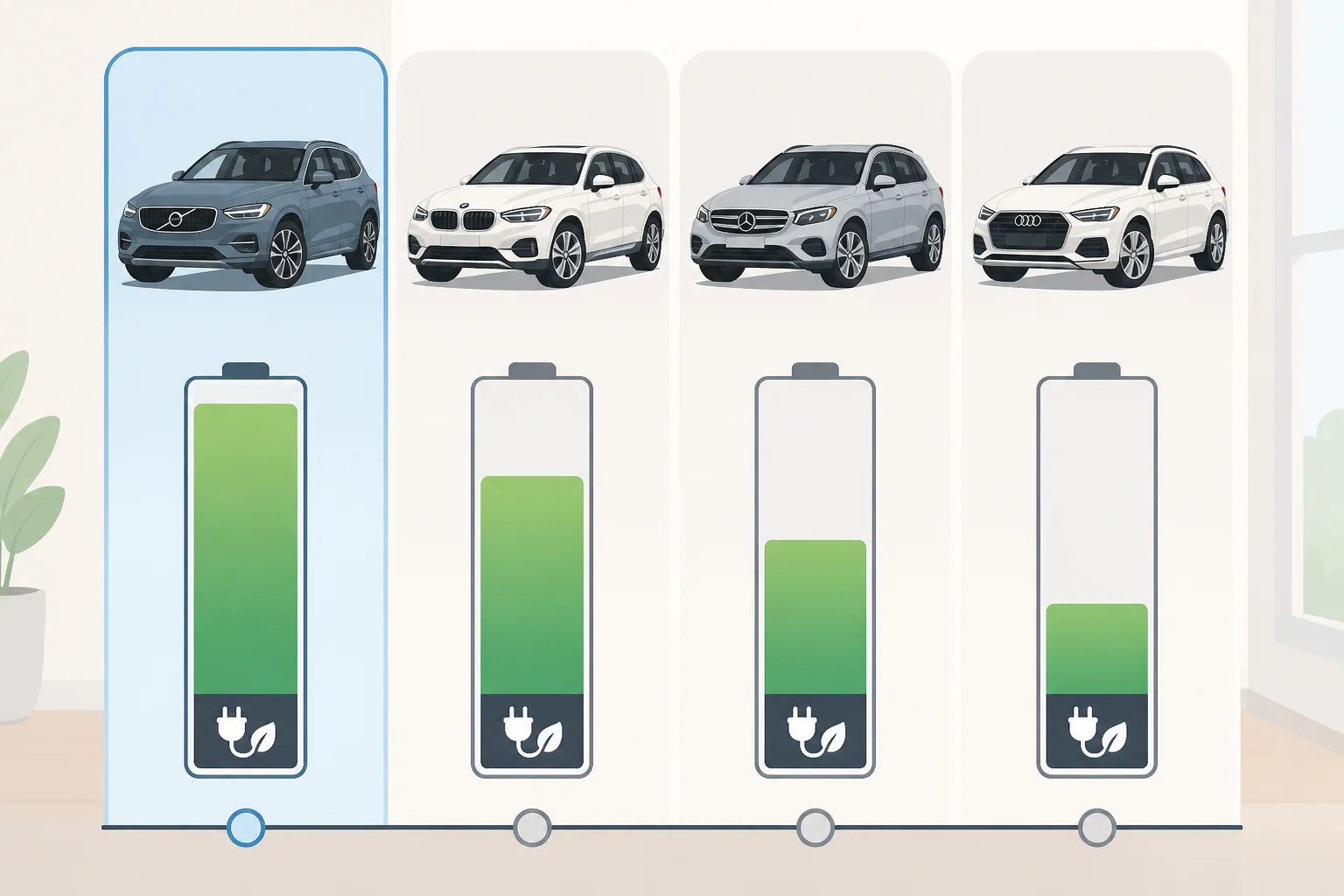
Two versions of the new powertrain go into the XC60. The 178bhp T6 carries the claimed 124-mile electric-only range, while the more powerful 246bhp T8 is said to manage 117 miles, according to Autocar.
That T6 figure also matches the claimed range of the XC70, a larger Volvo crossover currently sold only in China that could eventually reach the UK, per Autocar's reporting.
Rival premium SUVs trail well behind on paper. The BMW X3 30e is rated at 56 miles, the Audi Q5 TFSIe at 62 miles, and the Mercedes-Benz GLC PHEV at 80 miles, according to Autocar.
Volvo is applying the same formula to its flagship. The XC90 gets the new powertrain too, with its claimed EV range rising from 38 to 100 miles, according to Autocar, a pattern that suggests a broader strategy across Volvo's largest SUVs rather than a one-model change.
These are manufacturer figures, published ahead of any independent testing. They establish the scale of the claim and where it sits against competitors, nothing more.
Video of the Day
Volvo XC60 PHEV 41.2kWh battery: what changed under the skin
The new powertrain keeps the existing 2.0-litre four-cylinder petrol engine and four-wheel drive, but more than doubles battery capacity from 19kWh to 41.2kWh, according to Autocar. Volvo paired it with a more powerful electric motor to put the extra capacity to use.
The bigger pack takes longer to fill. Volvo says a 0-100% charge on a 16A home supply now takes four hours, up from three, according to Autocar. That detail may matter more to daily usability than the headline range figure, since it governs how quickly the battery can be recharged between drives rather than how far it goes once full.
Volvo says "clever" packaging keeps boot space unchanged at 468 litres despite the larger battery, according to Autocar, a claim worth revisiting once independent reviewers get their hands on the finished car.
The powertrain arrives alongside a broader design refresh, similar in scope to the recent update of the smaller XC40. Autocar reports a reworked front end with new wings, bonnet, bumper and a slimmer grille, plus matrix LED headlights Volvo calls "Thor's Hammer." The rear gets new lights, a new tailgate and bumper, and buyers get fresh 20in and 21in wheel options along with a new Heather Bronze paint colour.
Inside, the refreshed XC60 gains an 11.2in touchscreen running Google's Gemini voice assistant, according to Autocar.
Volvo XC60 PHEV electric-only range: what the research says about bigger batteries
A peer-reviewed study published in 2024, covering almost 100,000 plug-in hybrids across more than 150 models and 41 countries, found that every additional 10km of official WLTP, or type-approval, range is associated with an average 13-17% drop in real-world fuel consumption and a 1-4% rise in electric driving share, according to IOPscience. The researchers built that finding from two separate datasets: one combining online sources, company-car records and a driver survey, the other drawn from onboard measurements collected by a single manufacturer.
That's an average association across existing PHEVs on the road today, not a guaranteed outcome for any single model, the new XC60 included. The same researchers identify long-distance driving and charging habits, not vehicle specifications, as the two largest reasons real-world PHEV performance diverges from official figures. A car with a 124-mile claimed range still depends on its owner plugging it in regularly to get anywhere near that number.
Why claimed and real-world PHEV performance still diverge
Newer evidence suggests bigger batteries haven't closed that gap. The International Council on Clean Transportation, or ICCT, published an analysis two weeks ago finding that the difference between official and real-world PHEV emissions has widened even as manufacturers extend electric ranges, according to ICCT.
That builds on earlier ICCT work from 2022 examining US plug-in hybrids, using self-reported fuel data from Fuelly.com and engine-off mileage collected by California's Bureau of Automotive Repair. That study found real-world electric-driving share may run 26-56% lower than EPA label ratings assume, with fuel consumption potentially 42-67% higher, according to ICCT. ICCT flagged its own datasets as vulnerable to self-selection bias, since owners willing to share driving data may not represent the wider PHEV fleet, which itself remains a small slice of overall car sales.
The European IOPscience study reached a broadly similar conclusion using a separate dataset and methodology, finding that real-world PHEV fuel consumption and tailpipe emissions already run higher on average than official EU values. The two studies didn't measure identical populations or use identical methods, but they point the same direction: Volvo's 124-mile figure is a claim to be tested against independent road tests and real-world user data, not a settled outcome.
What Volvo hasn't disclosed yet

Volvo hasn't confirmed pricing for the updated powertrain. The current XC60 starts at £50,000, and PHEV variants have commanded a £6,000-£7,000 premium over petrol equivalents, with deliveries expected in the coming months, according to Autocar.
Autocar's report doesn't include combined efficiency, CO2, or independent real-world range figures for either the T6 or T8. It also doesn't detail maximum charging rate or connector standards beyond the quoted 16A home-charge time, nor cold-weather performance.
Full kerb weights, along with those efficiency and CO2 figures, should follow once Volvo releases complete technical specifications ahead of deliveries.
What happens next will settle more than Volvo's marketing claim. Confirmed UK pricing, official WLTP efficiency and CO2 figures, detailed charging specifications, and the first independent road tests will determine whether 124 miles holds up as a number owners see regularly, or whether the gap between claim and reality that has dogged PHEVs for years reasserts itself once again.