Smart Contact Lenses 2030: Three Hurdles to a Real Launch
In July, XPANCEO and the MicroLED maker JBD moved from concept work to a component-level prototype: a printed circuit board with a micro-display wired directly into a lens processing unit (Unite.AI). It's a genuine engineering milestone. The cited announcement doesn't report any human wear, though, and that's the distance that matters here: building a part is not the same as proving a lens is safe to put on an eye. That gap is exactly what makes forecasting a timeline for XPANCEO smart contact lenses, or any smart contact lenses 2030 target, so hard to pin down.
XPANCEO has a second partner working a different problem. With the battery maker ITEN, the company announced in April a proof-of-concept microbattery meant to be thin, durable, stable, and safe enough to sit on a living eye (Unite.AI). "Meant to be" is doing real work in that sentence: the announcement describes a design goal, not a verified result. On a separate track, medical researchers have built a literature base spanning roughly two decades on tear-fluid sensors for glucose and eye pressure (Frontiers in Medicine), a more clinically grounded line of work that rarely gets the headlines the AR side does.
A smart contact lens, as this article uses the term, is an ordinary soft lens with a microscopic display, sensor, or power source built into it. That's a working definition for this piece, not an established industry standard, but it's the throughline for judging the hype. Whether the idea becomes something buyable by 2030 depends on three things going right at once: safe extended wear on a living eye, power and cleaning that hold up across months of daily use, and an actual regulatory clearance rather than a preliminary designation. The rest of this piece runs current announcements through that three-part test.
What a smart lens is supposed to do, and what's actually been shown
Video of the Day
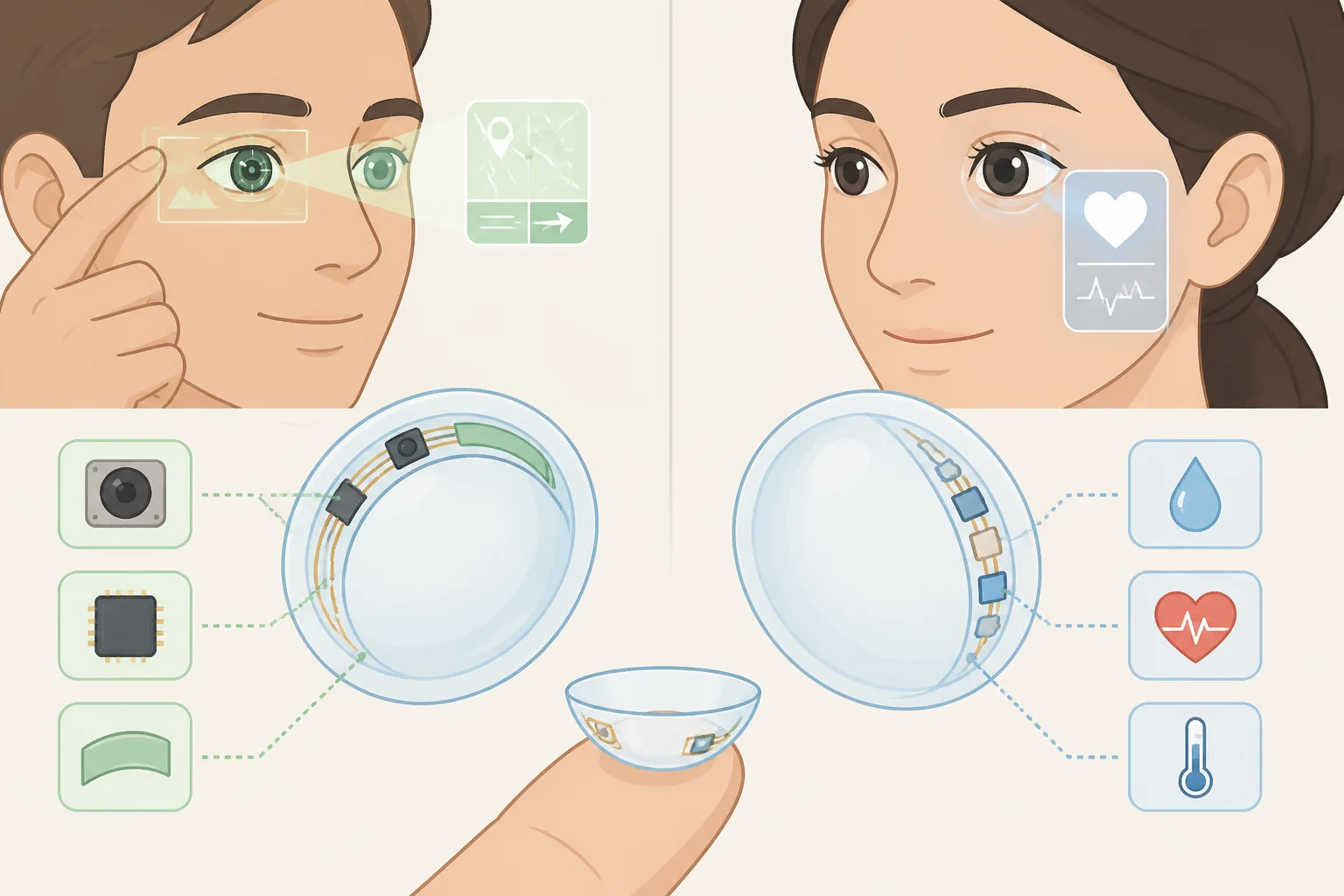
It helps to separate two product categories that often get lumped together in coverage: AR convenience and medical monitoring. That split is useful for sorting through announcements, though it's an analytical shorthand rather than an official taxonomy, and the lines blur in places. One track covers notifications and basic graphics, the glanceable information you'd otherwise check on a phone. The other covers glucose, eye pressure, and in some designs, drug delivery straight into the eye.
Reporting on Mojo Vision's augmented reality contact lenses describes something closer to a smartwatch screen than a cinematic display. Simple text and icons flash up for things like fitness stats, a ride-share status, or a flight gate, and eye movement itself is used to switch between items, the way flicking your gaze from one spot to another closes one app and opens the next (Journal of High Technology Law).
XPANCEO's own language reaches further than that. The company describes an eventual "invisible computing platform" combining augmented reality, biosensing, and identity verification in a single interface (Unite.AI). That's a stated ambition, worth noting as such, not a demonstrated product. What's verified, per the milestone described in that report, is the PCB-level display integration mentioned above, plus the separate microbattery proof of concept with ITEN.
On the medical side, researchers have concentrated on tear-fluid sensing for glucose and intraocular pressure, plus on-lens drug delivery aimed at a real limitation of eye drops: a substantial amount of the dose can dissipate rapidly through the nasolacrimal duct before the eye absorbs it (PMC/NIH review). The commercial appetite for solving that problem shows up in market projections: a 2023 review cited a 2018 valuation of $115 million for the global smart contact lens market, with projections at the time putting it near $1.6 billion by 2026 at a compound annual growth rate near 39% (Biosensors/PMC). A projection from a few years back isn't proof of a working product on shelves today, but it explains why so many labs are chasing this.
These two categories, in their current form, face different versions of the same three-part test. AR designs carry a heavier hardware burden: a full smart contact lens display, more components, and, by XPANCEO's own account, functions that draw more power than passive sensing does (Unite.AI). Medical designs carry a heavier evidence burden: clinical validation for a narrower, more clearly defined job. Neither path is easier. They're just hard in different places.
Video of the Day
How smart contact lenses work: display, power, and wearability
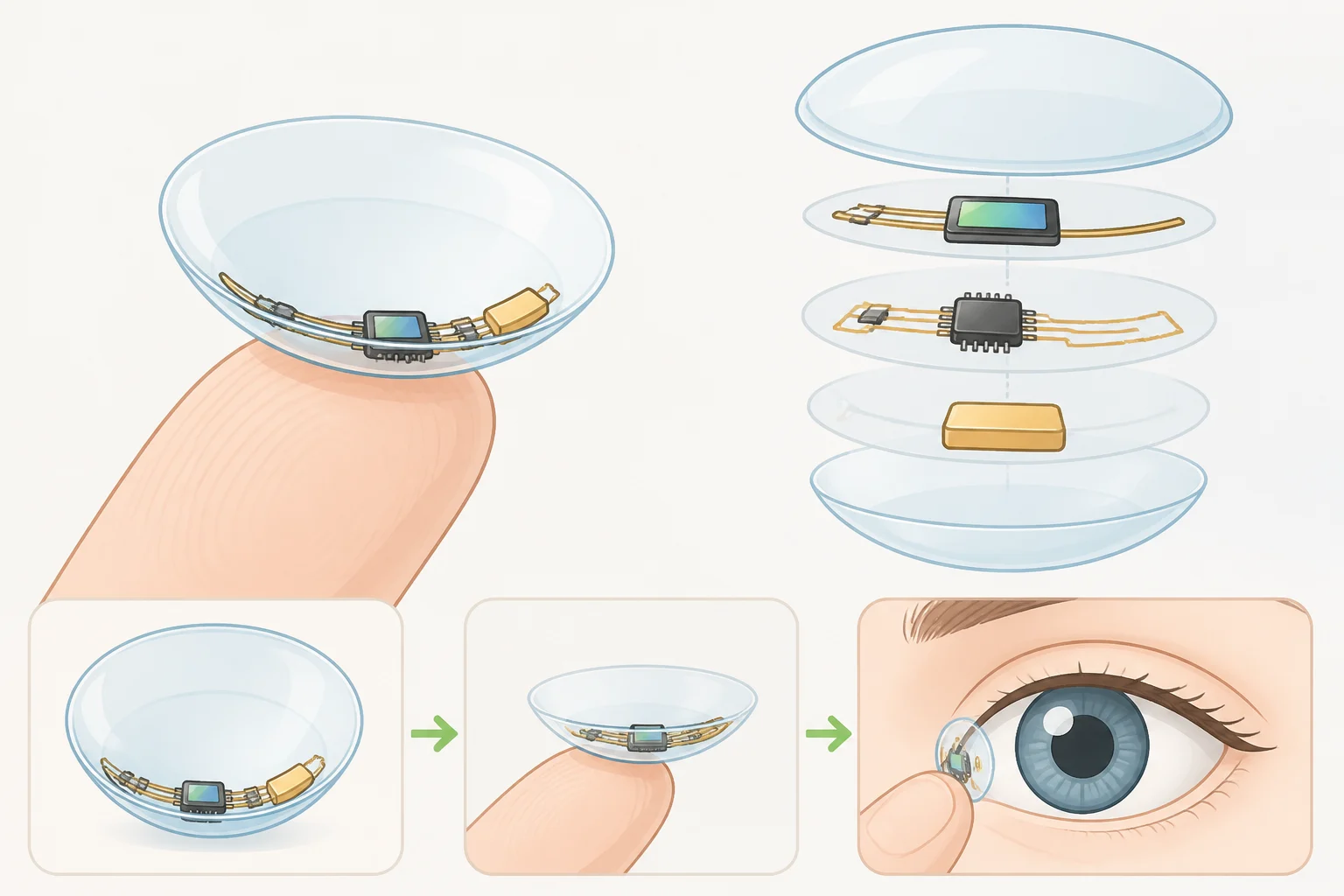
The core engineering problem, stated plainly, is this: a display, a processing unit, and a power source all need to fit inside a soft lens worn directly against a living eye. That's not a smartphone-miniaturization problem. It's a problem where the limits on size and the limits on what a living eye will tolerate converge in the same tiny space.
XPANCEO and JBD's current phase centers on custom optics built to let the eye focus on an image positioned extremely close to it (Unite.AI). Building a smart contact lens display that sits that close to the cornea is a fundamentally different optical challenge than shrinking an existing screen, which is likely why the collaboration needed a custom optical system rather than adapting an existing micro-display design.
Power is the least-resolved piece of the puzzle. The April announcement with ITEN describes a proof of concept, meaning the thinness, durability, stability, and ocular safety are design targets the teams are working toward, not properties that have been independently confirmed (Unite.AI). XPANCEO has also said that different lens functions, display, sensing, connectivity, draw different amounts of power, which complicates any single battery solution meant to serve all of them at once (Unite.AI).
Alternative power approaches show how early this stage still is. One experimental "bio-charging" battery draws on enzymatic reactions with glucose in tear fluid; the supplied research record identifies performance verified over 15 charge cycles and provides no longer-duration result (Biosensors/PMC). That's a useful demonstration of the underlying chemistry, not evidence of how such a battery would hold up across months of everyday wear.
Hurdle one, safe extended wear, gets less attention in press coverage than displays or batteries, but it's no smaller a problem. Legal analysis of Mojo Vision's design flags eye strain and infection among the health impacts that would need to be carefully monitored and addressed before a lens like this reaches consumers, without detailing what that monitoring would look like in practice (Journal of High Technology Law). A separate materials review takes a more optimistic angle: it reports that smart soft lenses have been shown to conform to a range of corneal curvatures and thicknesses in human eyes, and argues that lens-based monitoring could reduce the discomfort and infection risk tied to more invasive methods, like injections or in-office pressure exams (Biosensors/PMC). Both claims are real, and they point in different directions: one says comfort and safety are still open questions, the other says the base lens material already behaves well on real eyes. Neither source describes a finished, display-and-battery-equipped lens being worn for months at a stretch.
Put these pieces together, and the state of play, based on the sources reviewed for this article, looks like this: a display wired to a processing unit, a battery proof of concept, and lab-grade biosensors, including sensors tested in artificial tears. None of the sources reviewed here document a complete human-wearable prototype, let alone a cleared consumer product, though that reflects what's publicly available rather than everything happening in every lab. That distinction is worth holding onto heading into the next question: which category might close that distance first.
Why medical monitoring might reach patients first, in narrow settings
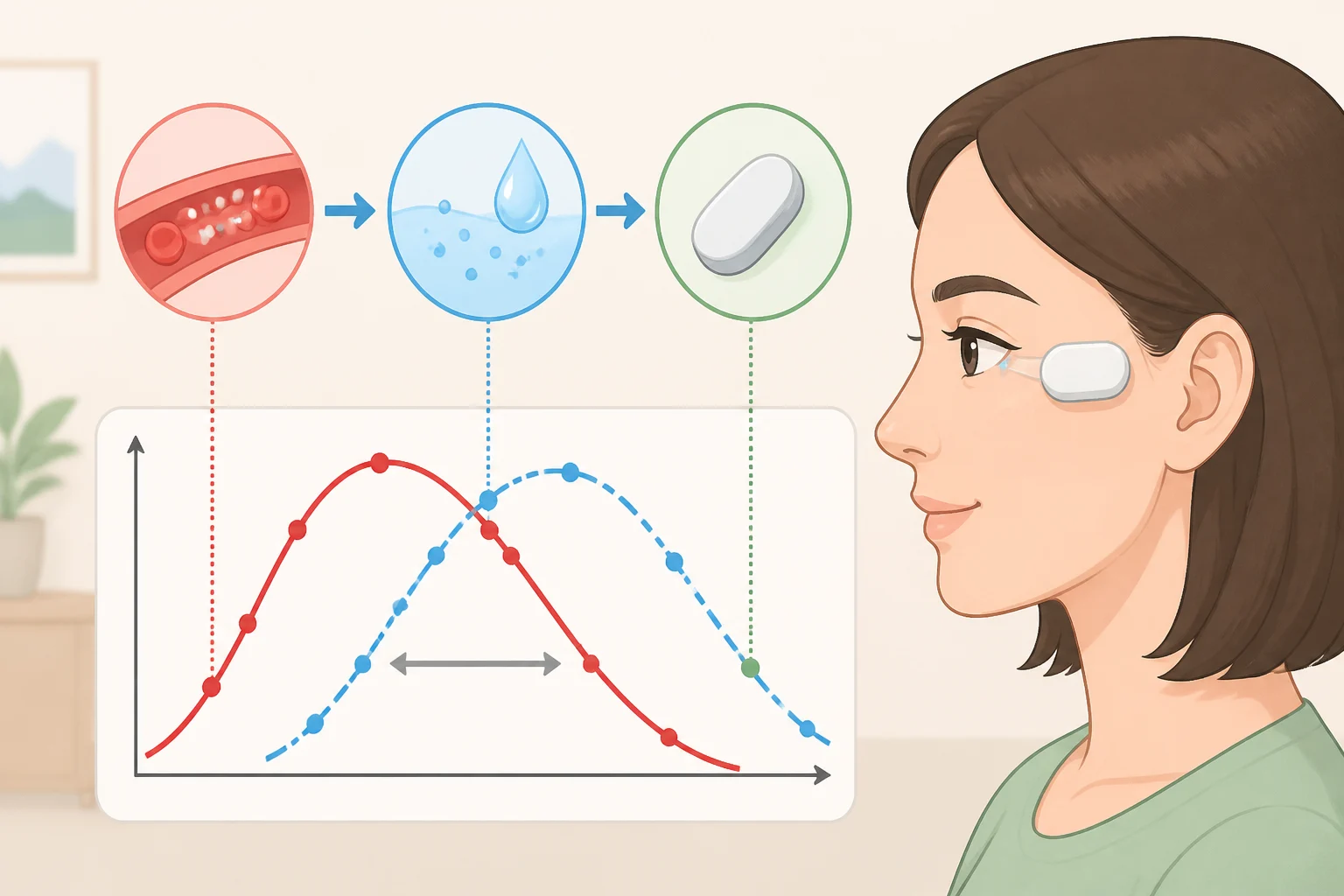
Not all medical applications are equally mature, so it's worth narrowing the comparison to two examples: intraocular pressure (IOP) monitoring for glaucoma, and glucose sensing.
Glucose is the harder of the two, biologically speaking. Tear glucose does correlate with blood glucose, but lab studies show the tear reading lags blood levels by roughly 10 to 20 minutes, which means a lens reading is a delayed echo of what's happening in the bloodstream, not a live number (Frontiers in Medicine). One prototype sensor reported a correlation coefficient near 0.99 across a clinically relevant range, though that result came from testing in artificial tears under controlled lab conditions, not from a lens worn on a living eye over extended periods, and it describes that particular device rather than glucose sensors generally (Frontiers in Medicine).
IOP monitoring has a different profile from glucose sensing. It doesn't require translating a proxy fluid reading into a blood value the way tear glucose does, since it tracks pressure inside the eye itself; the research reviewed here doesn't detail the specific sensing mechanism involved, so that's as far as the comparison can responsibly go. A 2022 review states that a glaucoma-monitoring contact lens has "recently been approved by the FDA," without naming the device, specifying the approval pathway, or confirming its current commercial status (Frontiers in Medicine). That's worth flagging as an interesting, unverified data point, not something solid enough to build a forecast on.
Mojo Vision's experience illustrates the difference between regulatory interest and regulatory clearance. The company announced in 2020 that it had received a Breakthrough Device Designation from the FDA, which it said signified the technology's potential to significantly impact health care (Journal of High Technology Law). A designation fast-tracks review; it is not an approval. The sources cited here do not document a subsequent clearance in the years since.
A broader review of the field is blunt about what's still missing. Smart lenses show real promise combining diagnosis and treatment, but "large-scale validation studies are required to establish clinical accuracy, patient adherence, and cost-effectiveness" before any of this reaches patients at scale (PMC/NIH review). IOP monitoring is one plausible candidate to clear that bar sooner, since it measures a more direct physical signal for a narrower patient population than glucose sensing does, but that's an inference drawn from the available evidence, not a documented regulatory lead. Nothing reviewed here has cleared all three hurdles yet.
The nontechnical barrier: regulation and privacy
Engineering isn't the only obstacle, and it may not even be the hardest one. Legal analysis of Mojo Vision's lenses identifies data privacy, cybersecurity, and healthcare regulation, not just hardware, as central open questions for that specific design (Journal of High Technology Law).
That concern is tied to how Mojo's proposed lens is built, not to every smart lens on the market. Mojo's design relies on wireless connectivity and onboard sensors, which is precisely why unauthorized access to that design raises a safety risk on top of a privacy one, a different category of concern than a hacked phone (Journal of High Technology Law). Other designs look different. One experimental glucose-sensing lens used an onboard LED paired with a solar cell specifically to eliminate the need for wireless communication and wireless power delivery, enabling standalone operation under room-ambient light (Frontiers in Medicine). That kind of design choice may shrink the wireless attack surface, though it doesn't necessarily eliminate other risks, like how data gets stored or how firmware gets updated. "Smart contact lens" isn't one architecture with one risk profile.
The Google Glass comparison is instructive on the adoption side, even though the devices aren't identical. Google Glass drew significant hype alongside significant privacy and safety concerns, and the legal review reads its decline as a sign the public wasn't ready to have daily life uploaded to servers (Journal of High Technology Law). A contact lens is far less visible than a pair of glasses, which could plausibly make bystander consent harder to manage, since there's no obvious visual cue that someone nearby might be recording or sensing. That's a reasonable inference from the comparison, not a documented outcome.
Because a lens that combines consumer electronics with health-monitoring claims counts, at least in part, as a medical device, companies like Mojo Vision have to satisfy health-device safety standards on top of the data-privacy and security expectations that apply to ordinary consumer electronics (Journal of High Technology Law). That's a structural reason timelines slip even once the hardware works: regulatory review isn't a paperwork step tacked onto the end, it's a separate track that has to finish alongside the engineering.
Applying the three-hurdle test to smart contact lenses 2030

Running the sources reviewed here through the article's own framework produces a mixed scorecard. The cited sources don't report a complete lens demonstrating safe extended wear on a living eye. Durable power has been tested so far only in short lab cycles, fifteen charges in the most detailed example available; cleaning and long-term sanitation aren't addressed in the research reviewed here at all. Regulatory clearance stands at one reported but unverified IOP-device approval and a Breakthrough Device Designation granted six years ago that the sources cited here do not show advancing further (Unite.AI; Frontiers in Medicine; Journal of High Technology Law).
Based on this evidence, nothing locks in a 2030 commercial launch. A narrow, supervised medical product, possibly one built around IOP monitoring, is a plausible candidate for that horizon, though confirming it would take stronger regulatory evidence than what's available today. A mass-market AR lens doesn't have a confirmed deadline attached to it, whatever a company's own marketing language suggests.
Going forward, it's worth treating any new display or battery demo as a lab milestone rather than a step toward 2030, unless it's paired with a named regulatory clearance, not just a designation, or a published human-wear safety trial lasting months rather than days. Those are the signals this article would treat as meaningful. Everything short of that is still engineering: promising engineering, but engineering nonetheless.