Do Nitrogen Tires Improve Fuel Economy? What Tests Show
Consumer Reports tested 31 all-season tire models over twelve months, filling one group with nitrogen and another with ordinary air, both set to 30 psi at room temperature, then checking them again a year later. The nitrogen-filled tires lost 2.2 psi. The air-filled tires lost 3.5 psi, a gap of just 1.3 psi across an entire year (Consumer Reports, updated last month). That result tells you something real about pressure retention. It doesn't, on its own, answer whether nitrogen tires improve fuel economy.
For that question, separate testing from the federal government measured rolling resistance, the property that actually ties tire pressure to how much gas a car uses. The National Highway Traffic Safety Administration found that swapping in nitrogen had "little or no direct effect on tire rolling resistance performance" (Consumer Reports, updated last month). Put the two findings together and the picture gets clear fast: nitrogen holds pressure a little longer, but that edge never shows up as better mileage.
So, do nitrogen tires improve fuel economy? The testing says no, not in any way that's been demonstrated once tires are properly maintained. Nitrogen is marketed with promises of longer tire life, better fuel economy, and improved safety (NRMA, last year), and that pitch has stuck around for a reason: it sounds plausible. What follows is a look at what nitrogen actually does to a tire, why that doesn't translate into meaningful savings at the pump, and the narrow situations where paying for it still makes sense.
Do nitrogen tires improve fuel economy? The short answer
Video of the Day
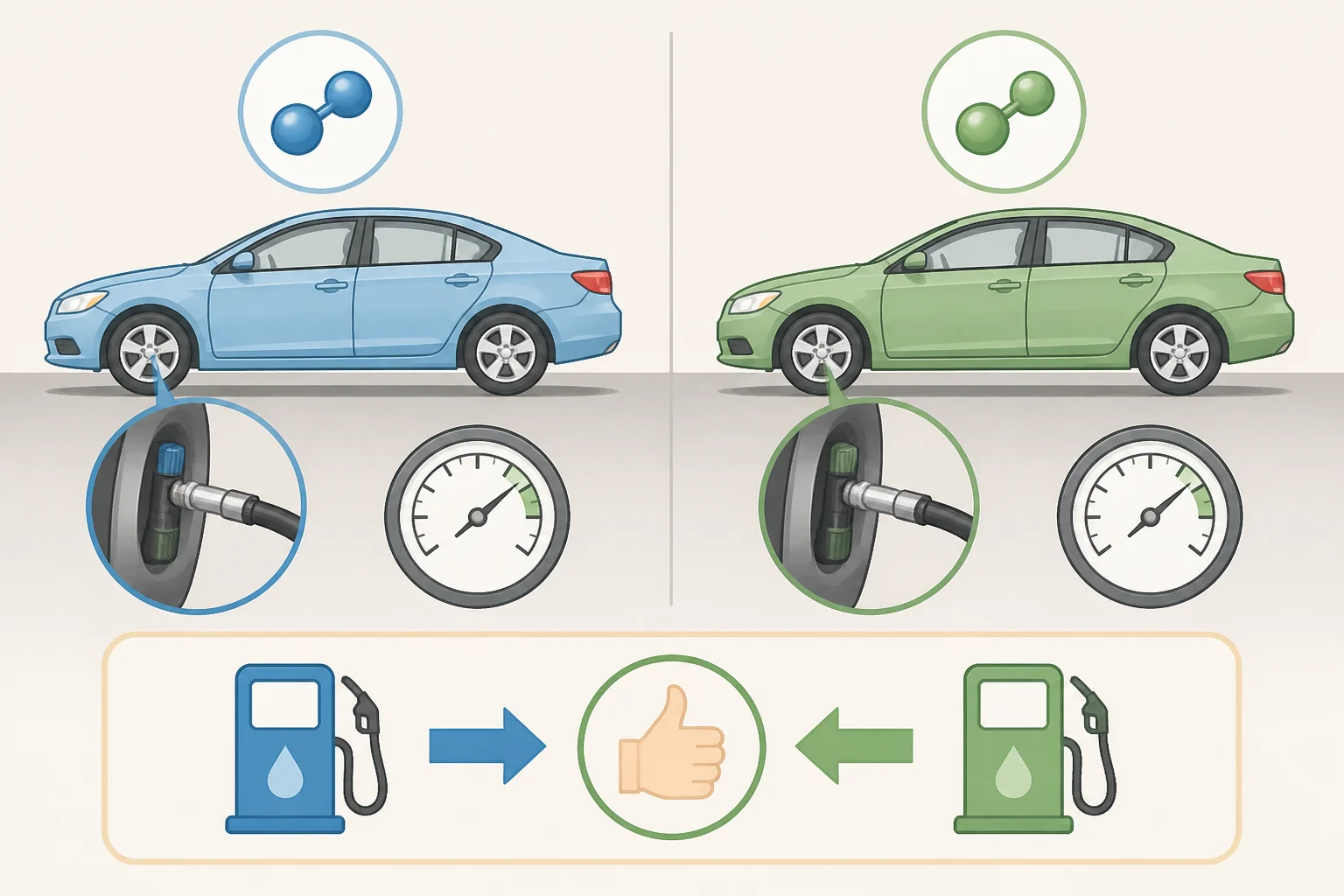
For a passenger car kept at the correct pressure, no. Fuel economy tracks pressure, not gas identity, and ordinary air gets a tire to spec just as well as nitrogen does, provided someone checks it. NHTSA's rolling-resistance testing found the two gases perform identically once tires are inflated correctly (Consumer Reports, updated last month).
Consumer Reports, NHTSA, and AAA findings point in the same direction. A review covering all three concluded that none of the testing turned up a substantial fuel-economy improvement once tires were properly maintained (Family Handyman, last year).
Tire Rack vice president Woody Rogers put the practical takeaway about as plainly as it can be put: "Proper tire inflation pressure is the objective," he said. "Air works fine and is essentially free" (Consumer Reports, updated last month). For ordinary drivers, the more useful question is whether the tire is at the correct pressure. Once it is, the gas filling it stops mattering much.
Video of the Day
Nitrogen vs. air in tires: what the gas actually changes
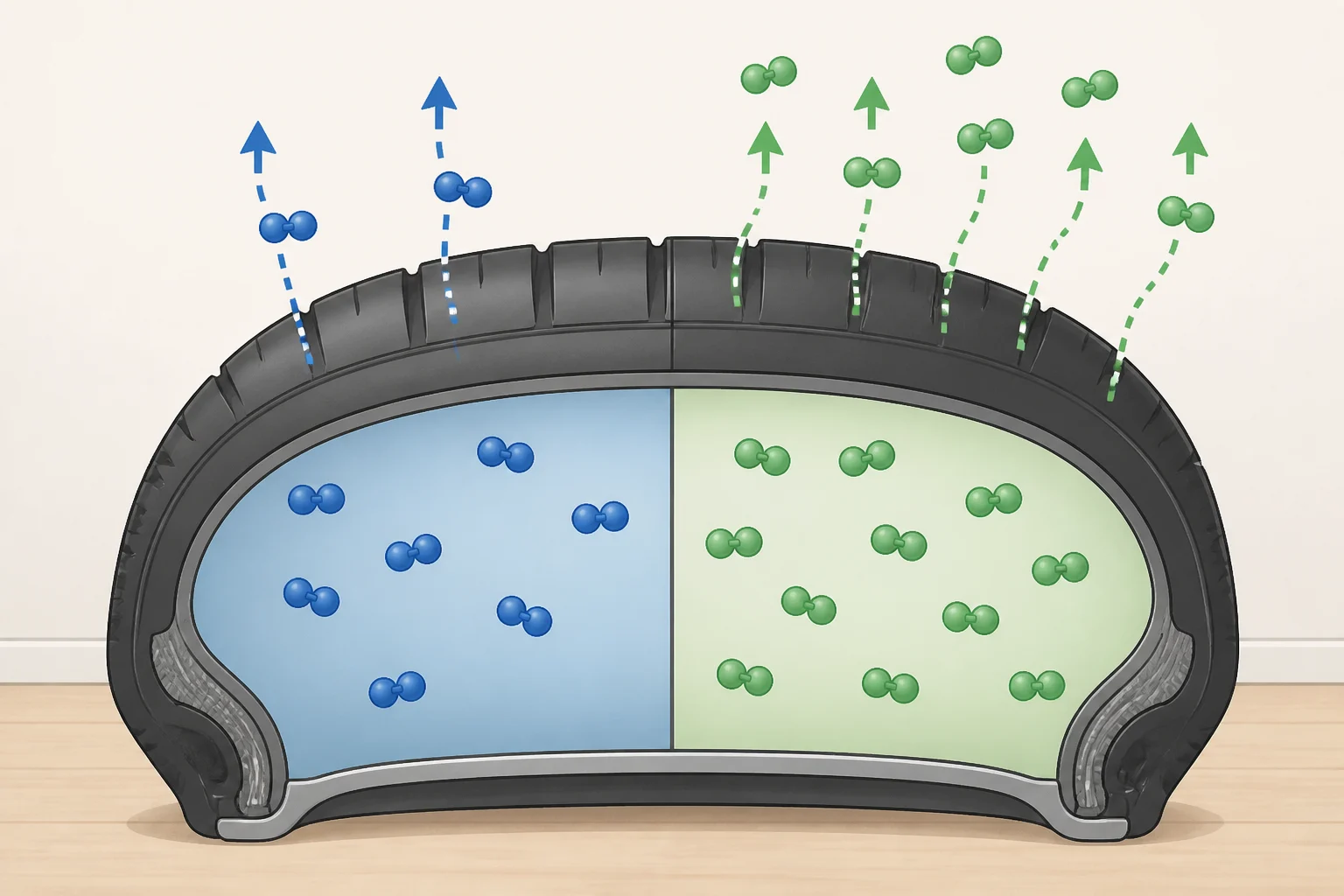
Start with what's already in a standard tire: regular air is roughly 78 percent nitrogen and 21 percent oxygen, with trace gases and some water vapor mixed in (Consumer Reports, updated last month; NRMA, last year). A nitrogen fill isn't some exotic substance. It's a processed gas that strips out most of the oxygen and moisture, leaving something closer to pure nitrogen. A retailer should remove the original air first if the goal is a high-purity fill; leave some of it behind and the tire ends up with a diluted mix rather than a true nitrogen fill (Consumer Reports, updated last month).
The physical reason nitrogen holds pressure longer comes down to molecule size. Nitrogen molecules are larger than oxygen molecules, so they escape through tire rubber three to four times more slowly (NRMA, last year). That's the main mechanism behind the 1.3-psi gap Consumer Reports measured, though moisture content and gas purity play a role too. Think of it as a slow leak with a slightly smaller hole: the tire still loses air over time, just a bit less of it.
There's a second effect worth noting. NHTSA's lab testing found nitrogen reduces internal oxidation, the slow chemical process that makes rubber stiffen and crack with age (Consumer Reports, updated last month). Consumer Reports adds its own caveat: most drivers replace tires before oxidation becomes a practical concern, so the benefit exists mostly on paper (Consumer Reports, updated last month). Nitrogen also runs drier than typical compressed air, and a dry, inert gas doesn't fluctuate with heat as much as air carrying moisture does, according to NRMA, though even nitrogen doesn't eliminate temperature swings entirely (NRMA, last year).
Why nitrogen's pressure edge doesn't translate to fuel savings
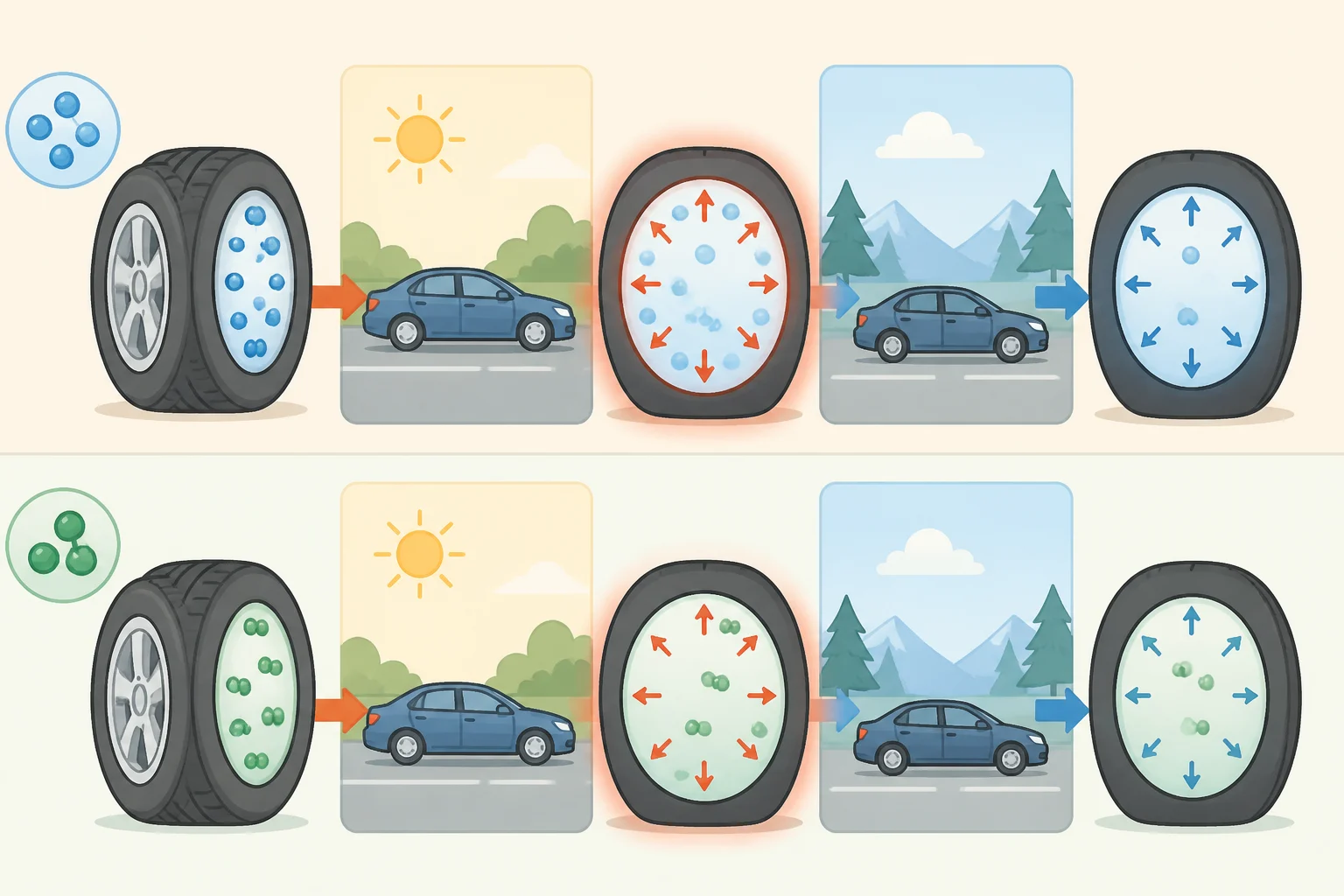
Underinflated tires genuinely do increase rolling resistance and hurt fuel economy, and temperature pushes pressure around constantly: for every 6°C rise in outside temperature, tire pressure can climb by roughly 1 psi (NRMA, last year). That's a pressure-maintenance problem, though, and ordinary air corrects it exactly as well as nitrogen does, as long as someone is checking and topping off; keeping tires at the right pressure is what cuts fuel use, regardless of which gas is doing the filling (NRMA, last year).
AAA's testing reinforces the point from another angle: nitrogen doesn't eliminate temperature-related pressure swings and doesn't turn tires into a maintenance-free product. "Since nitrogen does not completely eliminate temperature-related pressure changes under normal driving conditions, it is of little benefit to vehicle owners who properly maintain their tires," the organization found (Family Handyman, last year). That undercuts the part of the nitrogen pitch claiming the gas removes the need for regular checks.
There's also a durability problem with the fill itself. NHTSA's report, as summarized by Family Handyman, warned that "even slight contamination of the tire inflation gas with compressed atmospheric air during normal inflation pressure maintenance may negate the benefits of using nitrogen" (Family Handyman, last year). Topping off with a regular air hose, which is what most drivers would do in a pinch, introduces exactly the contamination that warning describes.
Consumer Reports' tire program manager, Ryan Pszczolkowski, frames the whole debate in one sentence: "Most of the selling points for nitrogen really relate to maintaining proper tire pressure," he says (Consumer Reports, updated last month). Not the gas. The pressure. Properly maintained air-filled tires and properly maintained nitrogen-filled tires produce the same rolling resistance, which is why findings from Consumer Reports, NHTSA, and AAA all land on the same conclusion: no substantial fuel-economy gain once tires are kept at the correct pressure (Consumer Reports, updated last month; Family Handyman, last year).
Are nitrogen-filled tires worth it for everyday drivers?
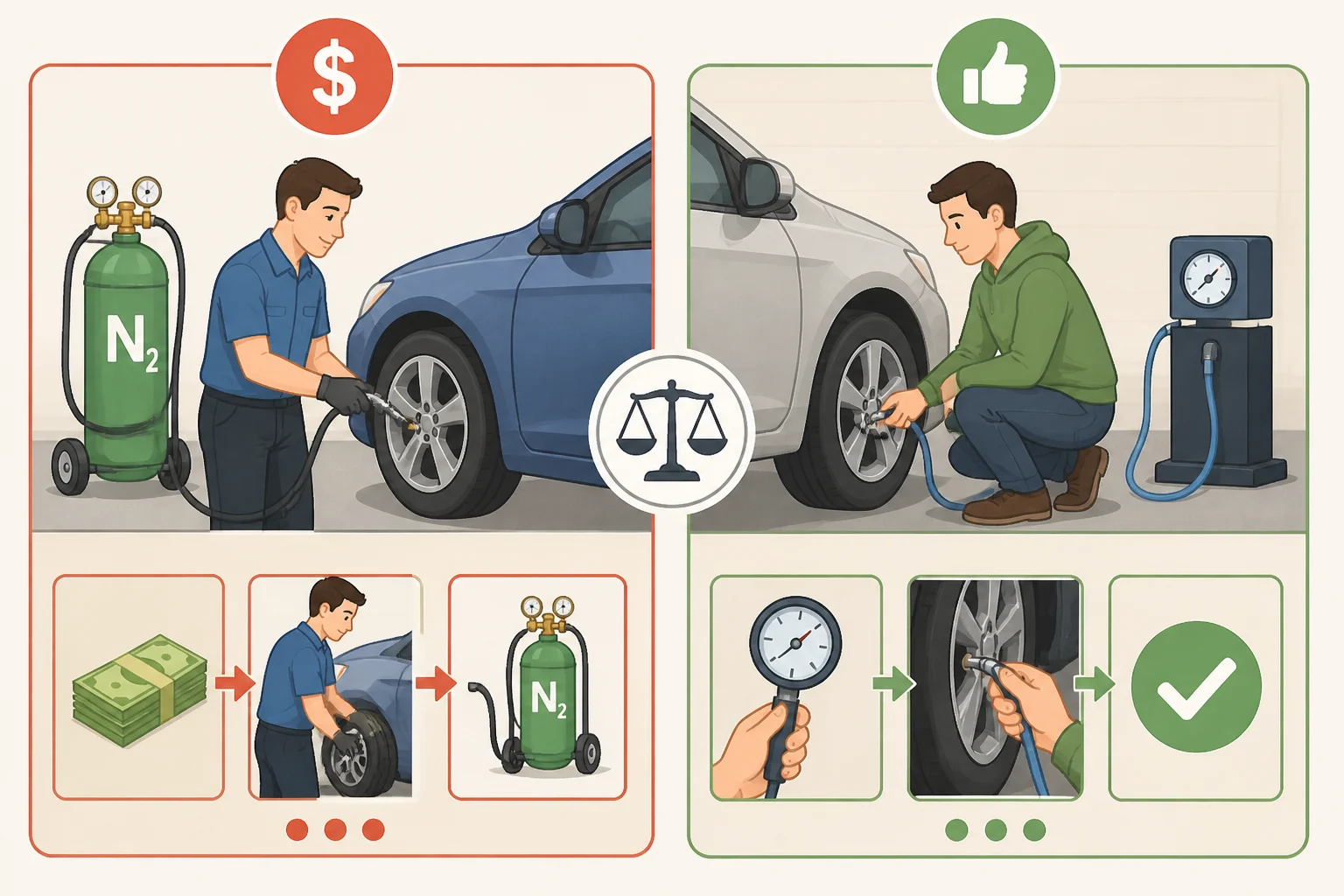
Run the numbers and the economics get even less compelling. NRMA estimates an Australian nitrogen fill costs roughly A$9.50 per tire, or close to A$40 for a small hatchback (NRMA, last year). The initial charge also creates an ongoing inconvenience: Consumer Reports notes that using nitrogen "does take commitment and potentially cost," since drivers are advised to keep topping off with nitrogen rather than regular air to preserve the intended benefit (Consumer Reports, updated last month). Adding ordinary air in an emergency won't ruin a tire, but it dilutes the nitrogen and chips away at whatever small edge it had.
Nitrogen does make more sense in a narrower set of applications. Consumer Reports points to high-pressure, heavy-duty uses, large commercial trucks and aircraft among them, where pressure stability carries higher stakes than it does in a commuter sedan (Consumer Reports, updated last month). NRMA makes a similar point, noting nitrogen has long been standard in racing cars, aircraft, trucks, and other heavy-duty settings (NRMA, last year). A peer-reviewed engineering study backs up the underlying chemistry: nitrogen's main advantages are low gas permeability and high resistance to ignition and explosion (engineering study, 2025), the same properties Consumer Reports and NRMA point to when explaining why nitrogen suits heavy-duty applications more than ordinary commuting.
There's a secondary, non-fuel-economy case too. NRMA says nitrogen may reduce the risk of heat-related blowouts on long trips or in hot conditions, and because it leaks more slowly, drivers spend less time at the air pump between checks (NRMA, last year). Those are potential conveniences, not a fuel-economy argument. NRMA's own assessment is blunt about the tradeoff for ordinary drivers: the advantages are small, and once the cost and hassle of finding nitrogen are factored in, sticking with air is the smarter choice for most people (NRMA, last year).
The real lever: pressure, not gas
NHTSA and Consumer Reports agree that nitrogen doesn't meaningfully change rolling resistance in a properly maintained passenger tire, and Family Handyman's review of AAA's testing lands in the same place (Consumer Reports, updated last month; Family Handyman, last year). The pressure-retention effect measured by Consumer Reports is real, but small, smaller still next to what a monthly pressure check accomplishes at no cost.
Consumer Reports' advice after running the test is the advice worth following: check tire pressure once a month, when tires are cool, and top off with regular air as needed (Consumer Reports, updated last month). That habit is the maintenance step most directly tied to the fuel-economy benefit of correct tire pressure, whatever gas happens to be in the valve stem. Nitrogen has its place in truck fleets and aircraft, where pressure stability is a genuinely higher-stakes problem. For the car in a typical driveway, the useful habit is simpler: check the pressure, and correct it when it's off.