Internet Safety Tips for Kids: 10 Skills to Recognize and Handle Online Risks
Fewer than one in four children who encounter something upsetting online ever tell a parent about it. That figure, drawn from Ofcom data cited in a peer-reviewed systematic review published earlier this year, is not a technology problem. It is a preparation problem. Nearly every child is already online about 96% of UK children aged 3–17 were online in 2024, with Australian children aged 12–17 averaging roughly 14 hours per week yet the internet safety tips for kids most widely taught in schools are barely landing. About 92% of 8–17-year-olds recall receiving an online safety lesson, but only 45% found those lessons useful, the same review found.
This article is for parents and caregivers of children aged roughly 8–16. Each lesson is something concrete to teach, model, or practice together. Lessons 1–5 apply broadly to middle childhood and early adolescence. Lessons 6–10 are most relevant for children with a smartphone or active social media accounts. Where age matters, the text says so.
Online safety is not a checklist. It is three practical skills: recognizing a risk, managing it in the moment, and recovering when something goes wrong. Schools have gotten reasonably good at the first. The third is almost entirely missing.
Why rules alone are not enough
Video of the Day
Many platforms run on business models that reward prolonged engagement. Autoplay, algorithmic recommendations, intermittent reward loops, and follower counts are deliberate design choices, not features built with children in mind. Those same recommendation systems can amplify harmful material self-harm content, dangerous challenges through user profiling, according to the American Academy of Pediatrics' policy statement published earlier this year. The platform is not neutral. It has preferences, and those preferences are about keeping a child watching.
That is why the AAP noted that children's media use cannot be understood "solely through the lens of individual child behaviors or screen limits alone." The FTC's guidance makes the same point plainly: parental controls help, but there is "no substitute for talking with your kids about your rules and expectations." Controls give children boundaries. Skills give them judgment.
Digital media, used with purpose and with adults involved, can support learning, creative expression, and connection particularly for children who feel isolated offline, the AAP notes. The goal is not to frighten families away from the internet. It is to send children into it better equipped.
Video of the Day
Internet safety tips for kids start with recognition
Lesson 1: Not everything online is what it looks like
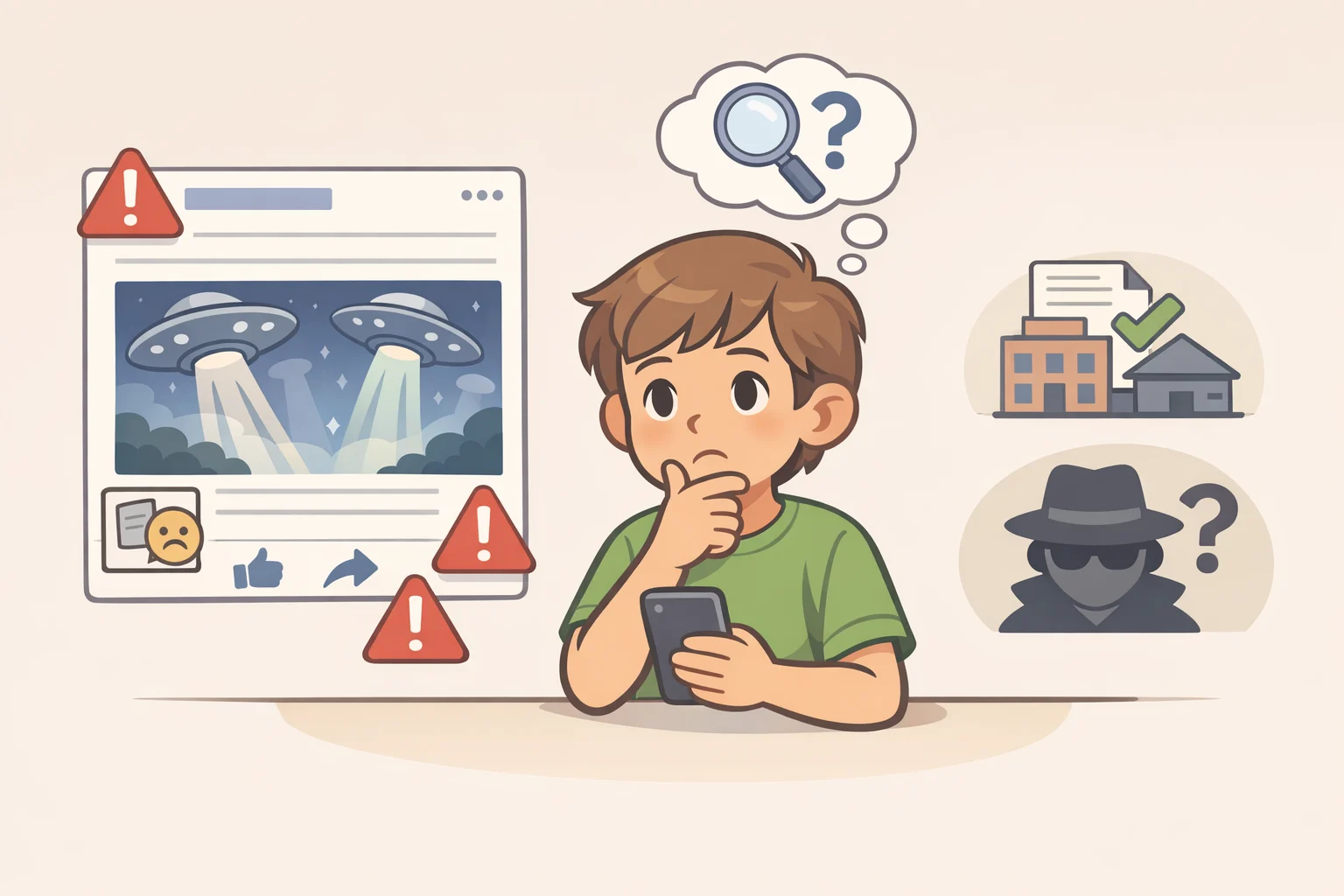
Content can be fabricated, misleading, or designed to provoke a reaction. A post that looks like news might be rumor or outright fiction. A friendly stranger in a game chat might not be who they claim to be. Cyberbullying frequently arrives disguised as ordinary social interaction. The practical habit: pause before reacting, sharing, or responding.
Around a third of 8–17-year-olds have encountered content described as worrying or distressing, with girls (about 34%) somewhat more likely to see it than boys (about 28%), according to Ofcom data cited in the 2026 systematic review. Teach children to notice content that creates urgency, triggers a strong emotion, or comes from someone unfamiliar and to check before sharing, think before responding. If a message from a stranger makes a child uncomfortable, or something feels threatening, that is when to tell an adult.
Lesson 2: Algorithms are not neutral
When a platform keeps serving up the same type of content especially extreme or upsetting material that is not coincidence. Platforms profile users based on what they click and watch, then serve more of what keeps them engaged longest. For vulnerable children, this mechanism may funnel content promoting self-harm or eating disorders, according to the AAP's policy statement. Children should understand that the feed reflects choices the platform made, not just choices they made. They can stop engaging, clear their history, or ask a parent to help reset the algorithm. If the content starts including self-harm or anything that makes a child feel worse about themselves, that warrants an adult conversation immediately.
Lesson 3: Ads and influencers are almost always trying to sell something
Children are often unable to distinguish advertisements and marketing from ordinary videos, according to research cited in the AAP's policy statement. That trusted creator talking enthusiastically about a product is almost certainly being compensated. This is not a reason to distrust every person online but it is a reason to ask: why is this person telling me this, and who paid them to? Teach children to treat any product mention like a commercial, not advice from a friend. Glowing recommendations, discount codes, and unboxing videos all belong in that category.
Lesson 4: Personal information is more valuable than it seems
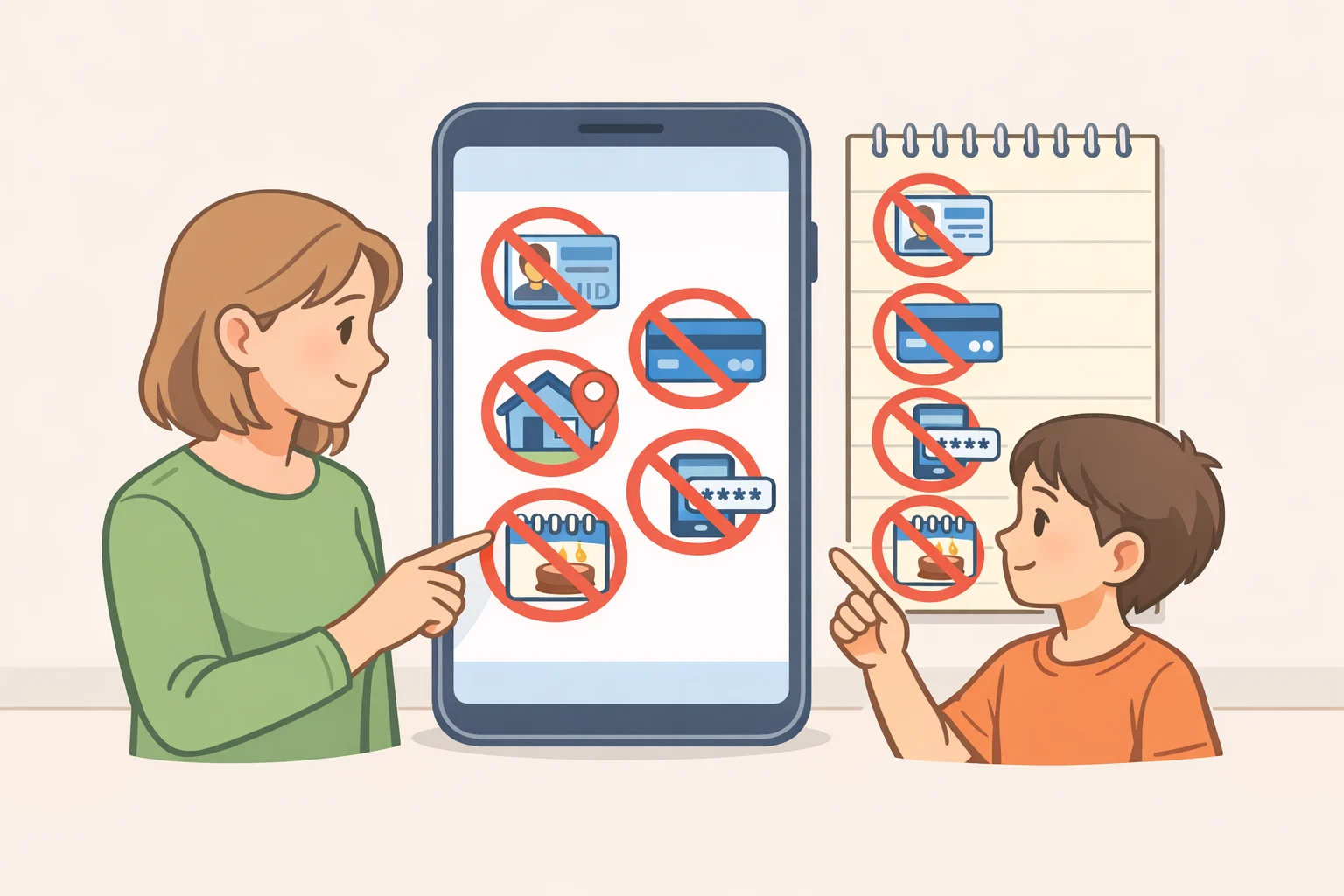
Platforms track what children watch, search, and click. Children have difficulty understanding how their information is collected online and cannot meaningfully consent to that collection, per the AAP. That data can be used to infer interests in unsafe activities alcohol, gambling, extreme dieting and then those topics get pushed back through targeting. The practical rule: full name, home address, school name, phone number, and passwords are never for public posts or group chats.
The FTC recommends building an ongoing family list of what never gets shared written down, posted somewhere visible, and updated together. Post it on the fridge. Add to it periodically. The habit sticks better than a one-time conversation. Any form asking for more personal detail than seems necessary is a reason to check with a parent first.
Family tool The Never-Share List: A short, plainly worded list of information that never goes online: full name, address, school, phone, passwords, and any photos that show the house or neighborhood. Review and update it together every few months. This exercise, recommended by the FTC, builds the habit more reliably than a single conversation ever will.
Managing online risks: what to do in the moment
Lesson 5: You are always allowed to stop, close, block, or report
Children often feel stuck or obligated to keep engaging with something uncomfortable. That feeling is worth naming directly, because many children simply do not know they are allowed to walk away. Every platform should have reporting tools that are easy to find and use; the AAP recommends those tools be prominent. When they are not, that is itself a signal to leave. Using a block or report function is not dramatic it is the right tool for the job.
The sequence: stop, close, block, report. Tell an adult immediately if a stranger has sent unwanted messages, or if harmful content about a specific person including the child appears anywhere.
Lesson 6: Protect your accounts like you protect your house key
Strong passwords, unique to each account, combined with multi-factor authentication a second verification step like a texted code make accounts significantly harder to compromise. The FTC's guidance frames this as something older children should be able to explain: how long a password should be, what makes a security question strong, and why sharing login credentials with anyone including close friends creates risk. Friends drift. Account access does not expire automatically.
Passwords should be at least 12 characters, unique to each account. Multi-factor authentication should be enabled wherever available. If an account behaves strangely or receives unexpected password-reset emails, tell an adult.
Lesson 7: Recognize when online pressure is real pressure and slow down
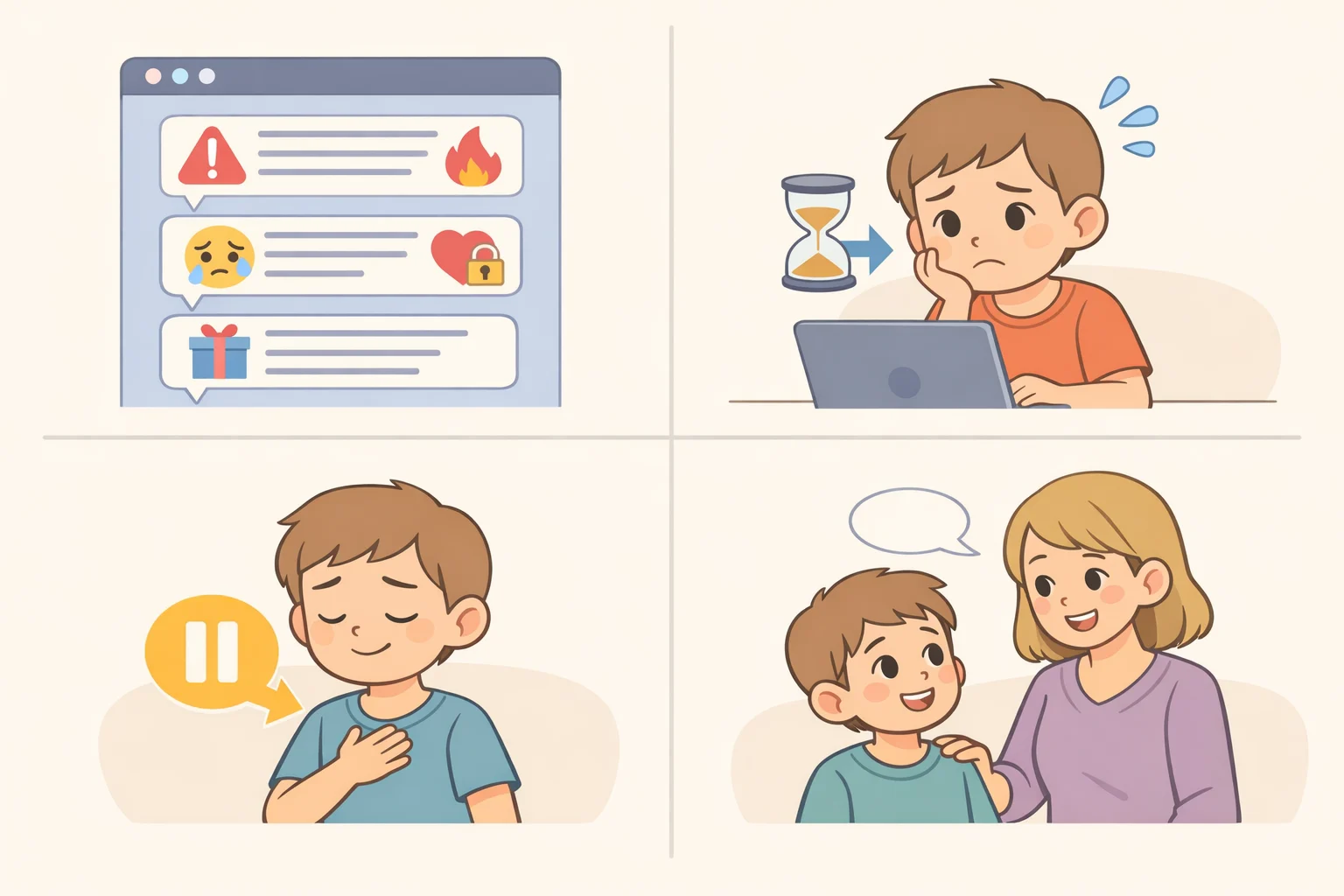
Social media can push children toward risky behaviors through peer pressure, social proof, and manufactured urgency, according to the AAP. A useful rule of thumb: if someone online is asking a child to do something they would not do in front of a trusted adult, or insisting they act fast before they can think, those are warning signs. Scammers, manipulators, and peer-pressure dynamics all rely on the same mechanism shortcutting the ability to pause and reconsider.
The right answer is almost never urgent. If anyone online asks a child to meet in person, requests photos, or makes a child feel they will be punished or embarrassed for saying no, tell an adult immediately.
A note on individual differences: The AAP is clear that effects vary. Early adolescence (ages 11–14) may be a period of heightened susceptibility, and children with ADHD, anxiety, or autism may face higher risk of adverse outcomes. For some children particularly those who feel marginalized in their offline communities online spaces can be genuinely important sources of connection and belonging. These lessons are starting points. What matters most is knowing your child and keeping the conversation going.
Recovery: the skill schools almost never teach
Of 15 school-based safety programs examined in the 2026 systematic review, 13 showed some evidence of improving children's ability to recognize online risks, and 10 showed some evidence of improving management skills. Only two measured recovery. Almost none included it in their content at all. Children who do not know how to recover from an online incident are more likely to stay silent, carry shame, and be less equipped when something similar happens again.
Lesson 8: Poor sleep makes every other lesson harder
Digital devices disrupt sleep through several overlapping mechanisms blue light suppresses melatonin production, stimulating content keeps the brain aroused, and having a phone in the room creates a persistent pull toward checking, per the AAP's policy statement. Sleep deprivation impairs judgment and emotional regulation. A child who is chronically underslept is simply less capable of applying the previous seven lessons when it counts. A phone-free bedroom is practical harm reduction frame it around judgment and resilience, not just a house rule about devices.
Charge devices outside the bedroom overnight. Aim for at least an hour without screens before sleep. This one is primarily for caregivers to implement together with a child, not hand down unilaterally.
Lesson 9: Name a trusted adult before you need one
Only 23% of parents reported that their children talked to them about upsetting or scary content they saw online, according to Ofcom data cited in the 2026 systematic review. The reasons are predictable: embarrassment, fear of losing phone access, not wanting to worry someone, not knowing how to start. The solution is not waiting for the right moment. It is building the relationship before anything goes wrong.
The AAP recommends that caregivers talk early and often about digital experiences precisely so that when something does happen, a child already knows it is safe to bring it up. Children should have a named person a parent, school counselor, trusted relative and know that "I saw something weird online and it's bothering me" is enough to start. When a child seems withdrawn or secretive about their online activity, ask with curiosity rather than accusation. Keep the response calm. Modeling this helps: share a time you encountered something confusing or uncomfortable online.
Family tool The Trusted Adult Plan: Write down who a child can go to if something goes wrong online first choice and a backup. Keep it somewhere private but accessible to the child. Review it periodically as circumstances change. Connected relationships with trusted adults are among the strongest protective factors in children's digital wellbeing, AAP research consistently shows. Naming those adults in advance makes using them more likely.
Lesson 10: Getting something wrong online is survivable and shame makes recovery harder
This is the least-taught lesson in online safety, and probably the most durable. Children who feel shame after an online incident oversharing, being manipulated, having something embarrassing spread are less likely to report it, seek help, or handle similar situations better in the future. Recovery, as the UK resilience framework defines it, means accepting what happened and sometimes learning from it. Not pretending it did not occur, but not treating it as permanent damage either.
The FTC recommends that adults model this directly: share real stories about online mistakes a scam that nearly worked, a post that should not have been shared and let children see that adults navigate this imperfectly too. Shame is the bully's best ally. Removing it is an act of protection.
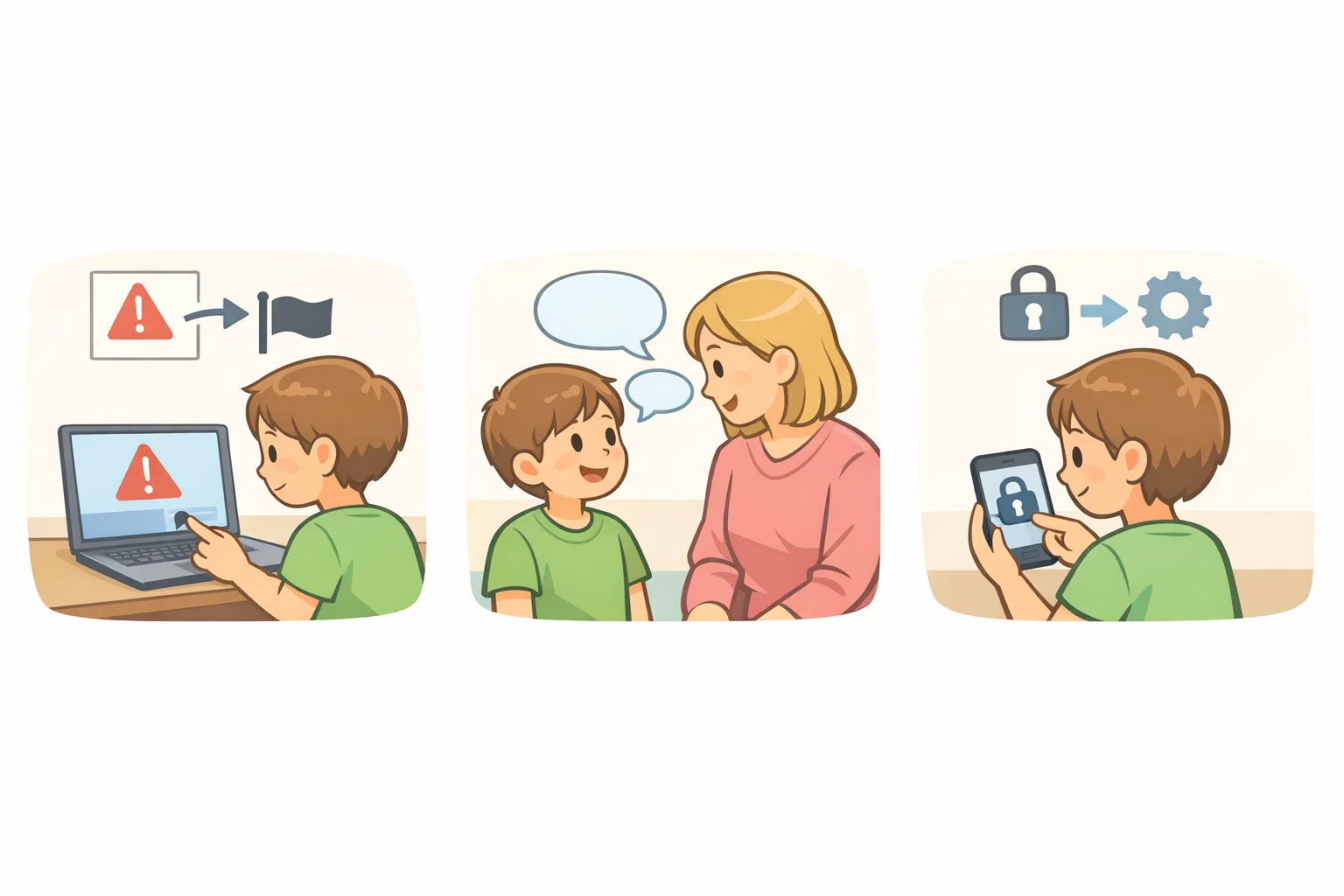
Recovery looks different by situation. After seeing upsetting content: name it, close it, talk about it. After oversharing personal information: take stock of what was shared, tell a trusted adult, adjust privacy settings. After being bullied or harassed: document it, report it, reach out for support. After contact from a stranger: tell an adult immediately, do not respond further, and understand clearly that no child is responsible for an adult's inappropriate behavior.
Where to go from here
The AAP's updated guidance moves families beyond screen-time limits toward quality, context, and conversation. The school programs with the strongest results used practice, demonstration, and rehearsal rather than information delivery alone, per the systematic review. Knowing something is not the same as being able to do it under pressure.
So this week: walk through the reporting flow on one platform your child actually uses. Make a never-share list and put it somewhere visible. Write down a trusted adult's name and a backup. Those three things take twenty minutes and address the gaps that formal safety education has largely skipped.
The landscape will keep shifting as AI-generated content and new platforms change what children encounter. No rule set keeps pace with that. A child who can recognize manipulation, knows how to ask for help, and understands that something going wrong online is not the end of the story that child is built for whatever comes next.