PS6 Handheld PSSR 3.0 Support: Leak Claims vs Sony Facts
Sony hasn't announced a PS6 handheld. The supplied reporting contains no Sony statement on the device at all. What it does contain, published today, is a detailed leak describing PS6 handheld PSSR 3.0 support: frame generation, 24GB of RAM, and an RDNA 5 GPU, all attributed to a leaker known as KeplerL2 (Digital Foundry, today).
What Sony has confirmed is narrower, but real. It has shipped a substantially upgraded PSSR upscaler on PS5 Pro, built through a joint AI research partnership with AMD called Project Amethyst (PlayStation.Blog, earlier this year). Whatever boosted performance ends up meaning for a PS6 handheld, it will draw on that groundwork rather than appear from nothing.
The PS6 handheld specs leak: what KeplerL2 claims
Video of the Day

According to Digital Foundry, the rumored device is said to support "PSSR 3.0," with frame generation included as part of the package (Digital Foundry, today). The report attributes the specifications, including 24GB of RAM and an RDNA 5 GPU, to KeplerL2. The material provided here contains no independent documentation or benchmark to check that against.
The supplied Sony materials don't mention the name "PSSR 3.0" or frame generation for a handheld anywhere. That silence doesn't make the leak wrong. It just means there's one source for the entire spec sheet right now.
For context, a SIGGRAPH presentation on PSSR 2.0, the version currently shipping on PS5 Pro, appeared to show no transformer element involved, Digital Foundry reported last month (Digital Foundry, last month). The leak doesn't specify what machine-learning architecture PSSR 3.0 would use, so the two claims don't connect directly. It confirms only that whatever Sony ships next remains undefined in any public material so far.
Video of the Day
What Sony has actually shipped: PSSR's confirmed upgrade and the AMD partnership
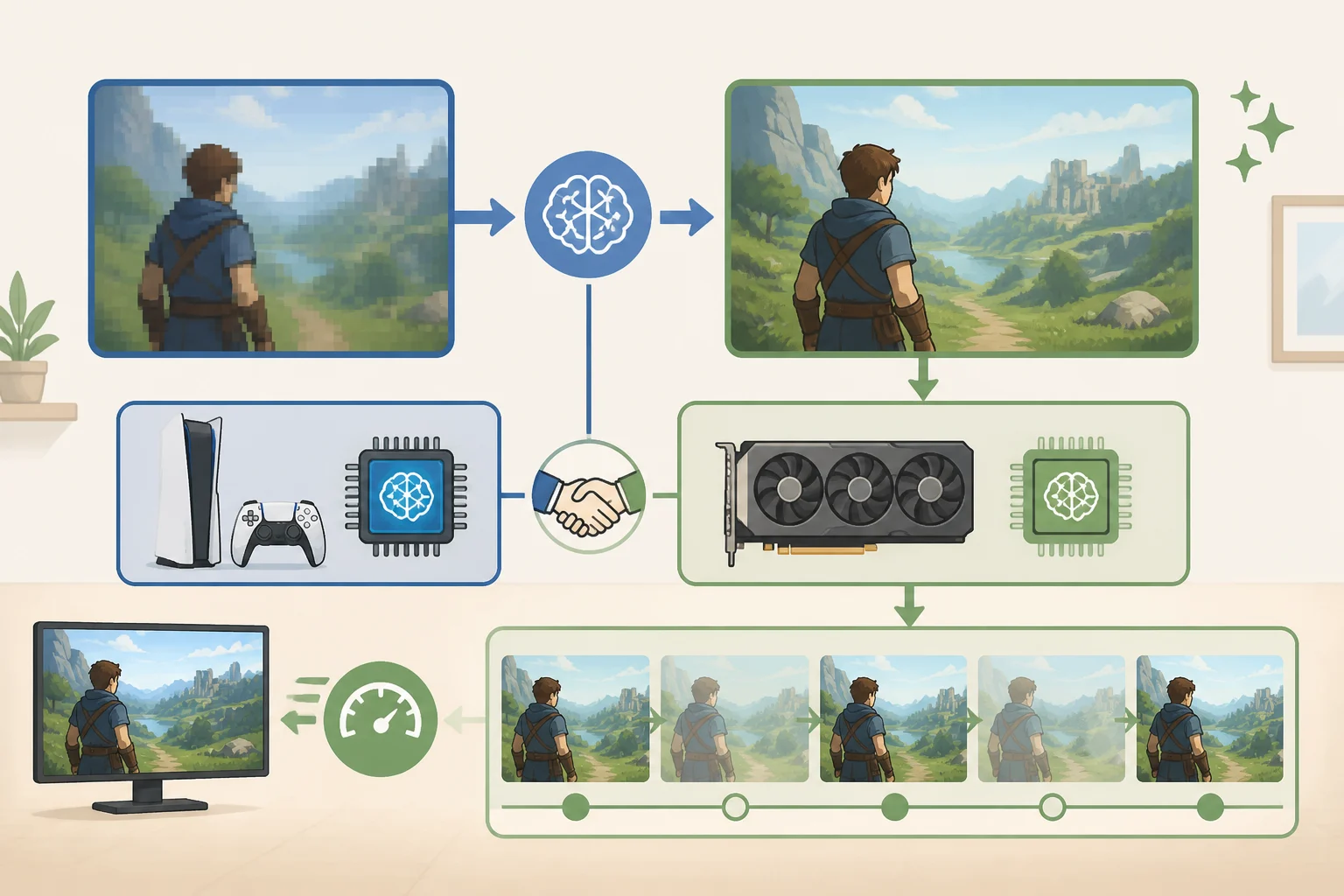
PSSR, Sony's AI upscaler that analyzes images pixel by pixel, has been used to boost the effective resolution of more than 50 titles on PS5 Pro (PlayStation.Blog, earlier this year). Sony announced an upgraded version in February, built on a different neural network and algorithm than the original, aimed at sharper reconstruction, steadier motion, and more developer control over the fidelity-performance tradeoff. Resident Evil Requiem, launched the same day as the announcement, was the first title to use it.
The wider rollout followed in March, when a system software update brought the upgraded PSSR to additional titles including Silent Hill f, Monster Hunter Wilds, Final Fantasy VII Rebirth, and Crimson Desert (PlayStation.Blog, earlier this year).
Mark Cerny told Digital Foundry the new version runs roughly 100 microseconds faster than the original (Digital Foundry, earlier this year). That speed gain is what let Sony add a system-wide "Enhance PSSR Image Quality" toggle, applying the upgrade to any PSSR-supported game. The same update let Sony automatically substitute the new version into eleven previously announced titles, such as Silent Hill 2, through a driver-level change made at each developer's request and based on their own testing (Digital Foundry, earlier this year).
Cerny confirmed the new PSSR shares its core algorithm with AMD's FSR Redstone Upscaling, and that FSR Frame Generation is likewise co-developed technology between Sony and AMD (Digital Foundry, earlier this year). That partnership establishes a technical connection between Sony's upscaling work and AMD's frame-generation technology. It doesn't confirm that a handheld implementation exists.
What PS6 handheld PSSR 3.0 support would require from the hardware

PS5 Pro's PSSR runs on custom machine-learning silicon, with Cerny citing a peak figure of 300 8-bit TOPS. He said FSR and PSSR use different implementations because of the hardware underneath them: FSR uses 8-bit floating point, PSSR uses 8-bit integer (Digital Foundry, earlier this year). An RDNA 5 label on its own says little about upscaling performance without knowing how much dedicated machine-learning throughput the chip actually carries.
Digital Foundry's feasibility analysis from last year identified 720p rendering upscaled through PSSR as one possible configuration for cutting power draw on a portable device, without treating it as a confirmed target (Digital Foundry, last year). The same piece noted that RDNA 5's architecture, as discussed in the Project Amethyst update, should share fundamentals with whatever Sony eventually builds for PlayStation 6.
Frame generation works differently from upscaling. As commonly implemented, it raises the displayed frame rate by inserting synthetic frames between rendered ones rather than increasing native GPU throughput. Whether PS6 handheld frame generation ships as described remains unverified. Neither Sony's confirmed material nor the leak addresses the base frame rate a PS6 portable PSSR 3.0 setup would run from, the input latency it would add, or the battery cost of running it on the go.
What current PSSR shows about the work still required
Sony's own rollout wasn't a blanket fix. Some titles needed developer-requested QA before adopting the new PSSR, and Cerny said achieving ideal results in certain games required adjustments such as changes to mipmap bias or exposure calculation (Digital Foundry, earlier this year).
Cerny also acknowledged the upgraded PSSR can introduce aliasing in specific scenes, including instability in light sources smaller than a pixel, even in games it broadly improves. He said he'd leave the feature on anyway, since it improves most of the game, but that the choice belongs to each player (Digital Foundry, earlier this year).
Sony's own messaging carries the same caveat. PlayStation.Blog described results as variable by title and noted that players can turn the feature off if it produces unwanted effects (PlayStation.Blog, earlier this year). That's language built around per-game tuning, not a universal performance guarantee.
A plugged-in console still needs this much per-title calibration. A handheld, with tighter power and thermal limits, would need at least as much groundwork, and Sony's own PS5 Pro rollout would not by itself establish that a portable device could deliver a smooth experience without visual artifacts.
Where this leaves the PS6 handheld PSSR 3.0 rumor

Sony's confirmed record is specific: a faster, AMD-linked PSSR upgrade, rolled out in phases since February, with a stated speed gain of roughly 100 microseconds. Digital Foundry's own testing found the quality improvement over the original PSSR immediately apparent across every title it examined, with the previous version's most obvious issues largely gone (Digital Foundry, earlier this year).
Everything specific to a PS6 handheld, the PSSR 3.0 name, frame generation's inclusion, 24GB of RAM, and an RDNA 5 GPU, still traces back to a single leak attributed to KeplerL2, with no confirmation from Sony or AMD in the reporting so far (Digital Foundry, today).
What's still missing from that picture: how much dedicated machine-learning throughput a handheld chip would carry, what base frame rate any frame-generation feature would run from, how much latency it would add, and what it would cost in battery life. None of that has surfaced in any leak, or in any Sony statement, so far.