Samsung Galaxy A37 review: is it worth buying now?
Samsung built the Galaxy A37 around a six-year promise of OS and security updates, then paired that commitment with an Exynos 1480 chip and just 6GB of RAM that already struggles under everyday use. Pickr measured app loads taking two to four seconds, compared with an instant result on other devices, and called the real-world experience "a slog."
That tension sits at the center of every Samsung Galaxy A37 review published so far, and the verdict shifts depending on where you're buying. Android Authority's review, published this week, calls the U.S. 6GB/128GB model "an easy recommendation" at $349 to $400, but says the same hardware gets hard to justify once the price nears $500. Pickr's identical 6GB/128GB configuration carries an Australian recommended price of A$599, which the outlet rates as merely "acceptable value" and argues would be more compelling closer to A$499. UK buyers get a configuration neither of those reviews tested: a 256GB/8GB option at £459 alongside the standard 128GB/6GB model at £399 (Samsung UK).
These are three separate regional judgments on largely the same base hardware, not one price converted across currencies. This review walks through what's confirmed about the A37's build, software support, real-world performance, battery, and cameras, then breaks down when it's a buy, a wait, or a skip depending on your market and configuration.
Samsung Galaxy A37 price: when is it worth buying?
Video of the Day
U.S. pricing has swung considerably since launch. The 6GB/128GB model launched at $449.99, dropped to $349 during a recent Amazon Prime Day sale, then climbed to $489 on Samsung's own site as part of a broader A-series price increase. Third-party Amazon listings still sit under $400, according to Android Authority.
UK shoppers get a real configuration choice the other two reviews don't address: £399 for 128GB/6GB, or £459 for 256GB/8GB (Samsung UK). Paying the extra £60 buys more RAM on paper, which could ease the performance issues described later in this review, but no independent outlet has actually tested that higher-memory unit.
In Australia, Pickr's review unit, a 6GB/128GB model, carries a recommended retail price of A$599. Pickr argues Samsung would need to cut that to A$499 to make the phone clearly compelling, a judgment based on Australian-dollar pricing that shouldn't be read as equivalent to any U.S. or UK threshold (Pickr).
Those numbers only mean something once you match them against your market and the configuration you'd actually buy:
- Buy if you can confirm a real sale price: U.S. buyers near $349 to $400 for 6GB/128GB, UK buyers near or below the £399 to £459 list prices depending on storage tier, Australian buyers near or below A$499.
- Wait if the only price available in your market sits close to list price. Both independent reviewers tie their harshest performance complaints to full-price purchases.
- Skip and compare if a similarly priced alternative is sold locally. Android Authority points U.S. shoppers toward the Pixel 10a or a discounted Pixel 9a near $499, though that comparison is U.S.-specific and hasn't been checked against UK or Australian Pixel pricing.
- Verify before buying: which RAM and storage variant is actually listed, third-party seller reliability and local warranty coverage, whether your charger supports 45W PPS charging or needs replacing, and whether 128GB with no microSD slot covers your storage needs.
Price alone doesn't make the A37 good or bad. The real question is whether a specific configuration at a specific local price still makes sense given the performance trade-offs below.
Video of the Day
Build quality, display, and six years of software support

Samsung rates the Galaxy A37 IP68 for dust and water resistance, and in hand, Pickr described it as feeling more durable than expected, crediting the aluminum frame and Gorilla Glass front. The phone measures a slim 7.4mm and weighs 196 grams. Pickr noted that handsets priced under A$700 rarely combine an aluminum edge, a slim body, and IP-rated resistance the way the A37 does (Pickr; confirmed by Samsung UK).
The 6.7-inch, 120Hz Super AMOLED display is essentially carried over from last year's A36, with Samsung quoting the same 1,200-nit high-brightness and 1,900-nit peak figures. Nothing new here, but it's still a strong panel for the price tier, Android Authority notes.
Where the A37 stands out is software longevity. Samsung commits to six Android and One UI version upgrades plus six years of security patches, with One UI 9 already rolling out to A-series devices in some regions (Samsung Global Newsroom; Android Authority). That's generous support for a phone at this price. Neither source benchmarks it directly against every rival's update policy, so treat it as a strong commitment rather than a guaranteed category leader.
A six-year software runway is the strongest argument for buying the A37 and keeping it for years. But that promise only pays off if the hardware underneath can still run current apps and OS versions comfortably that far out, and that's where things get complicated.
Performance, storage, and battery: where the Exynos 1480 shows its limits
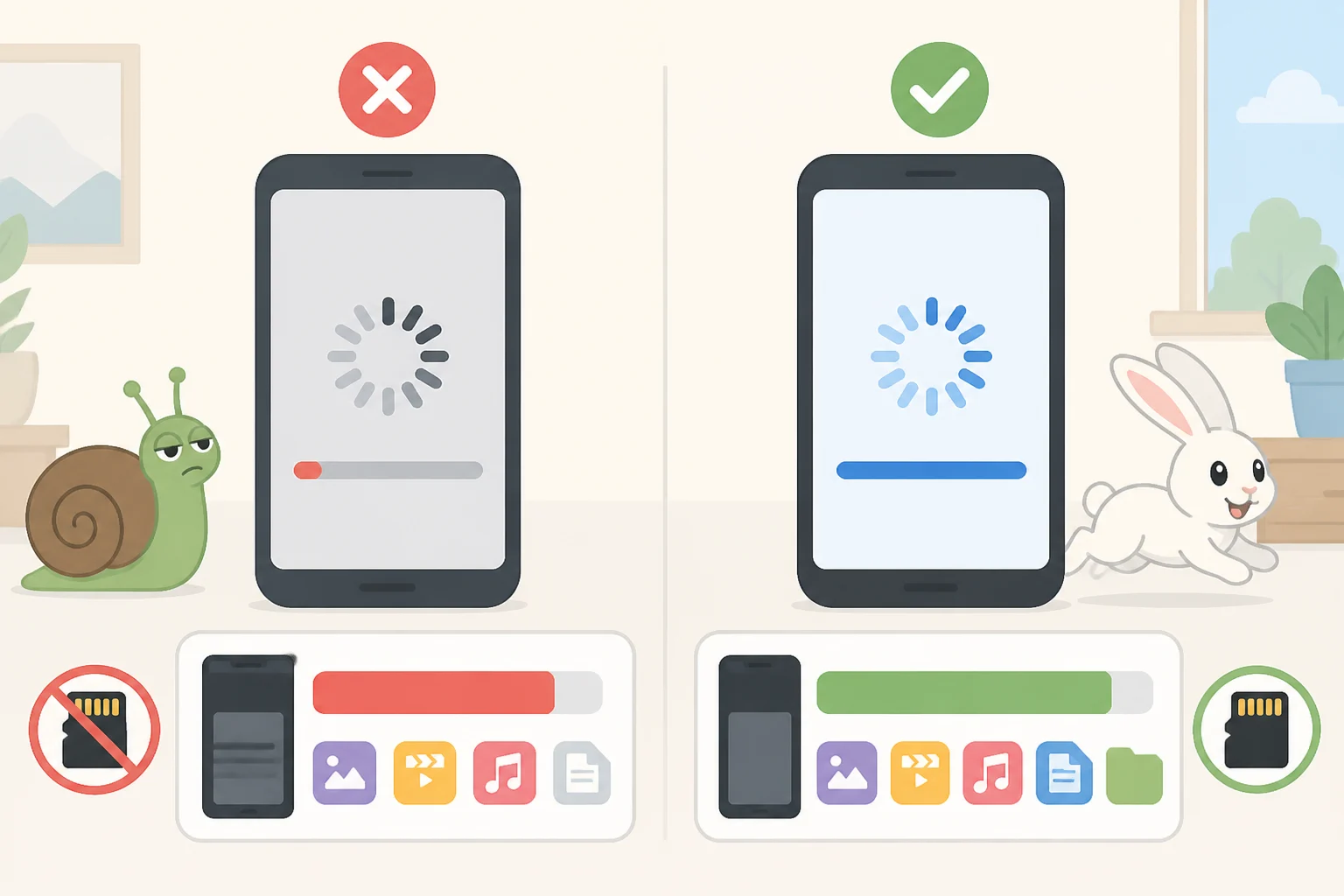
The base configuration pairs the Exynos 1480 with 6GB of RAM and 128GB of storage. Pickr's extended testing recorded two-to-four-second app load times against near-instant results on other phones, and Android Authority independently described the phone as sluggish under pressure. Two reviewers, two different markets, the same configuration, and the same conclusion, which makes this one of the more consistent findings across either review.
Storage is worth checking before you buy. The 128GB base model has no microSD slot and leaves less than 120GB usable once the OS and apps are accounted for. UK buyers can step up to 256GB/8GB for £459, a configuration neither performance review actually tested (Samsung UK). More RAM plausibly helps with multitasking, and more storage removes the microSD headache entirely, but nobody has run that higher-memory unit through the kind of extended testing Pickr and Android Authority applied to the 6GB model. Don't assume the 8GB option quietly fixes the lag both reviews documented; it's an untested variable, not a confirmed solution.
Battery life fares better, with some variance between testers. Android Authority found the 5,000mAh cell lasts a full day even under heavy use, while Pickr measured roughly a day and a half with five to six hours of screen time, and judged up to two days possible under lighter use.
Charging is fast with the right adapter but skips a common convenience. Both reviewers independently confirmed roughly 70 minutes from empty to full with a 45W PPS-compatible charger, about 90 minutes with a standard 25W charger, and no wireless charging at all. Worth flagging: Samsung's joint A57/A37 announcement, from earlier this year, attributes "up to two days of use," a 60% charge in around 30 minutes, and a 13% larger vapor chamber specifically to the Galaxy A57, in the sentences describing that model. Those figures don't apply to the A37 and shouldn't be quoted as its specifications (Samsung Global Newsroom).
This is where the six-year update promise meets its limit. If 6GB of RAM already struggles with everyday app switching today, it's fair to ask whether this configuration will handle Android updates comfortably in year five or six. That uncertainty is the real risk buyers take on with the base model.
Camera performance: fine in daylight, a reason to wait for a discount

The 50MP main camera picked up a larger 1/1.56-inch sensor, the same size Samsung uses in the higher-tier Galaxy A57, Android Authority reports.
Results diverge between the two reviews. Android Authority was "mostly happy" with 4K/30fps video from both the main and selfie cameras outside low light, while Pickr judged the 50MP main and 8MP ultrawide only "acceptable" in daylight, with "virtually no low-light performance to talk about" (Pickr).
Samsung's own marketing describes "pro-level" camera features and low-light Nightography that adapts seamlessly (Samsung UK). At least one independent review directly contradicts the low-light claim, so it's best treated as a company claim rather than a verified result. The camera is adequate for casual daylight shooting, not strong enough to justify paying close to list price on its own merits. It reinforces that the A37 earns its reputation through build and battery, not imaging.
Final verdict: buy, wait, or skip
Independent testing backs up Samsung's durability claims: an IP68 rating, an aluminum frame that Pickr found feels sturdier than its price suggests, a capable 120Hz AMOLED display, dependable battery life, and a genuinely generous six-year update commitment. Set against that is the Exynos 1480 and 6GB RAM combination, which already produces two-to-four-second app load delays in testing today. That gap, not the update policy, is the central risk in a phone meant to last years.
Software longevity and hardware comfort aren't the same promise. A six-year update commitment matters less if the phone already feels slow out of the box. Buyers prioritizing long-term use, particularly in the UK, should weigh whether the 8GB/256GB option is worth the extra £60 for the storage headroom and multitasking buffer it should provide, keeping in mind that no independent review has actually tested whether it resolves the lag documented on the 6GB model.
Check your local, current sale price against the thresholds above, not the list price and not a number converted from another country's currency. Buy at a verified discount on the configuration you actually want. Wait if full price is the only option where you live. And if a similarly priced Pixel A-series phone is sold in your market, put it side by side with the A37 before deciding either way.