Anker Nano 10-in-1 Smart Display Hub Now : Full Specs
Anker's Nano 10-in-1 Smart Display Hub went on sale yesterday for $99 through Amazon and Anker's own U.S. store, according to 9to5Toys and Notebookcheck. The hub was unveiled at IFA 2026 alongside a new 100W laptop charger, pairing native 4K and high-refresh display output with a built-in screen that tracks port and charging activity in real time, per Notebookcheck.
That combination is the pitch: an Anker dual monitor USB-C docking station priced below some of Anker's other smart-display dock combos, per 9to5Toys, with single-display refresh rates reaching 240Hz and dual-display modes that can hit the same number under the right conditions. But "dual monitor" isn't one fixed spec here. It spans a reported 4K/60Hz mode up to a far more demanding 240Hz mode that depends on what the laptop's own USB-C port can actually do.
Price and positioning
Video of the Day
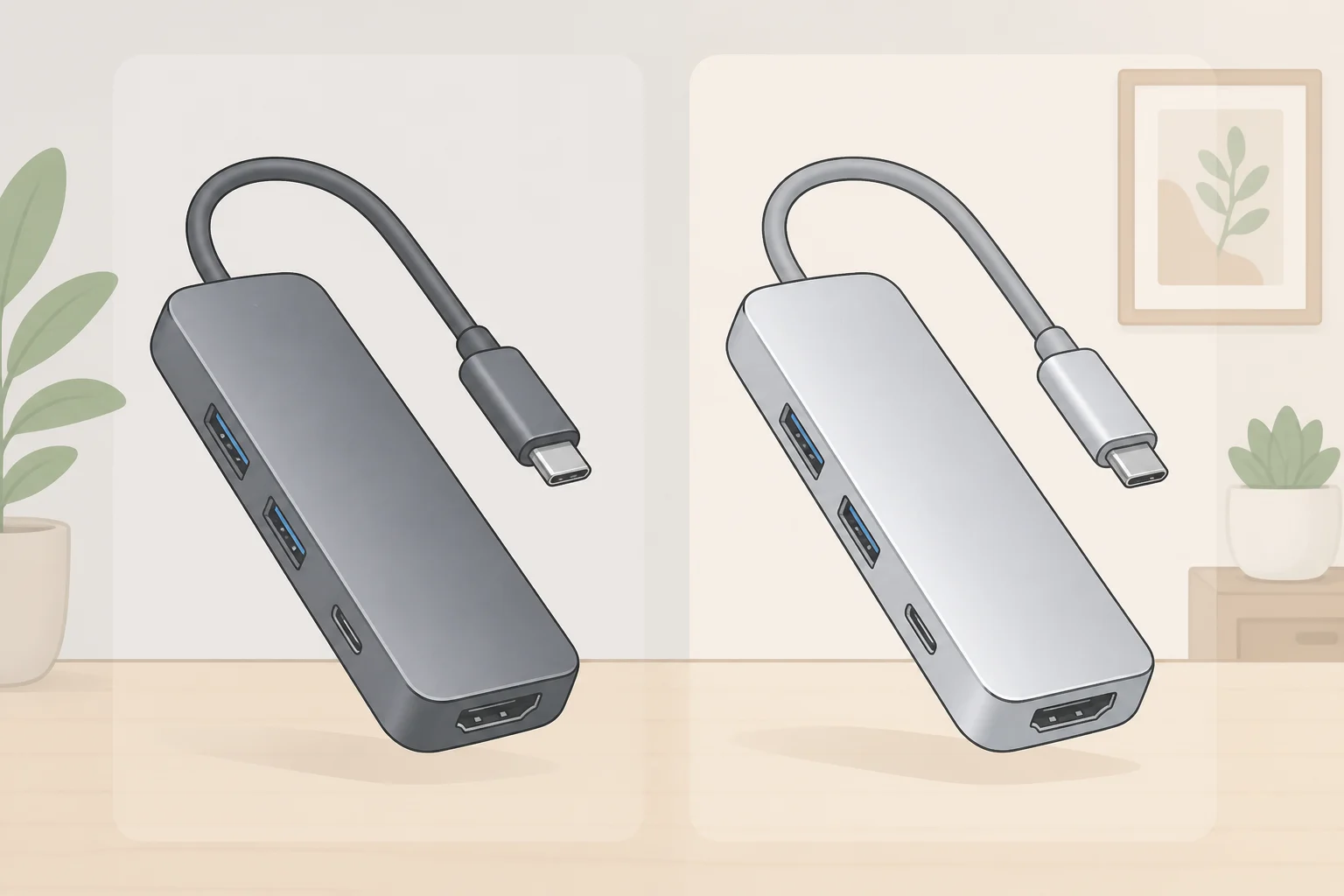
The Anker Nano 10-in-1 USB-C hub ships in two colorways, iron gray and starlight silver, and sells through both Amazon and Anker's direct storefront, per Notebookcheck. At $99, it undercuts some of Anker's newer smart-display charging station and dock combos, Notebookcheck reports.
The hub uses native 4K video output rather than DisplayLink, the technology built into Anker's older 563 dock, according to the same report. The supplied launch coverage does not include independent testing of throughput or display stability under sustained use, so how that claim holds up in daily practice remains unconfirmed.
Video of the Day
Anker Nano 10-in-1 Smart Display Hub display support
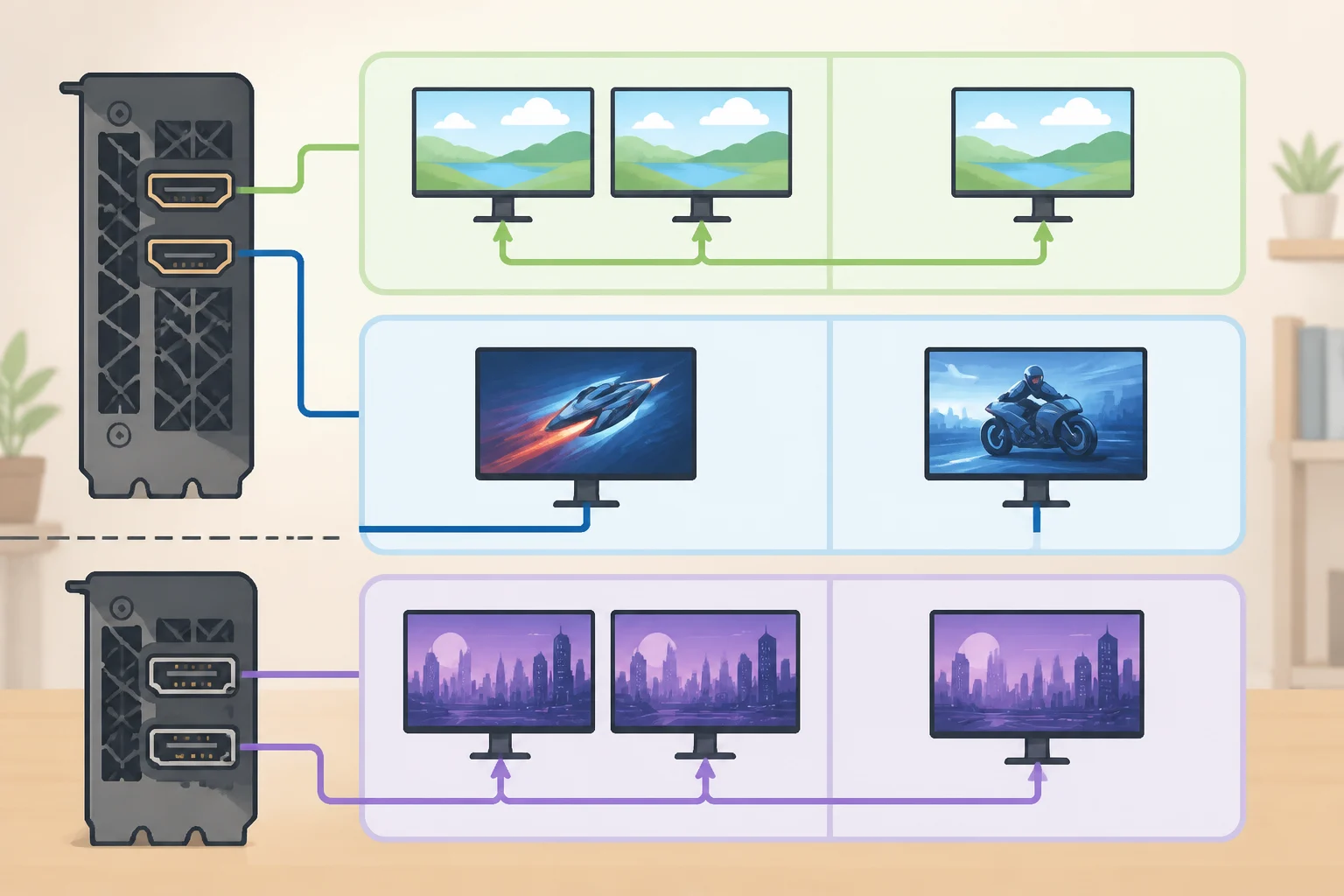
Through one HDMI 2.1 port and one DisplayPort 1.4 port, Notebookcheck reports the hub supports dual 4K displays at 60Hz. A single monitor can also run at 4K/144Hz or 1440p/240Hz; the reports describe this mode as 2K or 1440p, per 9to5Toys and Notebookcheck.
The most demanding mode is dual 1440p displays at 240Hz. That combination only activates if the laptop's own USB-C port supports DisplayPort 2.1 with DSC 3:1, a specification most laptops don't carry, per 9to5Toys. Video runs exclusively through the dedicated HDMI and DisplayPort connections, not through the hub's USB-C data ports, according to the same report.
The distinction means the laptop's USB-C port, not the PD-IN port, determines whether the advertised display modes are available. The 100W PD-IN port is for power input, while video output is documented only through HDMI and DisplayPort, per 9to5Toys.
| Mode | Displays | Stated maximum | Connection | Host requirement |
|---|---|---|---|---|
| Baseline dual | 2 | 4K at 60Hz each, reported by Notebookcheck | HDMI 2.1 + DisplayPort 1.4 | Not specified in supplied coverage |
| Single high-refresh | 1 | 4K at 144Hz or 2K at 240Hz, reported by Notebookcheck | HDMI 2.1 or DisplayPort 1.4 | Not specified in supplied coverage |
| Dual high-refresh | 2 | 2K at 240Hz each | HDMI 2.1 + DisplayPort 1.4 | DP 2.1 with DSC 3:1 on the host USB-C connection, according to 9to5Toys |
Neither launch report says whether macOS extends across two external displays on this hub or mirrors them. Anker's own listing for the older 364 hub states that macOS mirrors rather than extends across its dual HDMI outputs, per Anker. The launch reports do not establish whether that same limitation carries over to the Nano hub.
Ports, charging, and the smart display
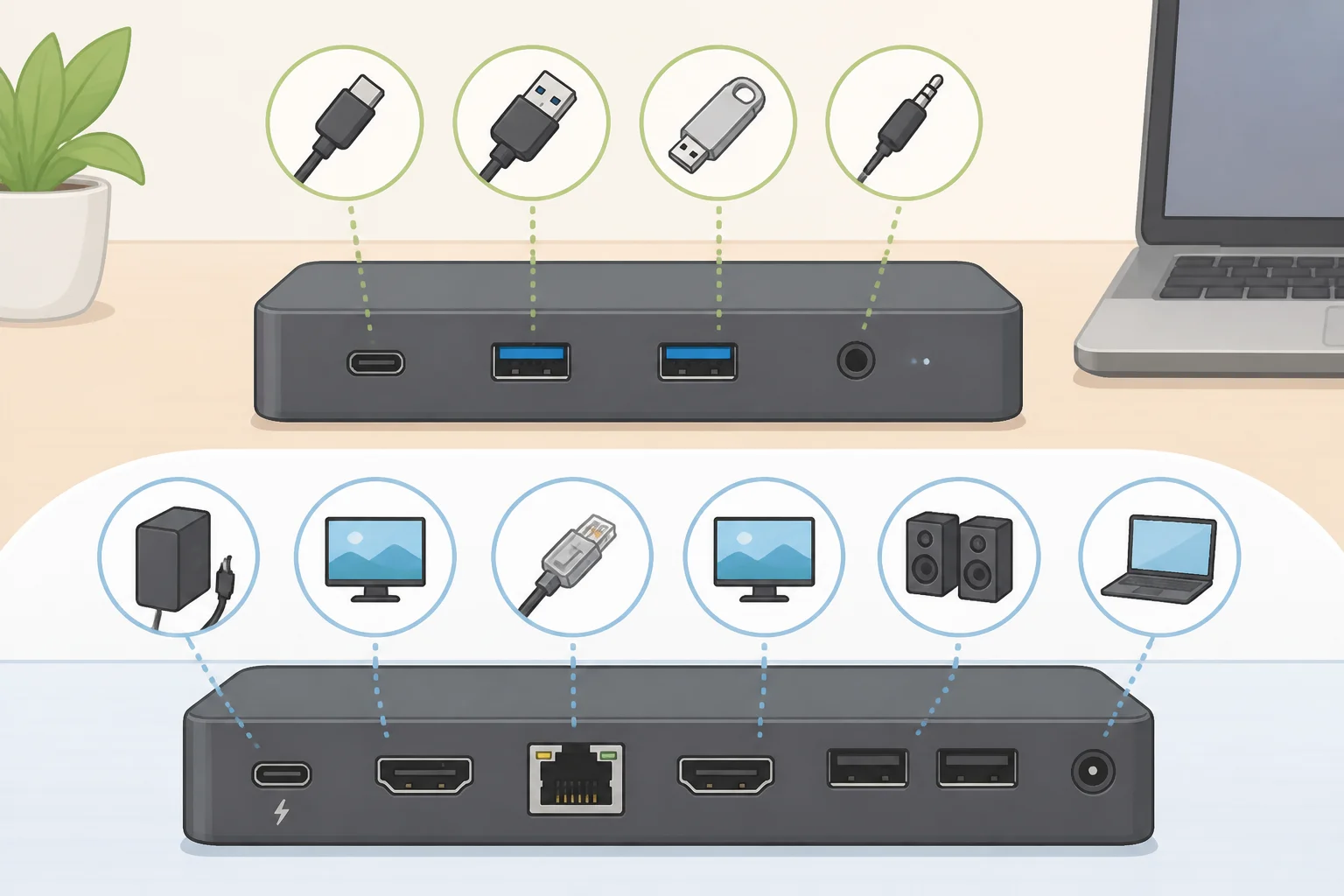
The hub has ten ports total: one HDMI 2.1 port, one DisplayPort 1.4 port, a 100W USB-C PD input, a 10Gbps USB-C data port, one 10Gbps USB-A port, two 5Gbps USB-A ports, Gigabit Ethernet, and SD/microSD 3.0 card slots, per 9to5Toys and Notebookcheck.
The layout separates ports meant for daily plug-in from ones that stay connected permanently. The front houses the USB-C data port and card readers, while power input, USB-A ports, Ethernet, and display outputs sit at the rear. Anker says roughly 80% of the ports face rearward to cut down on desk clutter, per both outlets.
The 100W figure describes what the PD-IN port accepts from an external charger, not what reaches the laptop. Of that input, up to 80W passes through to charge the host device, per 9to5Toys and Notebookcheck. Video output runs through a separate pair of connections entirely, the dedicated HDMI 2.1 and DisplayPort 1.4 ports, so a laptop plugged in purely for charging isn't using the same path that carries picture to a monitor. Neither report says whether the 100W charger itself ships in the box.
The built-in Smart Display shows live port status, charging wattage, transfer speed, device temperature, and details on connected monitors including resolution and refresh rate, according to both reports. Beyond monitoring, the screen supports a rotating image slideshow and a customizable focus timer, controlled through touch inputs on the hub's top surface, per 9to5Toys. The launch coverage doesn't say whether setting up or customizing those features requires a companion app.
How it compares to Anker's other hubs
Anker's current 364 hub, model A83A2, offers dual 4K output capped at 30Hz through two HDMI ports, 5Gbps data speeds, and 85W pass-through charging, per Anker. The Nano hub's dual 4K/60Hz output and 10Gbps data ports exceed both figures.
The Anker 563 dock, listed at $259.99 on Anker's product page, takes a different approach: it uses DisplayLink technology to support up to three monitors, though most of its display combinations top out well below 4K/60Hz, and its listing explicitly excludes Linux support. The Nano hub trades that multi-monitor DisplayLink setup for native output and higher refresh rates on fewer displays, at a fraction of the 563's listed price. Whether the Nano hub supports Linux isn't addressed in the 9to5Toys or Notebookcheck coverage.
What the launch does and doesn't establish
Dual 2K output at 240Hz depends on the host laptop's USB-C port supporting DisplayPort 2.1 with DSC 3:1, per 9to5Toys. That requirement is what separates the hub's headline spec from what most laptops will actually deliver out of the box.
Several other questions stay open in the current coverage: whether macOS extends or mirrors across two external monitors on this model, whether Linux is supported at all, and whether the $99 price includes the charger needed to reach the advertised 80W passthrough. None of that is addressed in Anker's launch materials as reported by 9to5Toys or Notebookcheck.
The absence of independent testing leaves sustained performance unresolved. A spec sheet promising native 4K output and 240Hz refresh rates is one thing; whether the hub holds that performance without dropped frames or overheating under daily use is something only hands-on review data can settle.